


ESA Hera Spacecraft on Final Approach to Asteroid Didymos as DART Results Rewrite Planetary Defense Theory

In the early hours of March 17, 2026, engineers at the European Space Agency watched as a spacecraft roughly 1.6 billion kilometers away executed the largest trajectory correction of its mission. Hera’s three main engines fired in sequence over several hours, consuming 123 kilograms of hydrazine propellant and delivering a velocity change of 367 meters per second. The maneuver aligned the spacecraft’s solar orbit inclination with that of the Didymos binary asteroid system, confirming that the probe remains precisely on course for its rendezvous in November. Hera will spend the coming months quietly cruising toward a planetary science milestone that researchers have been anticipating since September 2022, when NASA deliberately collided a spacecraft with a small moonlet called Dimorphos.
The DART mission, Double Asteroid Redirection Test, impacted Dimorphos on September 26, 2022, at approximately 6.1 kilometers per second. The collision was not designed to destroy the asteroid but to test whether kinetic energy transferred from a spacecraft could measurably alter the orbit of a body around its parent asteroid. Scientists estimated the impact would shorten Dimorphos’s orbital period around Didymos by roughly 10 percent, a change that ground-based telescopes began measuring within days. The initial finding of approximately 32 minutes shortening was striking enough to declare the test a success, but the full picture required more time and more data to emerge.
In March 2026, NASA announced the conclusion of a multi-year analysis combining radar observations, ground-based telescope measurements, and 22 stellar occultations recorded by volunteer astronomers worldwide. The results confirmed not only that Dimorphos’s orbital period around Didymos shortened by approximately 33 minutes but also that the entire binary system’s orbit around the Sun changed in a measurable way. The Didymos-Dimorphos system’s 770-day solar orbit shortened by approximately 0.15 seconds per revolution, and its orbital speed increased by roughly 11.7 microns per second. The mechanism behind the solar orbit change differs from the immediate transfer of momentum during the impact. Instead, the effect arises from the substantial ejection of rocky debris from Dimorphos following the collision. When the DART spacecraft struck Dimorphos, it displaced millions of kilograms of material that accelerated away from the asteroid in various directions. The conservation of momentum in the system meant that the ejected debris carried away additional orbital energy, effectively acting as a secondary propulsion event. The phenomenon is called momentum enhancement, and the DART results indicate it approximately doubled the net impulse delivered to the asteroid compared to the spacecraft’s own momentum alone.
The 22 stellar occultations that contributed to the measurement illustrate an elegant form of interplanetary science that requires no spacecraft at all. When an asteroid passes in front of a distant star as seen from Earth, the star’s light dims in a characteristic pattern that encodes information about the asteroid’s size, shape, and orbital position. Volunteer astronomers using commercially available equipment recorded these events across multiple continents between October 2022 and March 2025, building a dataset precise enough to detect changes in Dimorphos’s trajectory measured in meters per second. The coordination required to time these observations across dozens of sites reflects the kind of international scientific collaboration that planetary defense has increasingly attracted.
The binary nature of the Didymos-Dimorphos system added complexity to the analysis because the two bodies orbit each other while together orbiting the Sun. Changes in the internal orbital period affect the center of mass of the system, which in turn affects how the system responds to external gravitational influences. Researchers found that the momentum enhancement from debris ejection altered the binary orbit in ways that rippled outward to change the system’s solar orbit. This had never been directly measured before and provides a data point that asteroid deflection models had predicted but never confirmed.
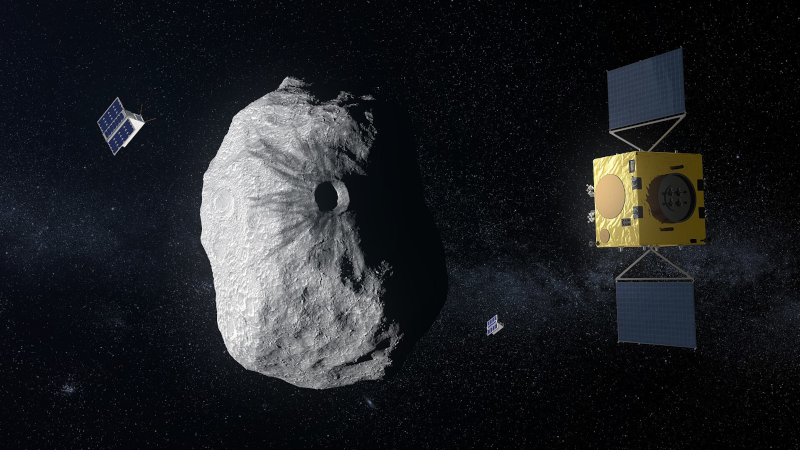
Hera’s mission now is to examine the aftermath of this event at close range. The spacecraft carries two CubeSats named Juventus and Milani that will deploy upon arrival to conduct complementary measurements. Juventus will use a tri-axial magnetometer and a susceptibility probe to characterize Dimorphos’s internal composition and magnetic properties, while Milani will conduct spectroscopic analysis of the asteroid’s surface to map mineralogy and search for organic compounds. The primary spacecraft will map the DART impact crater in high resolution, measure the mass of Dimorphos through subtle gravitational effects on Hera’s trajectory, and characterize the surface morphology that resulted from the collision and subsequent debris cascade.
The approach phase beginning in October 2026 represents the highest-risk period of the mission aside from arrival itself. Hera’s onboard software will use its asteroid framing cameras to autonomously detect and track Didymos and Dimorphos during the three-week approach, a capability that has been tested in simulations but never validated in the actual environment. The navigation challenge is compounded by the binary system’s mutual orbit, which means both bodies are moving relative to each other at velocities that require the spacecraft’s guidance system to track two objects simultaneously. Engineers have uploaded software updates during the cruise phase to prepare for these operations, and mission controllers will monitor the process from ESA’s European Space Operations Centre in Darmstadt.
Understanding why DART produced effects extending to the solar orbit requires examining the three-body dynamics that govern binary asteroid systems. When two objects orbit each other, their motions are governed by their mutual gravitational attraction, which depends on their masses and the distance between them. The impact by DART altered the orbital velocity of Dimorphos, which changed the balance of forces in the binary system. This in turn changed the rate at which the two bodies orbit each other, and the resulting shift in the location of the center of mass altered the system’s overall momentum.
The momentum enhancement factor of approximately 2 observed in the DART results has significant implications for the design of future deflection missions. If a spacecraft impact can deliver twice the expected momentum transfer through debris ejection, then smaller missions could achieve the same deflection effect, reducing launch mass requirements and mission costs. However, the magnitude of the enhancement depends on the surface properties of the target asteroid, which vary considerably. Loose rubble pile asteroids like Dimorphos produce more debris than solid rock bodies, making the enhancement factor difficult to predict for new targets.
The crater formed by DART on Dimorphos will provide direct evidence of the surface response to hypervelocity impact. The crater size and shape encode information about the target’s material properties, including its tensile strength, porosity, and layering. Hera’s high-resolution camera will resolve features down to a few meters, allowing scientists to compare the observed crater with pre-impact predictions and refine impact models for future use.


 Subscribe to blog posts using RSS












