


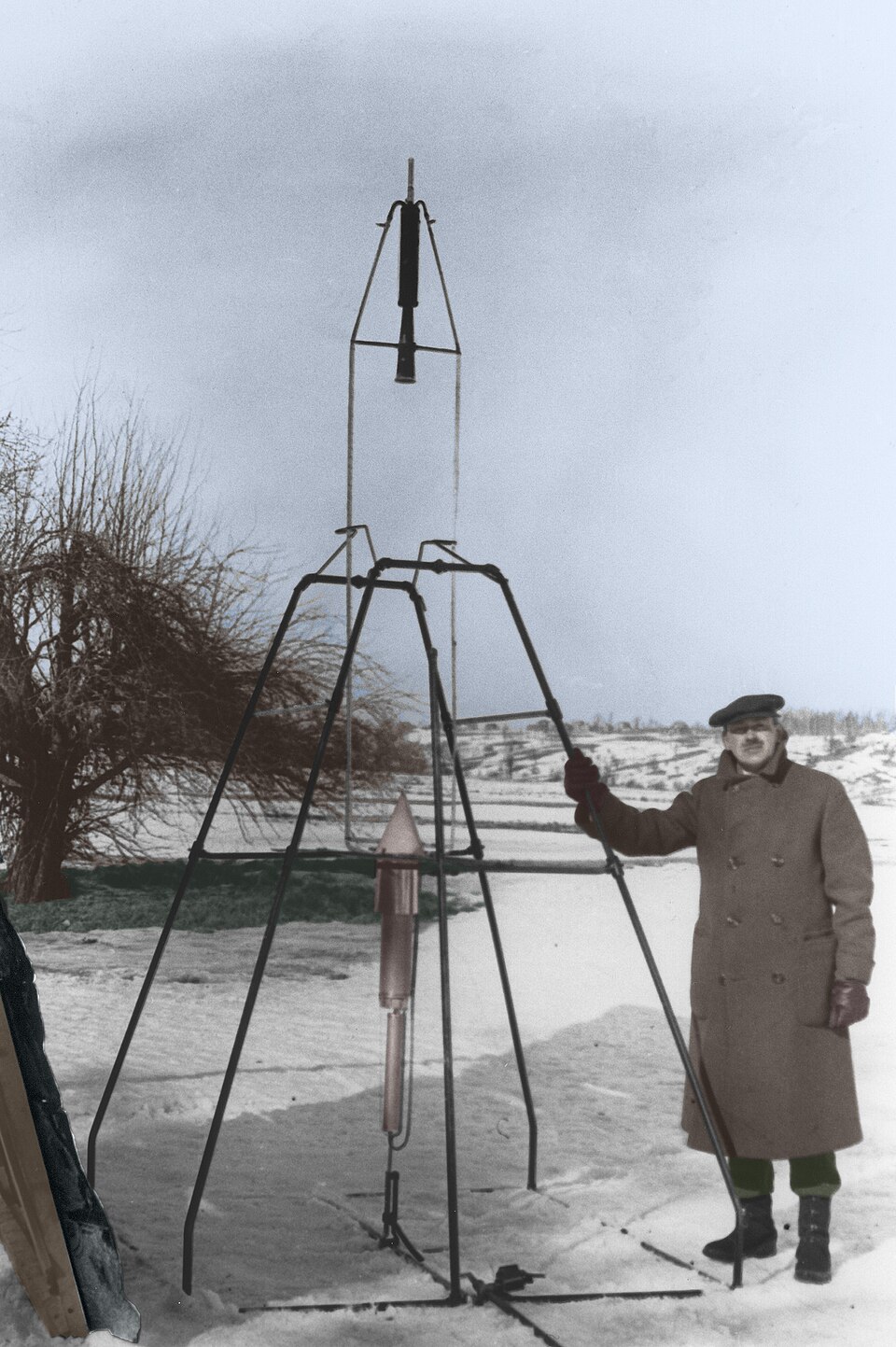
On March 16, 2026, the space community marks the 100th anniversary of Dr. Robert H. Goddard’s historic first flight of a liquid propulsion rocket. This milestone represents one of the most significant moments in the history of rocketry, comparable to the Wright Brothers’ first powered airplane flight at Kitty Hawk in 1903. The anniversary provides an opportunity to reflect on Goddard’s pioneering contributions and their lasting impact on modern space exploration.
Goddard launched the world’s first liquid-fueled rocket in Auburn, Massachusetts, on that March morning in 1926. The rocket climbed 41 feet and traveled 184 feet in just 2.5 seconds before landing. While modest by today’s standards, this flight demonstrated the fundamental principle that would enable humanity to reach space. From 1930 to 1941, Goddard continued developing increasingly sophisticated rockets, eventually achieving altitudes of 2,400 meters, approximately 1.5 miles, while refining guidance systems, welding techniques, insulation, and propulsion components.
The advances in rocket propulsion, guidance, and control that Goddard pioneered throughout the 1920s and 1940s formed the foundation for virtually every modern launch vehicle and in-space propulsion system. Communications satellites, human spaceflight, the Apollo Moon landings, robotic exploration of the solar system, space astronomy, the Space Shuttle, Earth observation satellites, space stations, GPS navigation, and orbital space tourism all trace their technological lineage to Goddard’s early work in liquid propulsion.
Alan Stern, planetary scientist and leader of NASA’s New Horizons mission to the Kuiper Belt, wrote about the significance of Goddard’s contributions in Aerospace America. Stern noted that it is profoundly regrettable that Goddard’s pioneering work was largely unappreciated during his lifetime. Goddard passed away in 1945, before witnessing the rapid advancement of rocketry in the 1950s and 1960s that led to satellites, human space travel, and eventually Moon landings.
Today, with a century of progress and perspective since that first flight, the space community can more clearly appreciate the profound and pivotal nature of Goddard’s contributions. The Goddard Centennial offers an occasion for celebration across the global space community, including space companies, government agencies, professional societies, and educational institutions.
Throughout March 2026, rocket clubs across the United States, including the National Association of Rocketry, the Tripoli Rocketry Association, and the American Rocketry Challenge, will launch rockets to honor Goddard’s achievements. Events are planned at the original launch site in Auburn, Massachusetts, and at the Hanover Theatre and Conservatory in Worcester. These celebrations provide opportunities to share the significance of Goddard’s contributions with the public, students, and future generations of engineers and scientists.
Goddard’s legacy extends beyond his technical achievements. His perseverance against doubters and critics, his inventive approach to engineering challenges, and his dedication to advancing the field of rocketry continue to inspire those working in space exploration today. As the industry looks toward the next century of spaceflight, Goddard’s example reminds practitioners of the importance of persistence, innovation, and technical rigor.
 Subscribe to blog posts using RSS








