OrbitalHub

The place where space exploration, science, and engineering meet

Domain is for sale. $50,000,000.00 USD. Direct any inquiries to contact@orbitalhub.com.

06-1-09

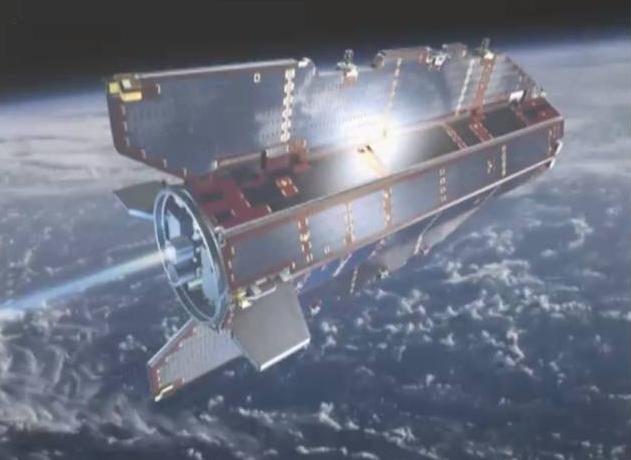
GOCE Free-Falls At Last

Posted by


Credits: ESA


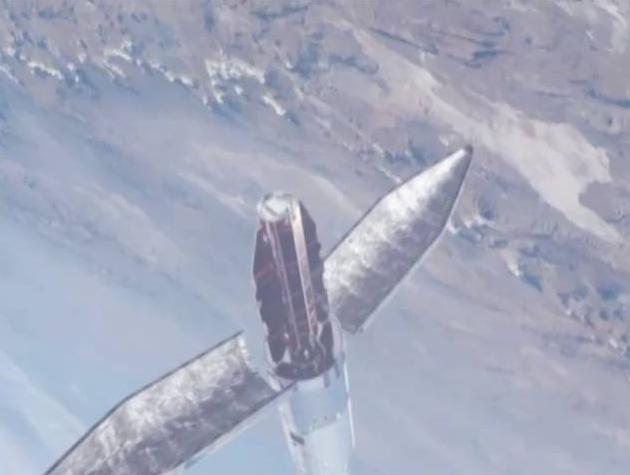
After a successful launch from the Plesetsk Cosmodrome in northern Russia by a Rockot launch vehicle, GOCE has to go through a number of preparation stages before becoming operational and starting to collect three-dimensional gravity data all over the globe.


On April 6, 2009, the GOCE’s propulsion system was switched on. The system was confirmed to be operating normally. Two days later, on April 8, 2009, the gradiometer was switched on as well. The instrument started to produce data instantly.


“With the ion engine and the gradiometer working, we have started to tune the satellite and its instruments,” GOCE System Manager Michael Fehringer said.


The payload, an Electrostatic Gravity Gradiometer, consists of six accelerometers mounted in pairs on three perpendicular axes on an ultra-stable carbon-carbon structure. Measurements of the tiny differences in the readings from the accelerometer pairs will render very accurate results for the geoid altitude and the detection of gravity-field anomalies.


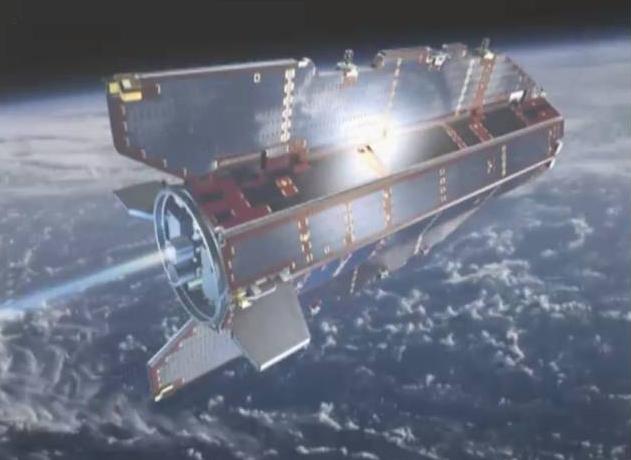
Given the unique payload onboard the spacecraft, GOCE has to provide an undisturbed environment for the instruments. Two additional accelerometers mounted on the velocity axes will control the two low-power xenon ion engines in order to compensate for the atmospheric drag. The ion engines each can provide only 1 to 20 milli-Newtons of thrust, which does not sound like very much, but it is enough to overcome the drag experienced by the spacecraft in orbit.


GOCE has been losing altitude at a rate of 150m to 200m a day, until May 26, 2009, when the spacecraft entered the drag-free mode.


Rune Floberghagen, ESA’s GOCE Mission Manager, stated that, “Knowing that the drag-free control system works perfectly means we now have everything in place to carry out the complex process of calibrating the gradiometer instrument. Once calibration has been completed we will be able to see the true excellence of GOCE’s gravity-field measurements.”


The instruments have to undergo a further six weeks of commissioning and calibration. Mission operations are scheduled to start in summer 2009.


You can read more about the GOCE mission on the dedicated page on ESA’s web site.


  • Facebook
  • Google
  • Slashdot
  • Reddit
  • Live
  • TwitThis


Credits: ESA


ESA is about to launch a satellite capable of measuring very small variations in the Earth’s gravitational field. Even if it is a common-sense assumption that the force of gravity on the surface of the Earth has a constant value, there are subtle variations caused by the rotation of the Earth, the position of the mountains and ocean trenches, and by the variations of the Earth’s inner density. Determining the variations in the Earth’s gravitational field will improve our knowledge of ocean circulation, and will also help to make advances in geodesy and surveying.


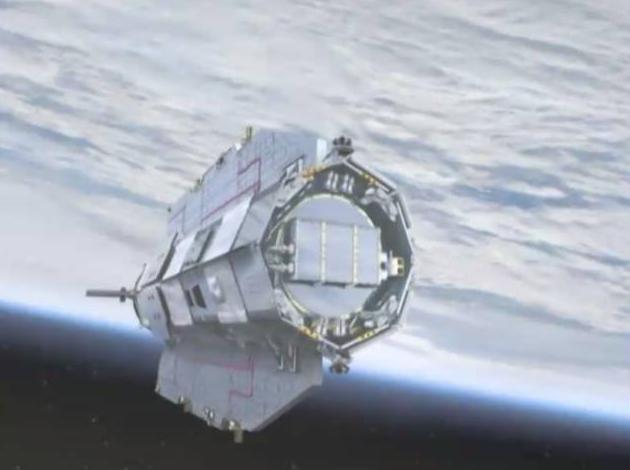
The Gravity field and steady-state Ocean Circulation Explorer (GOCE) satellite will measure the small variations of the gravitational field. GOCE is the most advanced gravity space mission to date. Scientists will build a detailed map of Earth’s gravity using data collected by GOCE.


Credits: ESA


In order to make accurate measurements, the GOCE satellite will orbit in a low altitude orbit, around 250 km above the surface of the Earth.


An elongated shape has been chosen for the satellite design to minimize the atmospheric drag. GOCE is five meters long, one meter in diameter, and has a mass of roughly 1050 kg.


The heart of the GOCE satellite is a scientific instrument called gradiometer. The gradiometer consists of three pairs of accelerometers, and it measures acceleration variations over short distances between proof masses inside the satellite. One important thing to mention here is that the calibration of the gradiometer takes place after launch. The reason? The instrument cannot be calibrated on the ground, under the force of gravity.


Credits: ESA


You can find out more about the calibration of the GOCE instrument by reading an interesting article on ESA’s website.


Daniel Lamarre, a Canadian national working at ESA’s European Space Research and Technology Centre (ESTEC), is the inventor and the developer of the method used for the calibration of the instrument. He won an ESA award for developing the calibration method.


The GOCE satellite will be launched from the Plesetsk Cosmodrome in northern Russia. Eurockot Launch Services GmbH, a company that provides commercial launch services with the Rockot launch system, will be the launch provider for the GOCE mission. Eurockot was formed in 1993. EADS Astrium, located in Bremen, Germany, holds 51 percent of the company. The Khrunichev State Research and Production Space Center in Moscow, Russia, owns the remaining 49 percent.


Credits: ESA


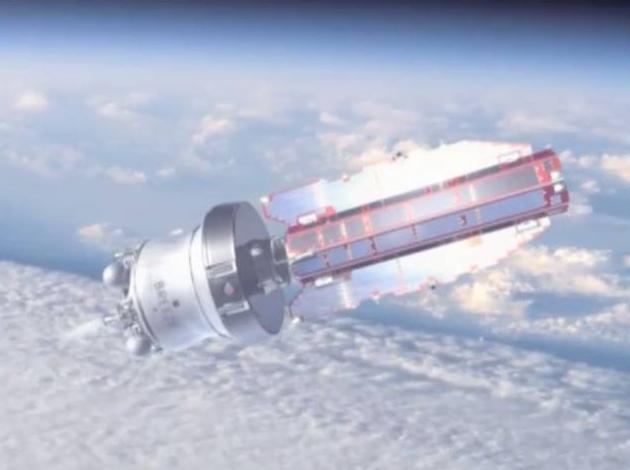
The Rockot launcher is based on the SS-19 Intercontinental Ballistic Missiles. The upper stage of the launch system, Breeze KM, extends the performance capabilities of the Rockot lower stages. The system is capable of injecting a 1950 kg payload into Low Earth Orbit (LEO). The re-ignitable main engine of the Breeze KM allows various injection schemes for the payload. The length of the launch vehicle is 29 meters, with a launch mass of 107 tons. The external diameter of the three stages is 2.5 meters, while the payload fairing has an external diameter of 2.6 meters and a height of 6.7 meters.


The initial launch date was postponed due to an anomaly identified in the guidance and navigation subsystem of the Breeze KM upper stage. The new launch date has been scheduled for Monday, October 27th, 2008.


  • Facebook
  • Google
  • Slashdot
  • Reddit
  • Live
  • TwitThis