We can start by defining the key concepts: sustaining technology and disruptive technology. These are the textbook definitions: A sustaining technology is a new technology that improves the performance of established products, the performance being perceived along the dimensions that mainstream customers value. A disruptive technology is a new technology that brings to market a radical value proposition. They underperform products in mainstream markets, but they have features that are valued by some customers.
What is not obvious is that even though disruptive technologies may result in worse product performance in the short term, they can be fully competitive in the same market in the long run because technologies tend to progress faster than market demand.
Now let us see what are the 5 principles of disruptive technologies (as defined by Clayton Christensen):
Principle #1: Companies depend on customers and investors for resources (at the end of the day, the customers and the investors dictate how a company spends its money).
Principle #2: Small markets do not solve the growth needs of large companies (large companies wait until small markets become interesting and to enter a small market at the moment when it becomes interesting is often too late).
Principle #3: Markets that do not exist cannot be analyzed (there are no established methods to study or to make predictions for emerging markets, as there is no data to infer from).
Principle #4: An organization’s capabilities define its disabilities (we all have our blind spots).
Principle #5: Technology supply may not equal market demand (as established companies move towards higher-margin markets, the vacuum created at lower price points is filled by companies employing disruptive technologies).
Why do you think established companies fail to adopt disruptive technologies? Established companies listen to their customers, invest aggressively only in new technologies that provide customers more and better products that they want, and they study their markets and allocate investment capital only to innovations that promise best return. Good management is sometimes the best reason why established companies fail to stay atop their industries.
And this is why technology startups can fill in the niche… Many of the good management principles widely accepted are only situationally appropriate. Sometimes it is right not to listen to your customers, right to invest in technology that promise lower margins, and right to pursue small markets. This can happen in a small company, a technology startup where big outside stakeholders are not vested, and where new technology development is the big drive.
Now that the lecture has been delivered, it is time to ask the questions. Why is SpaceX perceived as disruptive? Is SpaceX really disruptive? In what way?
The declared goal of SpaceX is to make space more accessible, that is to bring the kg-to-LEO prices down. If you have a basic knowledge of launch systems, you know that the propulsion technology employed today is pretty much the same used by Mercury, Gemini, and Apollo space programs: liquid fuel rocket engines. The Russian Soyuz, for which the basic rocket engine design has not changed much since the Semyorka days, is a living proof that rocket engineers do not want to fix things that work well. While aerospike engines and nuclear rocket engines make the front page from time to time, the good old liquid fuel expansion nozzle rocket engines will be here to stay for a long time.
Given the circumstances, how to bring the manufacturing and launch costs down? As a software engineer who spent a number of years in a software startup, I can recognize a number of patterns… First, Musk knows how to motivate his engineers. Doing something cool is a big driver. I know that. And working on a space launch system than one day may put the first human colonists on Mars must be a hell of a motivator.
Modular design… software engineering principles are at work. Build reliable components and gradually increase the complexity of your design. Falcon 9 and Falcon Heavy, are built on a modular design that has at the core the Merlin 1D engine. And an important detail to mention here, SpaceX builds the hardware in-house. Obviously, outsourcing would increase the manufacturing costs.
If you are familiar with the Russian Soyuz launch vehicle, you will acknowledge that Musk has borrowed proven (and cheaper) technology for Falcon launch vehicles: LOX/RP-1 as fuel, vernier thrusters, and horizontal integration for the first stage, second stage, and the Dragon spacecraft. These choices simplify the overall design and bring the costs down substantially.
To put it the way SpaceX many times did: “simplicity, reliability, and low cost can go hand-in-hand.”
One thing to notice is that the most important innovation introduced by SpaceX is in the design and manufacturing process, which is in-house and as flat as possible. Rearranging the pieces of the puzzle can often give the competitive advantage. Lean and mean is the new way.
SpaceX is not just trying to bring down the launch prices, it is actually trying to disrupt the status quo… and this makes the battle harder. SpaceX dixit: “SpaceX’s goal is to renew a sense of excellence in the space industry by disrupting the current paradigm of complacency and replacing it with innovation and commercialized price points; laying the foundation for a truly space-faring human civilization.”
When developing the theory around disruptive technologies, Clayton Christensen has studied the hard disk drive and the mechanical excavator industries. The US space industry is a different ecosystem. Do the 5 principles presented above need adjustment?
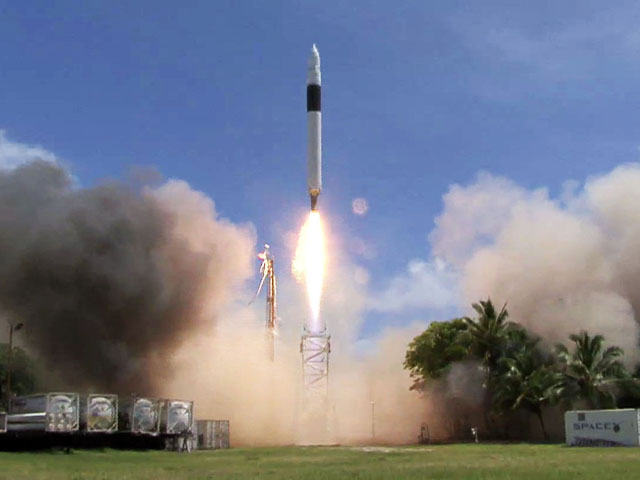
Not really. Principle #1 is valid and applies in this case as well. Self-funded SpaceX followed a market strategy not dictated by customers or investors. The small payload launcher market, targeted by SpaceX with Falcon 1 and Falcon 1e, was an area neglected by established space companies as Principle #2 states. Principle #3 explains why established companies have neglected the small payload market.
Does mastering the small payload launcher technology qualifies one to enter the heavy launcher market? SpaceX managed to overcome Principle #4. Will SpaceX retire its Falcon 1 launch vehicles and leave the small launcher market for good? In this case, I would see Principle #5 as a warning. While the heavy launchers offer better profit margins, would it be a smart move to leave an emerging market (currently) offering low profit margins? This remains to be seen.



 Subscribe to blog posts using RSS












