OrbitalHub

The place where space exploration, science, and engineering meet

Domain is for sale. $50,000,000.00 USD. Direct any inquiries to contact@orbitalhub.com.

06-29-20

Sunsets on Other Worlds

Posted by


NASA dicit:

Geronimo Villanueva, a planetary scientist from NASA’s Goddard Space Flight Center in Greenbelt, Maryland, created the sunset simulations while building a computer modeling tool for a possible future mission to Uranus, an icy-cold planet in the outer solar system. The animations show all-sky views as if you were looking up at the sky through a super wide camera lens from Earth, Venus, Mars, Uranus, and Titan.

Video credit: Geronimo Villanueva/James Tralie/NASA’s Goddard Space Flight Center


  • Facebook
  • Google
  • Slashdot
  • Reddit
  • Live
  • TwitThis
07-22-17

Solar Eclipse

Posted by


Wikipedia dixit:

“As seen from the Earth, a solar eclipse is a type of eclipse that occurs when the Moon passes between the Sun and Earth, and the Moon fully or partially blocks (“occults”) the Sun. This can happen only at new moon when the Sun and the Moon are in conjunction as seen from Earth in an alignment referred to as syzygy. In a total eclipse, the disk of the Sun is fully obscured by the Moon. In partial and annular eclipses, only part of the Sun is obscured.

If the Moon were in a perfectly circular orbit, a little closer to the Earth, and in the same orbital plane, there would be total solar eclipses every month. However, the Moon’s orbit is inclined (tilted) at more than 5 degrees to the Earth’s orbit around the Sun (see ecliptic), so its shadow at new moon usually misses Earth. Earth’s orbit is called the ecliptic plane as the Moon’s orbit must cross this plane in order for an eclipse (both solar as well as lunar) to occur. In addition, the Moon’s actual orbit is elliptical, often taking it far enough away from Earth that its apparent size is not large enough to block the Sun totally. The orbital planes cross each other at a line of nodes resulting in at least two, and up to five, solar eclipses occurring each year; no more than two of which can be total eclipses. However, total solar eclipses are rare at any particular location because totality exists only along a narrow path on the Earth’s surface traced by the Moon’s shadow or umbra.

An eclipse is a natural phenomenon. Nevertheless, in some ancient and modern cultures, solar eclipses have been attributed to supernatural causes or regarded as bad omens. A total solar eclipse can be frightening to people who are unaware of its astronomical explanation, as the Sun seems to disappear during the day and the sky darkens in a matter of minutes.

Since looking directly at the Sun can lead to permanent eye damage or blindness, special eye protection or indirect viewing techniques are used when viewing a solar eclipse. It is technically safe to view only the total phase of a total solar eclipse with the unaided eye and without protection; however, this is a dangerous practice, as most people are not trained to recognize the phases of an eclipse, which can span over two hours while the total phase can only last a maximum of 7.5 minutes for any one location. People referred to as eclipse chasers or umbraphiles will travel to remote locations to observe or witness predicted central solar eclipses.”

Video credit: NASA Goddard


  • Facebook
  • Google
  • Slashdot
  • Reddit
  • Live
  • TwitThis
07-26-11

Interplanetary Internet

Posted by


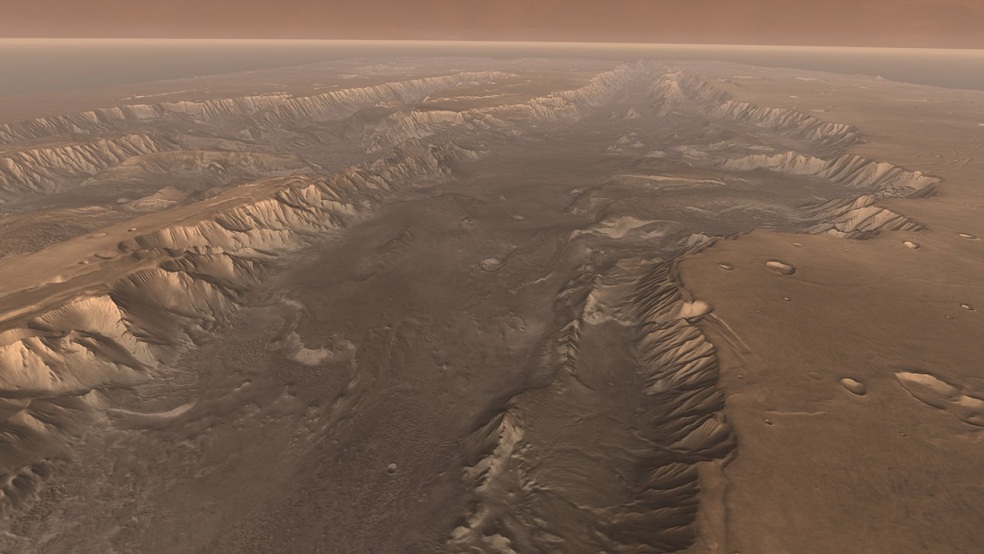
Credits: NASA/JPL/Arizona State University


You know the frustration you experience when the new hit of your favorite band takes too long to download on your iPhone? Imagine 30 years from now (an optimistic estimate)… you are one of the happy colonists who work around the clock to build one of the first outposts on Mars.


At the end of your shift in the hydroponics, you head back to your luxurious 20mx10m quarters (the shoebox, as your relatives back on Earth like to call it), have a hot shower, and a delicious vegetarian dinner while enjoying the view over the Valles Marineris (the $100 million view, as you like to call it). You receive an email with a link to the new hit of your favorite Earth band, and after clicking on the link in your favorite Internet browser, you download the song in less than one second.


What’s wrong with this scenario? It describes what software engineers would call a wonderful user experience, but something is wrong with this picture… what is it?


One short story might give you a hint. In January 2004, when the two Mars Exploration Rovers, Spirit and Opportunity, landed on Mars, you could watch videos of the scientists in the mission control room at JPL cheering when receiving confirmations of successful landings. The detail that might have escaped you is that those confirmation messages traveled around 20 minutes through interplanetary space before reaching the room at JPL. The scientists were cheering at JPL 20 minutes after the landings happened. If anything went wrong, the bad news would have reached Earth too late to do anything about it. This kind of explains why the engineers that designed and built the rovers had to make sure that the rovers themselves were capable of making some decisions on their own.


To go back to our sci-fi novel attempt in the first paragraph, the little detail that is misplaced in our story is that the time delay is not present. Our colonist clicks on the link to a server which is somewhere on Earth and the download is performed in no time.


For someone who has a basic understanding of protocol stacks (i.e. HTTP/TCP/IP), it is obvious that it would take quite some time to download a file from a server located on Earth to our Mars colony. All of a sudden, the ACK packets have lost their charm.


No reason to worry. Even if Mars outposts are far in the future, time and effort is spent on finding solutions for such communication problems in the present. The challenges seem overwhelming: very long delays, possible communication disruptions, and significant loss due to big bit error rates. A leap is necessary. The present protocols and architecture on which Internet relays have been designed assuming continuous and bi-directional paths, short round-trip times, and small error-rates.


One architecture that promises to solve the problems inherent to our scenario is the Delay Tolerant Networking (DTN) architecture, proposed in RFC 4838. A physical architecture that could solve the problems mentioned above is also proposed by Takashi Iida (Tokyo Metropolitan University), Yoshinori Arimoto (National Institute of Information and Communications Technology), and Yoshiaki Suzuki (NEC Corporation). The architecture would include clusters of communication satellites in orbit around Earth and Mars and relay satellites located at the Lagrangian points L4 and L5 of the Sun-Earth system. The relay satellites would make communication between Earth and Mars possible even when Mars is behind the Sun. Just a smart placement of relay satellites does not do the trick. In order to increase the responsiveness of the network, mirroring of data is also necessary.


You can find more information about space data systems on The Consultative Committee for Space Data Systems website. Other good resources include The InterPlaNetary Internet Project, and The Delay Tolerant Networking Research Group.


  • Facebook
  • Google
  • Slashdot
  • Reddit
  • Live
  • TwitThis


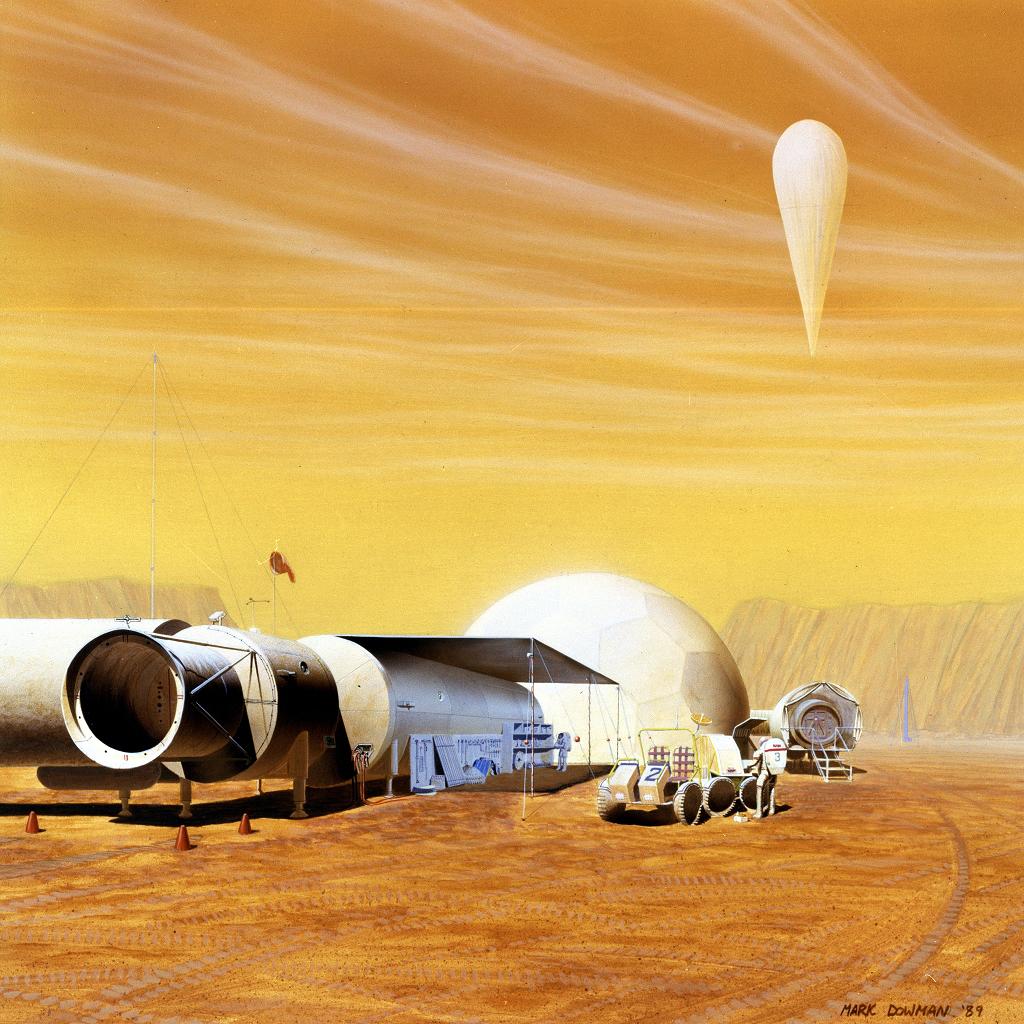
Credits: Mark Dowman


Airships are making a big comeback now as the energy consumption for all modes of transportation is being re-analyzed. Missions with special requirements like surveillance and reconnaissance missions and transportation of heavy payloads to remote outposts are the main driver for the reinvention of the airship.


But Earth is not the only place where airships can be deployed. There are a number of destinations in the solar system that would make a perfect environment for deployment and operation of airships, like Mars, Venus, and Titan – Saturn’s largest moon.


The presence of an atmosphere makes possible the use of vehicles that can fly within atmosphere for planetary exploration. Also, planetary exploration with low-powered vehicles like airships really makes sense considering the fact that energy is always at a premium.


So far, the only extraterrestrial deployment of an airship was performed during the Vega mission to Venus, in 1984. Two balloons were released and they floated 54 km above the planet’s surface for nearly two days.


Lighter-Than-Air (LTA) AERial ROBOTS (AEROBOTS) would present some advantages over their Heavier-Than-Air (HTA) siblings and the traditional planetary scouts, the exploration rovers: they would have long-duration mission and long-distance capabilities, they would not have to deal with obstacle avoidance problems, and they have low-power consumption. However, the environment in which the airship will operate will impose some restrictions on the capabilities of the airship (consider things like atmospheric composition and density, temperature, and the amount of solar radiation available). More on the planetary environments in the solar system and airship evaluations for each one of them can be found here.


NASA has funded a number of projects for solar system exploration that make use of aerobots. The Jet Propulsion Laboratory’s Planetary Aerobot Program is developing balloons to support scientific payloads in the atmosphere of other planets in our solar system. You can find more details about JPL’s Planetary Aerobot Program here.


  • Facebook
  • Google
  • Slashdot
  • Reddit
  • Live
  • TwitThis
09-7-10

How Tough is Life in LEO?

Posted by


Credits: NASA


In a nutshell, it is really tough! The higher you go, more bad things can happen to you… the increasingly rarefied air, freezing temperatures, ionized atoms, radiation, and space debris make life challenging. So, besides thinking of how to place spacecraft in orbit, engineers must consider all of the factors mentioned above (and much more) when designing a spacecraft.


The space environment (the vacuum, the radiation, the space debris, etc.) definitely poses big challenges to spacecraft design engineers. From 1971 to 1989, more than 2,700 spacecraft anomalies related to interactions with the space environment were recorded. These interactions with the space environment are called space environment effects and the changes in the space environment define what is called the space weather. Believe it or not, there are dedicated programs aimed at developing the ability to predict these changes in the same way the weather forecasting does for terrestrial weather. The Space Weather program was formed in the mid-1990s by the National Science Foundation (NSF). The Europeans developed a similar program under the umbrella of the European Space Agency (ESA).


The space environment effects can be grouped into several categories. Such categories include: vacuum, neutral, plasma, radiation, and micrometeorid/orbital debris. So, basically, we can discuss the effects of the vacuum environment, the neutral environment, etc. Each one of these environments interact with the subsystems that comprise a spacecraft: the propulsion system that provides the means of maintaining a certain orbit or attitude, the electrical power system that provides power to the rest of the subsystems onboard, the thermal control system, the attitude and orbital determination and control system, etc.


The vacuum environment imposes challenges when it comes to designing the structure, choosing the materials, and defining a strategy for thermal control. The pressure differential between the inside and the outside of a manned spacecraft is tremendous (around 350 km above the surface of the Earth, the pressure is ten orders of magnitude less). The lack of atmosphere translates into the fact that the spacecraft will have to deal with solar ultraviolet (UV) radiation (the UV radiation is energetic enough to degrade material properties). Also, the spacecraft can only cool itself by conduction or radiation.


Credits: NASA


Even if very rarefied, the neutral atmosphere in low Earth orbit is dense enough to cause a significant atmospheric drag force. The atoms can physically sputter material from surfaces and even cause erosion. All these mechanical and chemical interactions depend on the atmospheric density.


In low Earth orbit, the solar UV radiation ionizes the oxygen and nitrogen atoms. This environment, known as the plasma environment, can give rise to very interesting effects, like spacecraft charging and arcing between regions of differing potentials.


By far, the most dangerous environment in Earth orbit is the radiation environment. In the regions of charged particles, known as trapped radiation belts, particles with energy levels in the order of MeV pass through the surface layer and interact with the materials inside the spacecraft. Present shielding technology cannot protect living organisms inside a spacecraft in these regions.


Micrometeoroids and orbital debris are a cause of great concern to spacecraft design engineers and spacecraft operators as the kinetic energies associated with impacts at orbital velocities are very high. The main effect on spacecraft in this case is the physical damage upon impact. Other effects include surface erosion, ejecta resulted from impacts, changes in thermal control properties, and generation of electro-magnetic impulses (EMIs).


As most of the characteristics of the space environment were determined by remote observations or during short duration missions, one long duration mission was necessary to verify and validate these measurements.


In April 1984, the Space Shuttle Challenger placed into low Earth orbit (LEO) a spacecraft carrying a number of experiments for the purpose of characterizing the low Earth orbit environment. The spacecraft (known as the Long Duration Exposure Facility, or LDEF for short) was a twelve-sided cylindrical structure three-axis stabilized in order to ensure an accurate environmental exposure. The spacecraft was supposed to spend one year in orbit, but just before the planned retrieval, the Space Shuttle fleet was grounded as a result of the Challenger accident on January 28, 1986.


The spacecraft was returned to Earth by the Space Shuttle Columbia in January 1990. After almost six years in low Earth orbit, the results of the experiments onboard the facility contributed a great deal to the understanding of interactions between artificial objects and the environment in low Earth orbit.

 

You can find all the above in much more detail in Alan Tribble’s book The Space Environment – Implications for Spacecraft Design. Alan Tribble presents an excellent account of the effects the space environment can have on operational spacecraft. The book offers a unique perspective, as it combines the study of the space environment with spacecraft design engineering. .


Alan Tribble spent over ten years designing spacecraft. He is a technical project manager in the International Software Defined Radios group for Rockwell Collins.


  • Facebook
  • Google
  • Slashdot
  • Reddit
  • Live
  • TwitThis