OrbitalHub

The place where space exploration, science, and engineering meet

Domain is for sale. $50,000,000.00 USD. Direct any inquiries to contact@orbitalhub.com.


Wikipedia dicit:

A nuclear thermal rocket (NTR) is a type of thermal rocket where the heat from a nuclear reaction, often nuclear fission, replaces the chemical energy of the propellants in a chemical rocket. In an NTR, a working fluid, usually liquid hydrogen, is heated to a high temperature in a nuclear reactor and then expands through a rocket nozzle to create thrust. The external nuclear heat source theoretically allows a higher effective exhaust velocity and is expected to double or triple payload capacity compared to chemical propellants that store energy internally.

NTRs have been proposed as a spacecraft propulsion technology, with the earliest ground tests occurring in 1955. The United States maintained an NTR development program through 1973 when it was shut down for various reasons, for example to focus on Space Shuttle development. Although more than ten reactors of varying power output have been built and tested, as of 2023, no nuclear thermal rocket has flown.

Whereas all early applications for nuclear thermal rocket propulsion used fission processes, research in the 2010s has moved to fusion approaches. The Direct Fusion Drive project at the Princeton Plasma Physics Laboratory is one such example, although “energy-positive fusion has remained elusive”. In 2019, the U.S. Congress approved US$125 million in development funding for nuclear thermal propulsion rockets.

In May 2022 DARPA issued an RFP for the next phase of their Demonstration Rocket for Agile Cislunar Operations (DRACO) nuclear thermal engine program. This follows on their selection, in 2021, of an early engine design by General Atomics and two spacecraft concepts from Blue Origin and Lockheed Martin. The next phases of the program will focus on the design, development, fabrication, and assembly of a nuclear thermal rocket engine. In July 2023, Lockheed Martin was awarded the contract to build the spacecraft and BWX Technologies (BWXT) will develop the nuclear reactor. A launch is expected in 2027.

Video credit: Lockheed Martin


  • Facebook
  • Google
  • Slashdot
  • Reddit
  • Live
  • TwitThis
02-25-20

Alpha Draconis

Posted by


Wikipedia dicit:

Thuban, designation Alpha Draconis (α Draconis, abbreviated Alpha Dra, α Dra), is a star (or star system) in the constellation of Draco. A relatively inconspicuous star in the night sky of the Northern Hemisphere, it is historically significant as having been the north pole star from the 4th to 2nd millennium BCE. Even though Johann Bayer gave Thuban the designation Alpha, its apparent magnitude of 3.65 means it is 3.7 times fainter than the brightest star in the constellation, Gamma Draconis (Eltanin), whose apparent magnitude is 2.24.

Due to the precession of Earth’s rotational axis, Thuban was the naked-eye star closest to the north pole from 3942 BCE, when it superseded Iota Draconis as the Pole Star, until 1793 BCE, when it was superseded by Kappa Draconis. It was closest to the pole in 2830 BCE, when it was less than ten arc-minutes away from the pole. It remained within one degree of celestial north for nearly 200 years afterwards, and even 900 years after its closest approach, was just five degrees off the pole. Thuban was considered the pole star until about 1800 BCE, when the much brighter Beta Ursae Minoris (Kochab) began to approach the pole as well.

Having gradually drifted away from the pole over the last 4,800 years, Thuban is now seen in the night sky at a declination of 64° 20′ 45.6″, RA 14h 04m 33.58s. After moving nearly 47 degrees off the pole by 10000 CE, Thuban will gradually move back toward the north celestial pole. In 20346 CE, it will again be the pole star, that year reaching a maximum declination of 88° 43′ 17.3″, at right ascension 19h 08m 54.17s.

Video credit: NASA/ Chris Smith (USRA): Lead Producer/Chris Smith (USRA): Lead Animator/Francis Reddy (University of Maryland College Park): Lead Science Writer


  • Facebook
  • Google
  • Slashdot
  • Reddit
  • Live
  • TwitThis
06-8-14

SpaceX Dragon V2

Posted by


SpaceX dixit:

“SpaceX has completed qualification testing for the SuperDraco thruster, an engine that will power the Dragon spacecraft’s launch escape system and enable the vehicle to land propulsively on Earth or another planet with pinpoint accuracy.

The SuperDraco is an advanced version of the Draco engines currently used by SpaceX’s Dragon spacecraft to maneuver in orbit and during re-entry. SuperDracos will be used on the crew version of the Dragon spacecraft as part of the vehicle’s launch escape system; they will also enable propulsive landing on land. Each SuperDraco produces 16,000 pounds of thrust and can be restarted multiple times if necessary. In addition, the engines have the ability to deep throttle, providing astronauts with precise control and enormous power.

The qualification testing program took place over the last month at SpaceX’s Rocket Development Facility in McGregor, Texas. The program included testing across a variety of conditions including multiple starts, extended firing durations and extreme off-nominal propellant flow and temperatures.”

Credit: SpaceX


  • Facebook
  • Google
  • Slashdot
  • Reddit
  • Live
  • TwitThis


Credits: SpaceX


The Draco thruster and the Draco propulsion tank completed qualification tests at the SpaceX Test Facility in McGregor, Texas.


The certification test included 42 firings with over 4,600 pulses of varying lengths. The tests are performed in a vacuum test chamber in order to simulate the space environment. The total firing time on a single thruster was over 50 minutes.


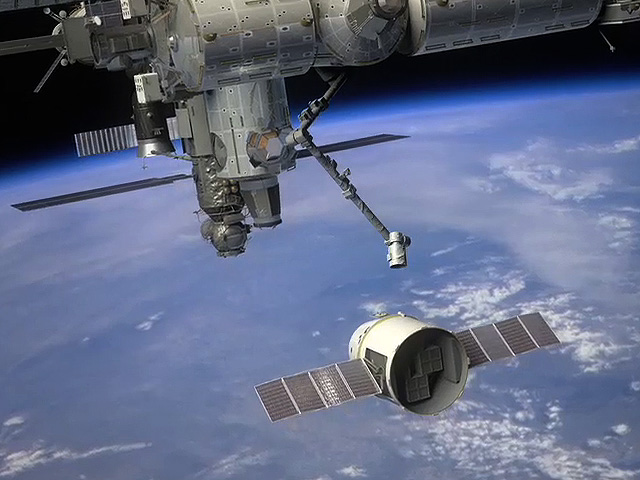
“The Draco thrusters allow Dragon to maneuver in close proximity to the ISS in preparation for berthing or docking,” said Tom Mueller VP Propulsion, SpaceX. “Maximum control during these procedures is critical for the safety of the station and its inhabitants.”


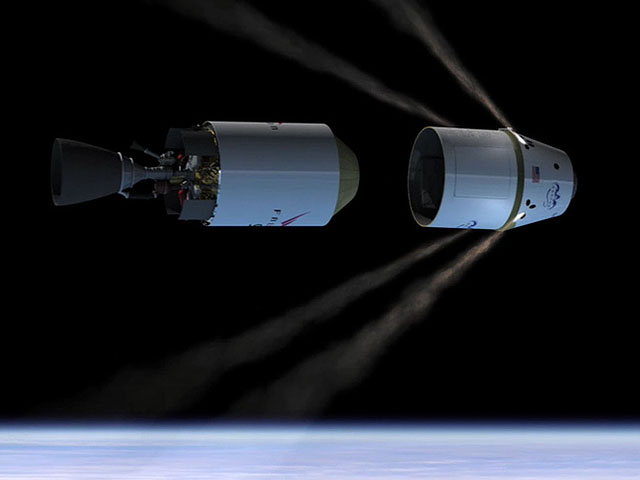
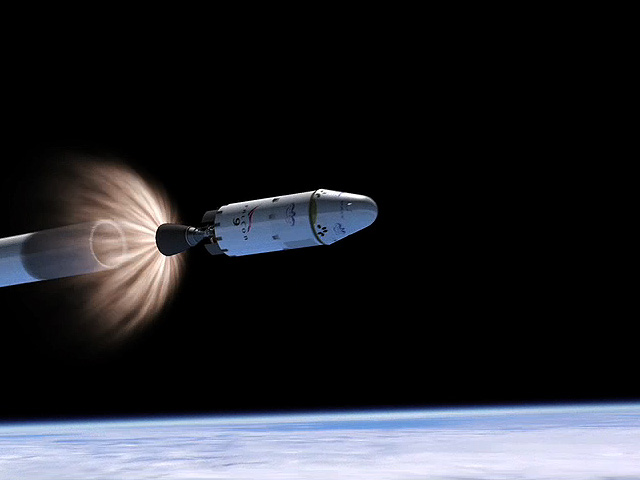
The Dragon spacecraft utilizes 18 Draco thrusters for maneuvering, attitude control, and to initiate the return to Earth. One important characteristic of the thrusters is that they are powered by storable propellants with long on-orbit lifetimes. This will allow the Dragon spacecraft to remain berthed at the International Space Station for up to a year.


The inaugural flight of Falcon 9 is scheduled for late 2009 from SpaceX’s launch site in Cape Canaveral, Florida.


  • Facebook
  • Google
  • Slashdot
  • Reddit
  • Live
  • TwitThis


Credits: NASA


The propulsion division of SpaceX has performed another important test. After the test of the Falcon 9’s first stage Merlin engines, the smallest engine of the SpaceX family, Draco, has been put to test.


During the test, the thruster fired for ten minutes, paused for ten minutes, and then was restarted for an additional minute.


The test was performed on a new vacuum test stand built by SpaceX, and put into operation in March 2008 at the SpaceX Test Facility outside McGregor, Texas.


“Draco performed perfectly during the entire test, with expected temperatures and excellent performance,” said David Giger, Propulsion Manager, SpaceX. “We also broke the SpaceX record for longest continuous burn previously held by Kestrel, the Falcon 1 second stage engine.”


The Dragon spacecraft uses eighteen Draco thrusters for orbital maneuvering, attitude control, and to initiate the atmospheric re-entry. Each Draco thruster can deliver up to 400N of force. The thruster is powered by a combination of mono methyl hydrazine (MMH) and nitrogen tetroxide (NTO), which is the same bipropellant used by the orbital maneuvering system (OMS) of the Space Shuttle.


Credits: NASA


MMH and NTO are used as propellants because they have long on-orbit lifetimes. This will allow the Dragon spacecraft to perform longer missions to the International Space Station (ISS). The goal is to use the spacecraft as an emergency escape capsule for the crew working on the ISS.


SpaceX has released a video of the Draco thruster vacuum firing.


  • Facebook
  • Google
  • Slashdot
  • Reddit
  • Live
  • TwitThis