


DARPA Selects Three Companies to Design Lunar Orbiter for Water Ice Prospecting at Extremely Low Altitudes
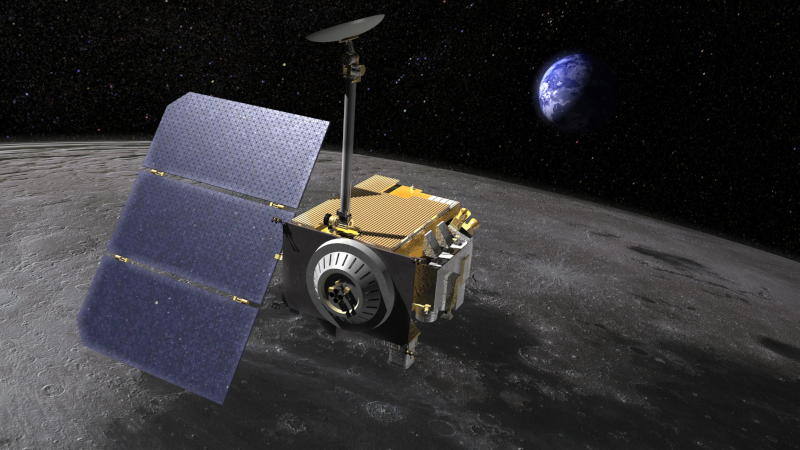
The Defense Advanced Research Projects Agency announced in late April 2026 that it had selected three companies for the first phase of a lunar mission study program focused on detecting and mapping water ice deposits in the lunar south polar region from very low orbits. The Lunar Assay via Small Satellite Orbiter program, known as LASSO, would demonstrate sustained operations at altitudes where atmospheric drag, even in the extremely thin exosphere above the Moon, affects orbital stability, while gathering data that supports both NASA’s Artemis program and commercial plans to extract lunar resources.
The three companies awarded Phase 1A and Phase 1B studies are Benchmark Space Systems, Quantum Space, and Revolution Space. Benchmark Space Systems, which has built its reputation as a propulsion supplier but is moving up the value chain to integrated spacecraft development, proposed a mission architecture called Sapphire that combines chemical and electric propulsion with a terrain navigation and hazard avoidance system designed to handle the challenging topography of the lunar poles. Quantum Space, which acquired the propulsion assets of Phase Four in 2025 and has been developing a highly maneuverable spacecraft called Ranger, received an award whose details it has not publicly disclosed. Revolution Space is the third awardee and has not provided public information about its LASSO concept.
The scientific objective of LASSO is to find water ice concentrations above five percent by mass in the permanently shadowed regions near the lunar south pole. This threshold matters because it represents the concentration at which in-situ resource utilization becomes economically viable. Water ice can be electrolyzed to produce liquid hydrogen and liquid oxygen, which can serve as rocket propellant. A lander that can produce its own fuel on the Moon changes the calculus for sustained human presence by reducing the amount of propellant that must be launched from Earth. Finding deposits with sufficient concentration and accessibility to support this requires orbital surveys that can detect and quantify ice at depths of up to several meters.
Operating a spacecraft in very low lunar orbit presents technical challenges that distinguish LASSO from typical lunar missions. The Moon lacks a substantial atmosphere, but it does have an exosphere, a thin layer of atoms and molecules that extends from the surface outward. At altitudes below 50 kilometers, this exosphere creates measurable drag that degrades a spacecraft’s orbit over time. Maintaining a stable very low orbit requires either frequent propulsion maneuvers to counteract drag or a spacecraft design with a large propellant margin specifically allocated to orbit maintenance. LASSO is as much a technology demonstration for sustained low-orbit operations as it is a scientific mission.
The Phase 1A concept design study runs for six months, after which successful performers advance to Phase 1B, an 18-month effort that brings designs through critical design review. Phase 2, if funded, would build and launch the spacecraft. DARPA has not specified when a launch might occur or what launch vehicle would be used, but the agency has indicated that it intends to demonstrate the capability before NASA’s planned Artemis missions establish a sustained human presence near the south pole.
For Benchmark Space Systems, the LASSO award represents a strategic step in the company’s evolution. We will rigorously evaluate how hybrid propulsion, autonomy and spacecraft design can converge to meet DARPA’s expectations, said Ryan McDevitt, the company’s chief technology officer, in a statement accompanying the award announcement. The combination of chemical propulsion for high-thrust maneuvers and electric propulsion for efficient station-keeping defines the Sapphire architecture’s approach to the low-orbit problem, using chemical thrust to overcome drag events quickly and electric propulsion to maintain the orbit between those events with lower propellant consumption.
Quantum Space’s involvement reflects a broader pattern in the emerging cislunar economy, where companies with maneuverable spacecraft capabilities find natural applications in programs that require precision orbital operations. This award reflects the growing importance of the cislunar domain to U.S. national security, said Kerry Wisnosky, the company’s president and chief executive, in a separate statement. The reference to national security connects to DARPA’s role as a defense research agency and to the recognition that lunar surface operations will have implications for U.S. positioning in space.
The water ice mapping objective of LASSO builds on data from earlier missions. NASA’s Lunar Reconnaissance Orbiter has mapped the lunar surface using its LOLA instrument, which measures surface roughness and slope, and its LRO Diviner instrument has mapped thermal signatures in permanently shadowed regions that are consistent with ice deposits. NASA’s VIPER rover, scheduled to land on the Moon in 2027 aboard a Blue Origin Blue Moon Mark 1 lander, will conduct in-situ measurements of ice concentration at specific locations. LASSO bridges these by providing orbital data at resolutions and coverage depths that neither LRO nor VIPER can achieve alone.
A spacecraft orbiting the Moon at an altitude of 15 to 20 kilometers experiences an orbital environment fundamentally different from low Earth orbit, even though the physical principles are similar. In low Earth orbit, atmospheric drag is the dominant perturbation force. At the Moon’s altitude, the exospheric density is billions of times lower, but the absence of significant gravitational anomalies from a dense core means that even small perturbations accumulate over time. A spacecraft at 20 kilometers will experience measurable drag from particles that individually have very low mass but collectively represent a continuous deceleration.
The orbital velocity required to maintain a circular orbit at 20 kilometers altitude around the Moon is approximately 1.63 kilometers per second. At that speed, even a small amount of drag per orbit, on the order of a few millimeters per second of velocity change, requires correction. Left unchecked, the orbit decays, and the spacecraft eventually impacts the surface. For a spacecraft designed to operate in this regime for an extended period, propellant fraction becomes a critical design parameter. The mass allocated to propulsion and propellant reduces the mass available for instruments, requiring optimization across the entire mission architecture.
The detection of water ice below the lunar surface uses neutron spectrometry and radar, techniques that have heritage from missions to Mars and Mercury. A neutron spectrometer measures the energy spectrum of neutrons generated by cosmic ray impacts on the lunar regolith. Hydrogen atoms, present in water ice and hydroxyl groups, moderate neutron energies in characteristic patterns. By measuring the ratio of thermal to epithermal neutrons, the instrument can estimate hydrogen concentration at depths of approximately one meter. The LASSO orbiter would use such an instrument to map ice distribution across the south polar region, identifying targets for future in-situ resource utilization.
Radar sounding, which uses radio waves to penetrate the surface and detect subsurface interfaces, complements neutron spectrometry by revealing the depth structure of ice deposits. The distinction between surface frost, which can be stable in permanently shadowed regions, and deeper deposits, which may have different origins and characteristics, requires both measurement types. A radar instrument operating at frequencies between 10 and 100 megahertz can penetrate tens of meters into dry regolith but less far into ice-rich material, where the dielectric properties differ. The combination of neutron and radar data produces a three-dimensional map of ice distribution that directly informs where future missions might extract water.
The permanently shadowed regions near the lunar poles present thermal environments that preserve ice over geological timescales. Temperatures below minus 170 degrees Celsius prevent sublimation, the process by which ice transitions directly to vapor. The ice that exists in these regions was delivered over billions of years by comets and asteroids and has accumulated without significant loss. The concentration at the surface may differ from concentration at depth, and the vertical distribution determines how much resource is accessible given the excavation capabilities of robotic systems. LASSO’s orbital survey addresses these questions at scales that ground-based missions cannot match.

 Subscribe to blog posts using RSS








