OrbitalHub

The place where space exploration, science, and engineering meet

Domain is for sale. $50,000,000.00 USD. Direct any inquiries to contact@orbitalhub.com.

10-18-17

The Realm of Daphnis

Posted by


NASA dixit:

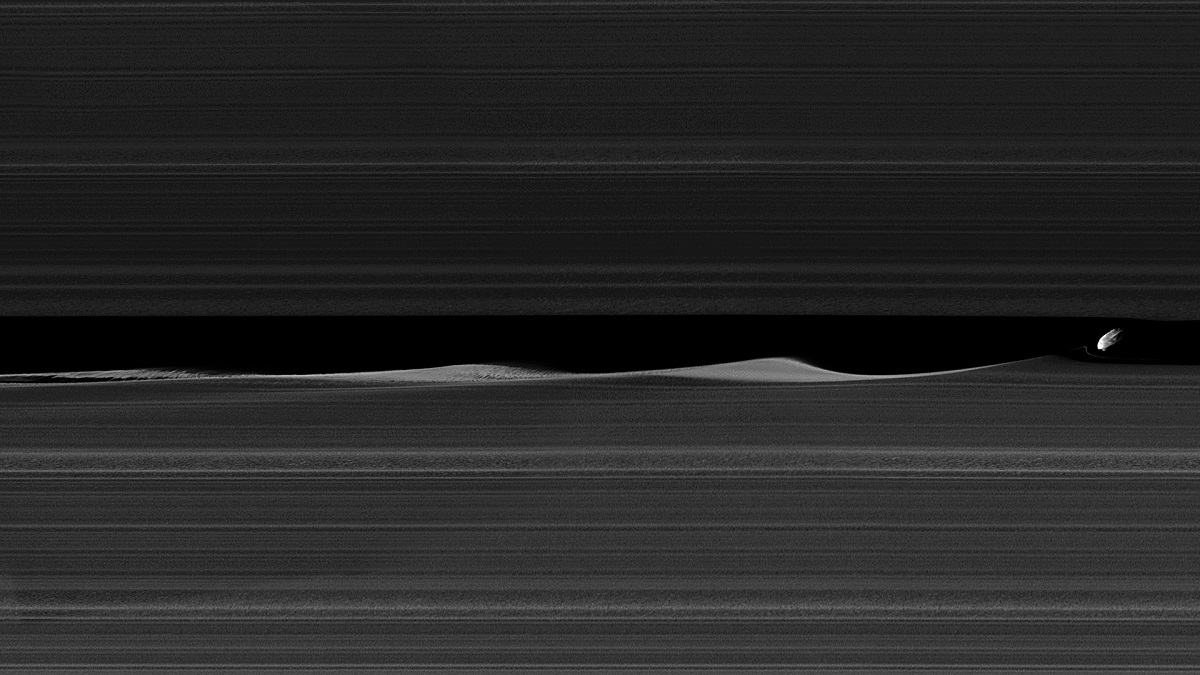
“February 14, 2017. Daphnis, one of Saturn’s ring-embedded moons, is featured in this view, kicking up waves as it orbits within the Keeler gap. The mosaic combines several images to show more waves in the gap edges. Daphnis is a small moon at 5 miles (8 kilometers) across, but its gravity is powerful enough to disrupt the tiny particles of the A ring that form the Keeler gap’s edge. As the moon moves through the Keeler gap, wave-like features are created in both the horizontal and vertical plane.

Images like this provide scientists with a close-up view of the complicated interactions between a moon and the rings, as well as the interactions between the ring particles themselves, in the wake of the moon’s passage. Three wave crests of diminishing sizes trail Daphnis here. In each subsequent crest, the shape of the wave evolves, as the ring particles within the crests collide with one another.

Close examination of Daphnis’ immediate vicinity also reveals a faint, thin strand of ring material that almost appears to have been directly ripped out of the A ring by Daphnis. The images in this mosaic were taken in visible light, using the Cassini spacecraft narrow-angle camera at a distance of approximately 17,000 miles (28,000 kilometers) from Daphnis and at a Sun-Daphnis-spacecraft, or phase, angle of 71 degrees. Image scale is 551 feet (168 meters) per pixel.”

Image credit: NASA/JPL-Caltech/Space Science Institute


  • Facebook
  • Google
  • Slashdot
  • Reddit
  • Live
  • TwitThis
10-16-17

Daphnis Up Close

Posted by


NASA dixit:

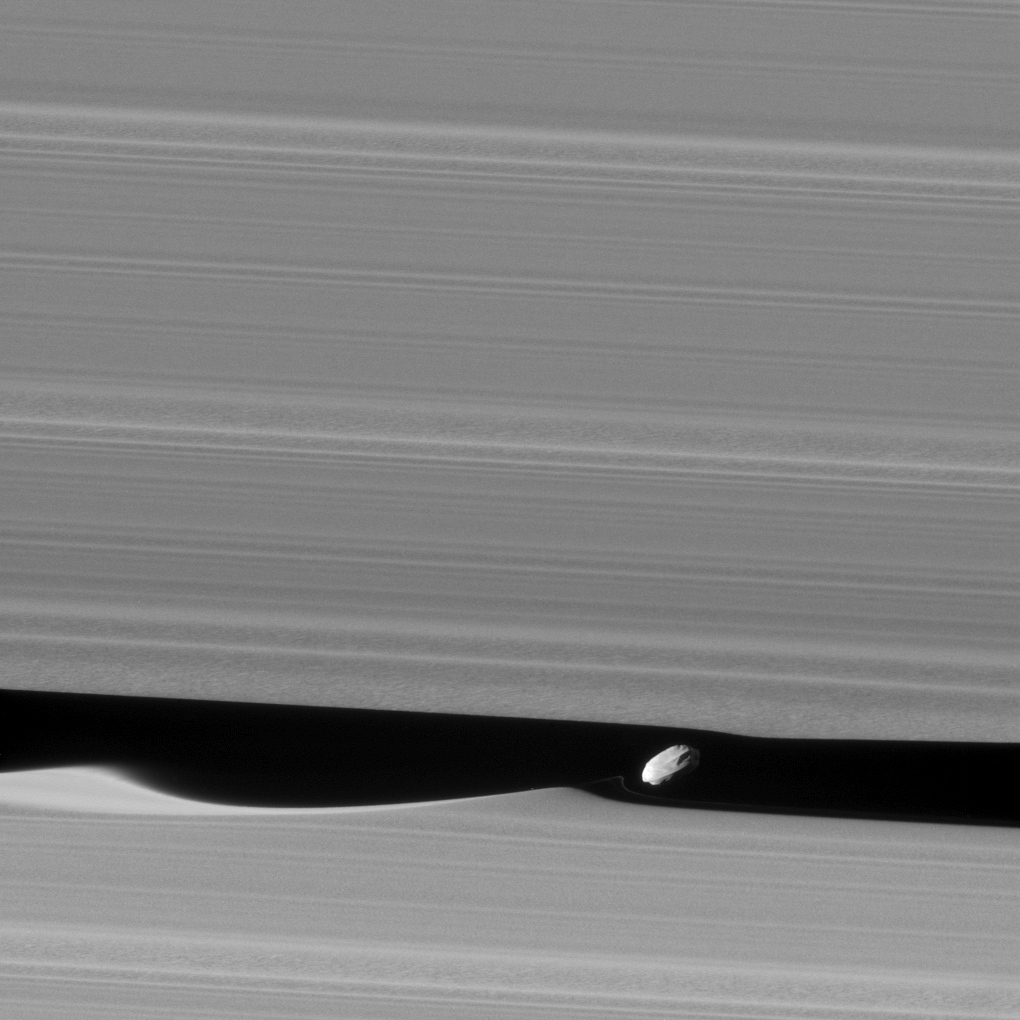
“January 16, 2017. The wavemaker moon, Daphnis, is featured in this view, taken as NASA’s Cassini spacecraft made one of its ring-grazing passes over the outer edges of Saturn’s rings. This is the closest view of the small moon obtained yet. Daphnis (5 miles or 8 kilometers across) orbits within the 42-kilometer (26-mile) wide Keeler Gap. Cassini’s viewing angle causes the gap to appear narrower than it actually is, due to foreshorteneing.

The little moon’s gravity raises waves in the edges of the gap in both the horizontal and vertical directions. Cassini was able to observe the vertical structures in 2009, around the time of Saturn’s equinox. Like a couple of Saturn’s other small ring moons, Atlas and Pan, Daphnis appears to have a narrow ridge around its equator and a fairly smooth mantle of material on its surface — likely an accumulation of fine particles from the rings. A few craters are obvious at this resolution. An additional ridge can be seen further north that runs parallel to the equatorial band.

Fine details in the rings are also on display in this image. In particular, a grainy texture is seen in several wide lanes which hints at structures where particles are clumping together. In comparison to the otherwise sharp edges of the Keeler Gap, the wave peak in the gap edge at left has a softened appearance. This is possibly due to the movement of fine ring particles being spread out into the gap following Daphnis’ last close approach to that edge on a previous orbit. A faint, narrow tendril of ring material follows just behind Daphnis (to its left). This may have resulted from a moment when Daphnis drew a packet of material out of the ring, and now that packet is spreading itself out.

The image was taken in visible (green) light with the Cassini spacecraft narrow-angle camera. The view was acquired at a distance of approximately 17,000 miles (28,000 kilometers) from Daphnis and at a Sun-Daphnis-spacecraft, or phase, angle of 71 degrees. Image scale is 551 feet (168 meters) per pixel.”

Image credit: NASA/JPL-Caltech/Space Science Institute


  • Facebook
  • Google
  • Slashdot
  • Reddit
  • Live
  • TwitThis