OrbitalHub

The place where space exploration, science, and engineering meet

Domain is for sale. $50,000,000.00 USD. Direct any inquiries to contact@orbitalhub.com.


The search for signs of past life on Mars crossed a significant threshold in late April 2026, when an international team of researchers announced that NASA’s Curiosity rover had identified more than 20 distinct organic molecules preserved in ancient Martian rocks, including a nitrogen-containing compound whose structure resembles one of the building blocks of DNA. The findings, published on April 21, 2026, in the journal Nature Communications, represent the most diverse inventory of organic compounds ever detected on the Red Planet and demonstrate that the Martian subsurface is capable of protecting complex carbon-based chemistry for billions of years.

The discovery came from a chemical experiment conducted on another planet for the first time in history. Scientists used the Sample Analysis at Mars instrument suite, known as SAM, aboard Curiosity to analyze regolith and rock powder collected in the Glen Torridon region of Gale Crater. This area, explored by the rover in 2020, sits on the flanks of Mount Sharp and contains clay minerals that formed in the presence of liquid water approximately 3.5 billion years ago. Clay-rich environments are especially effective at trapping and shielding organic material from the radiation and oxidation that would otherwise destroy complex molecules near the Martian surface.

The experiment employed a chemical reagent called tetramethylammonium hydroxide, abbreviated TMAH, to break down larger organic molecules into smaller fragments that the SAM instruments could vaporize and characterize. The reagent is commonly used in geochemistry laboratories on Earth to liberate organic compounds from rock matrices without destroying them. Because Curiosity carries only a limited supply of TMAH, researchers spent considerable time selecting the optimal sampling site and timing the experiment to maximize scientific return. The successful execution of this procedure on Mars marks a milestone in analytical chemistry performed by robotic spacecraft at interplanetary distances.

Among the compounds detected, the nitrogen-containing molecule attracted particular attention. Its structure resembles nucleobases, the units that encode genetic information in DNA and RNA on Earth. The same class of molecules has been found in carbonaceous meteorites, which deliver organic material to planetary surfaces throughout the solar system. “The same stuff that rained down on Mars from meteorites is what rained down on Earth, and it probably provided the building blocks for life as we know it on our planet,” said Amy Williams, a geological sciences professor at the University of Florida and a member of both the Curiosity and Perseverance science teams, in a statement accompanying the paper’s release.

The rover also detected benzothiophene, a sulfur-containing molecule with a double-ring structure that is commonly found in meteorites and is associated with organic matter delivered from space rather than biological processes. This underscores a central challenge in interpreting organic detections on Mars: distinguishing between compounds that arrived via meteorite infall and those that might have a more local or biological origin. The Glen Torridon samples contained molecules in sufficient quantity and variety that the researchers concluded they were examining genuinely preserved ancient organic matter, rather than terrestrial contamination or trace amounts consistent with meteorite delivery alone.

Gale Crater was chosen as Curiosity’s landing site precisely because orbital spectroscopy had identified clay minerals in the region, suggesting a past environment where liquid water was stable and potentially hospitable to life. The rover arrived in August 2012 and has spent the subsequent years traversing the crater floor and ascending Mount Sharp, analyzing rock formations that record billions of years of Martian geological history. The Glen Torridon stop represented a particularly promising target because the clay minerals there act as molecular sponges, capturing and preserving organic compounds that would otherwise be degraded by cosmic rays and perchlorate chemicals in the Martian soil.

The detection of preserved organics in the shallow subsurface has direct implications for how scientists plan the next phase of Mars exploration. The ESA Rosalind Franklin rover, scheduled to launch on a SpaceX Falcon Heavy in late 2028, will carry a version of the TMAH extraction technique to a different landing site on Oxia Planum, where clay-rich deposits also exist. NASA’s Dragonfly mission to Saturn’s moon Titan, currently targeting launch in the 2030s, will employ similar chemical analysis methods on organic-rich sediments on that distant world’s surface. The success of the SAM TMAH experiment on Curiosity validates the approach and builds confidence that robotic chemistry can recover meaningful organic signatures without requiring sample return to Earth.

The authors of the Nature Communications paper are careful to note that the presence of these molecules does not constitute evidence of past life on Mars. The compounds could have arrived via meteorite infall, formed through geochemical processes in the Martian crust, or been delivered by hydrothermal systems that once operated in Gale Crater. What the discovery demonstrates is that the chemistry of life, or its precursors, has existed on Mars in sufficient quantity and diversity to be detectable after 3.5 billion years of preservation. The question of whether that chemistry ever organized itself into anything resembling living systems remains unanswered and will only be resolved when Martian samples are returned to terrestrial laboratories.

NASA’s Perseverance rover, which landed in Jezero Crater in 2021, is actively collecting and caching rock samples for eventual return to Earth as part of the Mars Sample Return campaign. The campaign, involving NASA and ESA, plans to launch the collected samples aboard a small rocket from the Martian surface and rendezvous them with an Earth return orbiter for delivery to scientists on the ground. That mission architecture is currently undergoing review and development, with the first sample return targeted for the early 2030s. Until Martian material can be examined with the full arsenal of instruments available in terrestrial laboratories, Curiosity’s latest finding stands as the most compelling indication yet that the raw ingredients for life were present on our neighboring planet at a time when life was also emerging on Earth.

Understanding why organic molecules survive on Mars requires examining the planet’s unusual surface chemistry. The Martian regolith contains perchlorate salts at concentrations of up to one percent in some soils. Perchlorates are powerful oxidizing agents that break down organic compounds when activated by ultraviolet radiation from the Sun. This chemical environment, combined with the constant bombardment of cosmic rays and solar particles that penetrate the thin Martian atmosphere, should in theory destroy exposed organic molecules within millions of years.

The clay minerals in formations like Glen Torridon offer a protective environment that substantially extends this timescale. Smectite clays, the class of clay minerals dominant in Gale Crater, have a layered sheet structure that traps molecules between the layers and shields them from radiation and reactive chemicals. The same property makes these clays useful in contamination remediation on Earth, where they are employed to immobilize organic pollutants in soils and groundwater.

The TMAH extraction process works by dissolving the clay matrix and releasing the trapped molecules for analysis. The reagent acts as a strong base that breaks the chemical bonds between the clay layers and the organic compounds, allowing the molecules to enter solution where they can be vaporized and analyzed by mass spectrometry. The SAM instrument heats the extracted samples to temperatures that ionize the organic molecules, then separates the ions by mass-to-charge ratio to identify the constituent compounds. This technique, routine in terrestrial geochemistry, had never been applied on another planet until Curiosity’s team adapted it for the SAM instrument’s constraints on mass, power, and consumables.


  • Facebook
  • Google
  • Slashdot
  • Reddit
  • Live
  • TwitThis
07-23-24

Gediz Vallis

Posted by


NASA dicit:

This view was captured by NASA’s Curiosity Mars rover within Gediz Vallis channel, which was likely formed by ancient floodwaters and landslides. After Curiosity drove over a bright stone and cracked it open, scientists discovered it was filled with pure sulfur — something that’s never been seen on Mars before. The rover has discovered lots of sulfur-based minerals in the past, but not pure sulfur. In the video, a separate image of the sulfur crystals appears embedded roughly where the rock was found; the camera’s view of the rock was blocked by the rover at the time this panorama was taken.

You’ll also see Curiosity’s robotic arm, which is raised after drilling its 41st hole at a location nicknamed “Mammoth Lakes.†The sample collected by Curiosity was dropped into instruments in its belly, and will help scientists understand how this area formed.

The rover used its Mast Camera, or Mastcam, to take this panorama on June 19, 2024, the 4,220th Martian day, or sol, of the mission. It’s made up of 336 individual images that were stitched together. The color has been adjusted to match lighting conditions as the human eye would see them on Earth.

Video credit: NASA Jet Propulsion Laboratory


  • Facebook
  • Google
  • Slashdot
  • Reddit
  • Live
  • TwitThis


Wikipedia dicit:

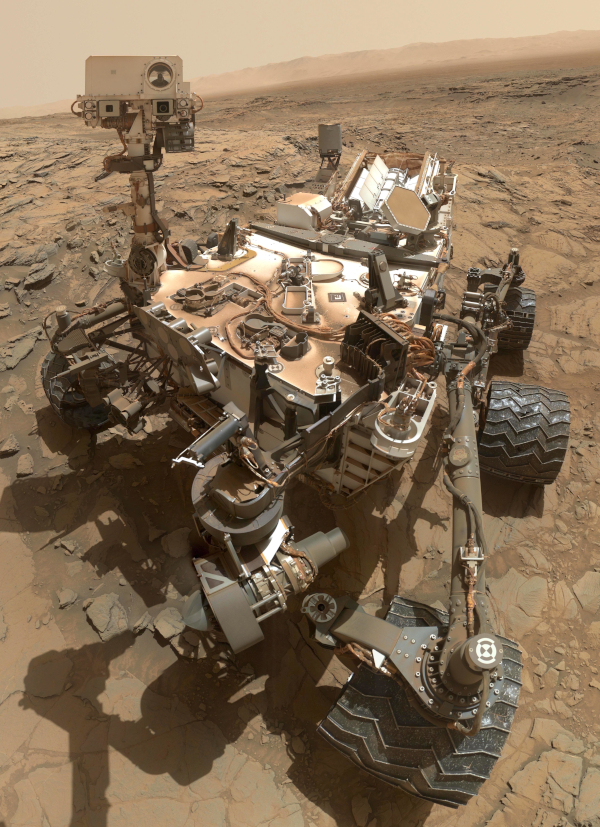
Curiosity is a car-sized Mars rover designed to explore the Gale crater on Mars as part of NASA’s Mars Science Laboratory (MSL) mission. Curiosity was launched from Cape Canaveral (CCAFS) on November 26, 2011, at 15:02:00 UTC and landed on Aeolis Palus inside Gale crater on Mars on August 6, 2012, 05:17:57 UTC. The Bradbury Landing site was less than 2.4 km (1.5 mi) from the center of the rover’s touchdown target after a 560 million km (350 million mi) journey.

Mission goals include an investigation of the Martian climate and geology, assessment of whether the selected field site inside Gale has ever offered environmental conditions favourable for microbial life (including investigation of the role of water), and planetary habitability studies in preparation for human exploration.

In December 2012, Curiosity’s two-year mission was extended indefinitely, and on August 5, 2017, NASA celebrated the fifth anniversary of the Curiosity rover landing. On August 6, 2022, a detailed overview of accomplishments by the Curiosity rover for the last ten years was reported. The rover is still operational, and as of 11 February 2023, Curiosity has been active on Mars for 3739 sols (3841 total days; 10 years, 189 days) since its landing.

Credit: NASA’s Marshall Space Flight Center


  • Facebook
  • Google
  • Slashdot
  • Reddit
  • Live
  • TwitThis
01-8-19

NASA Mars Report

Posted by


NASA dixit:

“NASA’s InSight has been busy. After landing on the Red Planet, the mission sent home pictures and sound, then placed its first instrument on the planet’s surface. Plus, find out what the Curiosity rover has been up to. “

Video Credit: NASA


  • Facebook
  • Google
  • Slashdot
  • Reddit
  • Live
  • TwitThis
08-7-17

A Guide to Gale Crater

Posted by


Wikipedia dixit:

“Gale is a crater, and probable dry lake, on Mars near the northwestern part of the Aeolis quadrangle at 5.4°S 137.8°E. It is 154 km (96 mi) in diameter and estimated to be about 3.5-3.8 billion years old. The crater was named after Walter Frederick Gale, an amateur astronomer from Sydney, Australia, who observed Mars in the late 19th century. Aeolis Mons is a mountain in the center of Gale and rises 5.5 km (18,000 ft) high. Aeolis Palus is the plain between the northern wall of Gale and the northern foothills of Aeolis Mons. Peace Vallis, a nearby outflow channel, ‘flows’ down from the Gale crater hills to the Aeolis Palus below and seems to have been carved by flowing water. The NASA Mars rover, Curiosity, of the Mars Science Laboratory (MSL) mission, landed in “Yellowknife” Quad 51 of Aeolis Palus in Gale at 05:32 UTC August 6, 2012. NASA named the landing location Bradbury Landing on August 22, 2012. Curiosity is exploring Aeolis Mons and surrounding areas.

Gale crater, named for Walter F. Gale (1865-1945), an amateur astronomer from Australia, spans 154 km (96 mi) in diameter and holds a mountain, Aeolis Mons (informally named “Mount Sharp” to pay tribute to geologist Robert P. Sharp) rising 18,000 ft (5,500 m) from the crater floor, higher than Mount Rainier rises above Seattle. Gale is roughly the size of Connecticut and Rhode Island.

The crater formed when a meteor hit Mars in its early history, about 3.5 to 3.8 billion years ago. The meteor impact punched a hole in the terrain, and the subsequent explosion ejected rocks and soil that landed around the crater. Layering in the central mound (Aeolis Mons) suggests it is the surviving remnant of an extensive sequence of deposits. Some scientists believe the crater filled in with sediments and, over time, the relentless Martian winds carved Aeolis Mons, which today rises about 5.5 km (3.4 mi) above the floor of Gale—three times higher than the Grand Canyon is deep.

At 10:32 p.m. PDT on Aug. 5, 2012 (1:32 a.m. EDT on Aug. 6, 2012), the Mars Science Laboratory rover, Curiosity, landed on Mars at 4.5°S 137.4°E, at the foot of the layered mountain inside Gale crater. Curiosity landed within a landing ellipse approximately 7 km (4.3 mi) by 20 km (12 mi). The landing ellipse is about 4,400 m (14,400 ft) below Martian “sea level” (defined as the average elevation around the equator). The expected near-surface atmospheric temperatures at the landing site during Curiosity’s primary mission (1 Martian year or 687 Earth days) are from −90 °C (−130 °F) to 0 °C (32 °F).

Scientists chose Gale as the landing site for Curiosity because it has many signs that water was present over its history. The crater’s geology is notable for containing both clays and sulfate minerals, which form in water under different conditions and may also preserve signs of past life. The history of water at Gale, as recorded in its rocks, is giving Curiosity lots of clues to study as it pieces together whether Mars ever could have been a habitat for microbes. Gale Crater contains a number of fans and deltas that provide information about lake levels in the past, including: Pancake Delta, Western Delta, Farah Vallis delta and the Peace Vallis Fan.”

Video credit: NASA Jet Propulsion Laboratory


  • Facebook
  • Google
  • Slashdot
  • Reddit
  • Live
  • TwitThis


Wikipedia dixit:

“Curiosity comprised 23 percent of the mass of the 3,893 kg (8,583 lb) Mars Science Laboratory (MSL) spacecraft, which had the sole mission of delivering the rover safely across space from Earth to a soft landing on the surface of Mars. The remaining mass of the MSL craft was discarded in the process of carrying out this task. Curiosity has a mass of 899 kg (1,982 lb) including 80 kg (180 lb) of scientific instruments. The rover is 2.9 m (9.5 ft) long by 2.7 m (8.9 ft) wide by 2.2 m (7.2 ft) in height.

Curiosity is powered by a radioisotope thermoelectric generator (RTG), like the successful Viking 1 and Viking 2 Mars landers in 1976. Radioisotope power systems (RPSs) are generators that produce electricity from the decay of radioactive isotopes, such as plutonium-238, which is a non-fissile isotope of plutonium. Heat given off by the decay of this isotope is converted into electric voltage by thermocouples, providing constant power during all seasons and through the day and night. Waste heat can be used via pipes to warm systems, freeing electrical power for the operation of the vehicle and instruments. Curiosity’s RTG is fueled by 4.8 kg (11 lb) of plutonium-238 dioxide supplied by the U.S. Department of Energy.

Curiosity is powered by a Multi-Mission Radioisotope Thermoelectric Generator (MMRTG), designed and built by Rocketdyne and Teledyne Energy Systems under contract to the U.S. Department of Energy, and assembled and tested by the Idaho National Laboratory. Based on legacy RTG technology, it represents a more flexible and compact development step, and is designed to produce 125 watts of electrical power from about 2,000 watts of thermal power at the start of the mission. The MMRTG produces less power over time as its plutonium fuel decays: at its minimum lifetime of 14 years, electrical power output is down to 100 watts. The power source will generate 9 MJ (2.5 kWh) each day, much more than the solar panels of the Mars Exploration Rovers, which can generate about 2.1 MJ (0.58 kWh) each day. The electrical output from the MMRTG charges two rechargeable lithium-ion batteries. This enables the power subsystem to meet peak power demands of rover activities when the demand temporarily exceeds the generator’s steady output level. Each battery has a capacity of about 42 ampere-hours.

The temperatures at the landing site can vary from −127 to 40 °C (−197 to 104 °F); therefore, the thermal system will warm the rover for most of the Martian year. The thermal system will do so in several ways: passively, through the dissipation to internal components; by electrical heaters strategically placed on key components; and by using the rover heat rejection system (HRS). It uses fluid pumped through 60 m (200 ft) of tubing in the rover body so that sensitive components are kept at optimal temperatures. The fluid loop serves the additional purpose of rejecting heat when the rover has become too warm, and it can also gather waste heat from the power source by pumping fluid through two heat exchangers that are mounted alongside the RTG. The HRS also has the ability to cool components if necessary.

The two identical on-board rover computers, called Rover Computer Element (RCE) contain radiation hardened memory to tolerate the extreme radiation from space and to safeguard against power-off cycles. The computers run the VxWorks real-time operating system (RTOS). Each computer’s memory includes 256 kB of EEPROM, 256 MB of DRAM, and 2 GB of flash memory. For comparison, the Mars Exploration Rovers used 3 MB of EEPROM, 128 MB of DRAM, and 256 MB of flash memory.

The RCE computers use the RAD750 CPU, which is a successor to the RAD6000 CPU of the Mars Exploration Rovers. The RAD750 CPU, a radiation-hardened version of the PowerPC 750, can execute up to 400 MIPS, while the RAD6000 CPU is capable of up to only 35 MIPS. Of the two on-board computers, one is configured as backup and will take over in the event of problems with the main computer. On February 28, 2013, NASA was forced to switch to the backup computer due to an issue with the then active computer’s flash memory, which resulted in the computer continuously rebooting in a loop. The backup computer was turned on in safe mode and subsequently returned to active status on March 4. The same issue happened in late March, resuming full operations on March 25, 2013.

The rover has an Inertial Measurement Unit (IMU) that provides 3-axis information on its position, which is used in rover navigation. The rover’s computers are constantly self-monitoring to keep the rover operational, such as by regulating the rover’s temperature. Activities such as taking pictures, driving, and operating the instruments are performed in a command sequence that is sent from the flight team to the rover. The rover installed its full surface operations software after the landing because its computers did not have sufficient main memory available during flight. The new software essentially replaced the flight software.

Curiosity is equipped with significant telecommunication redundancy by several means – an X band transmitter and receiver that can communicate directly with Earth, and a UHF Electra-Lite software-defined radio for communicating with Mars orbiters. Communication with orbiters is expected to be the main path for data return to Earth, since the orbiters have both more power and larger antennas than the lander allowing for faster transmission speeds. Telecommunication includes a small deep space transponder on the descent stage and a solid-state power amplifier on the rover for X band. The rover also has two UHF radios, the signals of which the 2001 Mars Odyssey satellite is capable of relaying back to Earth. An average of 14 minutes, 6 seconds will be required for signals to travel between Earth and Mars. Curiosity can communicate with Earth directly at speeds up to 32 kbit/s, but the bulk of the data transfer should be relayed through the Mars Reconnaissance Orbiter and Odyssey orbiter. Data transfer speeds between Curiosity and each orbiter may reach 2000 kbit/s and 256 kbit/s, respectively, but each orbiter is able to communicate with Curiosity for only about eight minutes per day (0.56% of the time). Communication from and to Curiosity relies on internationally agreed space data communications protocols as defined by the Consultative Committee for Space Data Systems.

JPL is the central data distribution hub where selected data products are provided to remote science operations sites as needed. JPL is also the central hub for the uplink process, though participants are distributed at their respective home institutions. At landing, telemetry was monitored by three orbiters, depending on their dynamic location: the 2001 Mars Odyssey, Mars Reconnaissance Orbiter and ESA’s Mars Express satellite.

Curiosity is equipped with six 50 cm (20 in) diameter wheels in a rocker-bogie suspension. The suspension system also served as landing gear for the vehicle, unlike its smaller predecessors. Each wheel has cleats and is independently actuated and geared, providing for climbing in soft sand and scrambling over rocks. Each front and rear wheel can be independently steered, allowing the vehicle to turn in place as well as execute arcing turns. Each wheel has a pattern that helps it maintain traction but also leaves patterned tracks in the sandy surface of Mars. That pattern is used by on-board cameras to estimate the distance traveled. The pattern itself is Morse code for “JPL” (·— ·–· ·-··). The rover is capable of climbing sand dunes with slopes up to 12.5°. Based on the center of mass, the vehicle can withstand a tilt of at least 50° in any direction without overturning, but automatic sensors will limit the rover from exceeding 30° tilts. After two years of use, the wheels are visibly worn with punctures and tears.

Curiosity can roll over obstacles approaching 65 cm (26 in) in height, and it has a ground clearance of 60 cm (24 in). Based on variables including power levels, terrain difficulty, slippage and visibility, the maximum terrain-traverse speed is estimated to be 200 m (660 ft) per day by automatic navigation. The rover landed about 10 km (6.2 mi) from the base of Mount Sharp, (officially named Aeolis Mons) and it is expected to traverse a minimum of 19 km (12 mi) during its primary two-year mission. It can travel up to 90 metres (300 ft) per hour but average speed is about 30 metres (98 ft) per hour.”

Video credit: NASA Jet Propulsion Laboratory


  • Facebook
  • Google
  • Slashdot
  • Reddit
  • Live
  • TwitThis