OrbitalHub

The place where space exploration, science, and engineering meet

Domain is for sale. $50,000,000.00 USD. Direct any inquiries to contact@orbitalhub.com.

06-26-24

Crab Nebula Sonification

Posted by


NASA dicit:

This is a sonification of X-ray light emitted by the Crab Nebula. The data was obtained by NASA’s NuSTAR and Chandra space observatories, whose teams turned the data into sound to enable people to audibly perceive different features of the Crab Nebula, making it more accessible for the visually impaired.

In this sonification, X-ray wavelengths from NuSTAR (represented as different colors) are mapped to different musical pitches and sounds. Red, yellow, purple, blue, and white are mapped to notes from low to high. For Chandra, brightness in the X-ray data corresponds with pitch and volume, and a bell sound indicates the position of the pulsar at the center of the nebula.

The Crab Nebula is what remains of a star that exploded as a supernova. The explosion that created the Crab Nebula was visible from Earth in the year 1054, when it was recorded by Chinese astronomers. Most of the star’s mass was pushed into space, creating a wide debris field that continues to expand.

The rest of the stellar material collapsed into a dense object called a pulsar. The pulsar’s rapid rotation and strong magnetic field accelerate particles and shoot them into space.The particles emit high-energy X-rays that NuSTAR can detect, but as they travel outward, they collide with the debris scattered by the supernova, causing them to slow down and lose their energy. This is why NuSTAR only sees light from a relatively small region close to the pulsar. Lower energy X-rays detected by Chandra can be seen farther out.

Video credit: NASA/JPL-Caltech/CXC/SAO


  • Facebook
  • Google
  • Slashdot
  • Reddit
  • Live
  • TwitThis
05-12-21

Chandra Deep Field South

Posted by


NASA dicit:

This is the deepest image ever taken in X-rays, representing over seven million seconds of Chandra observing time. For that reason, and because the observed field is in the southern hemisphere, astronomers call this region the “Chandra Deep Field South”.

At first glance, this image may appear to be a view of stars. Rather, almost all these different colored dots are black holes or galaxies. Most of the former are supermassive black holes that reside at the centers of galaxies.

In this data sonification, the colors dictate the tones as the bar moves from the bottom of the image to the top. More specifically, colors toward the red end of the rainbow are heard as low tones while colors towards purple are assigned to higher ones. Light that appears bright white in the image is heard as white noise. The wide range of musical frequencies represents the full range of X-ray frequencies collected by Chandra of this region.

In the visual color image, this large frequency range in X-rays had to be compressed to be shown as red, green, and blue for low, medium, and high-energy X-rays. Played as sound, however, the full range of data can be experienced. As the piece scans upward, the stereo position of the sounds can help distinguish the position of the sources from left to right.

Video credit: NASA/CXC/SAO/K.Arcand, SYSTEM Sounds (M. Russo, A. Santaguida)


  • Facebook
  • Google
  • Slashdot
  • Reddit
  • Live
  • TwitThis
11-2-18

GRB150101B

Posted by


NASA dixit:

“About a year ago, astronomers excitedly reported the first detection of electromagnetic waves, or light, from a gravitational wave source. Now, a year later, researchers are announcing the existence of a cosmic relative to that historic event. The discovery was made using data from telescopes including NASA’s Chandra X-ray Observatory, Fermi Gamma-ray Space Telescope, Neil Gehrels Swift Observatory, the NASA/ESA Hubble Space Telescope, and the Discovery Channel Telescope (DCT).

The object of the new study, called GRB150101B, was first reported as a gamma-ray burst detected by Fermi in January 2015. This detection and follow-up observations at other wavelengths show GRB150101B shares remarkable similarities to the neutron star merger and gravitational wave source discovered by Advanced Laser Interferometer Gravitational Wave Observatory (LIGO) and its European counterpart Virgo in 2017 known as GW170817. The latest study concludes that these two separate objects may, in fact, be related.”

Video Credit: NASA


  • Facebook
  • Google
  • Slashdot
  • Reddit
  • Live
  • TwitThis


NASA dixit:

“This artist’s rendering illustrates new findings about a star shredded by a black hole. When a star wanders too close to a black hole, intense tidal forces rip the star apart. In these events, called “tidal disruptions,” some of the stellar debris is flung outward at high speed while the rest falls toward the black hole. This causes a distinct X-ray flare that can last for a few years. NASA’s Chandra X-ray Observatory, Swift Gamma-ray Burst Explorer, and ESA/NASA’s XMM-Newton collected different pieces of this astronomical puzzle in a tidal disruption event called ASASSN-14li, which was found in an optical search by the All-Sky Automated Survey for Supernovae (ASAS-SN) in November 2014. The event occurred near a super-massive black hole estimated to weigh a few million times the mass of the sun in the center of PGC 043234, a galaxy that lies about 290 million light-years away. Astronomers hope to find more events like ASASSN-14li to test theoretical models about how black holes affect their environments.

During the tidal disruption event, filaments containing much of the star’s mass fall toward the black hole. Eventually these gaseous filaments merge into a smooth, hot disk glowing brightly in X-rays. As the disk forms, its central region heats up tremendously, which drives a flow of material, called a wind, away from the disk.”

Video credit: NASA’s Goddard Space Flight Center


  • Facebook
  • Google
  • Slashdot
  • Reddit
  • Live
  • TwitThis


Credits: NASA/JPL


The Nuclear Spectroscopic Telescope Array (NuSTAR) is a high-energy X-ray space telescope that will expand our understanding of the origins and the development of stars and galaxies.


NuSTAR was proposed to NASA in May 2003. In 2006, while NuSTAR was undergoing an extended feasibility study, NASA cancelled the program due to budgetary constraints. However, in September 2007, the program was restarted.


In 2007, Orbital Sciences Corporation was selected by NASA to design, manufacture, and test the NuSTAR telescope.


The spacecraft is based on a proven design, used by Orbital for other NASA Small Explorer missions: SORGE, GALEX, AIM, and OCO. NuSTAR will have a launch mass of 360 kg, and will be powered by articulated solar arrays providing 600 W.


The spacecraft incorporates a ten-meter long extendable mast. The mast allows the telescope to fit into a small launch vehicle.


The technology used to build the telescope is not new. A team of researchers, led by Dr. Fiona Harrison, professor of physics and astronomy at Caltech, has been improving the NuSTAR technology for the last ten years. A previous high energy X-ray telescope (High Energy Focusing Telescope or HEFT) was developed as part of a high altitude balloon payload.


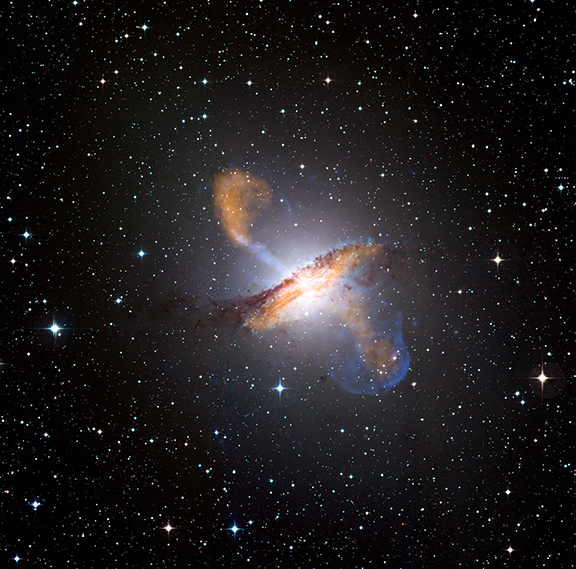
The currently operational X-ray telescopes, Chandra and XMM-Newton, observe the sky in the low energy X-ray spectrum (X-ray energies less than 10 keV). NuSTAR will make observations in a higher range, up to 79 keV. As much of the energy emitted by a black hole is absorbed by the surrounding gas and dust, observations in the high-energy X-ray spectrum can reveal in greater detail what is happening closer to the event horizon.


Credit: NASA/CXC/CfA/R.Kraft et al./MPIfR/ESO/APEX/A.Weiss et al./ESO/WFI


The NuSTAR telescope will have a sensitivity two orders of magnitude greater than any other instrument used to detect black holes. NuSTAR will help scientists understand how black holes are distributed throughout the universe, and what powers the most active galaxies.


The NuSTAR instrument consists of two co-aligned hard X-ray telescopes. The ten-meter mast mentioned above separates the mirrors and the imaging detectors. The detectors are Cadmium Zinc Telluride (CdZnTe) detectors and do not require cryogenic operation.


On February 9, 2009, NASA awarded Orbital the launch services contract for the NuSTAR mission. The telescope will be launched in 2011 aboard a Pegasus XL launch vehicle. Pegasus XL will be carried beneath a L-1011 aircraft and released over the Pacific Ocean. The air-launch system is very cost-effective, providing flexibility during operation and requiring minimal ground support.


NuSTAR will be deployed into a 525×525 km low Earth orbit (LEO) with a twenty-seven degree inclination.


For more details about the science of NuSTAR, you can visit the mission’s home page at Caltech. Orbital has also posted a NuSTAR fact sheet on their web site.


  • Facebook
  • Google
  • Slashdot
  • Reddit
  • Live
  • TwitThis