OrbitalHub

The place where space exploration, science, and engineering meet

Domain is for sale. $50,000,000.00 USD. Direct any inquiries to contact@orbitalhub.com.


ULA dixit:

“CisLunar – the space between Earth and the moon – holds vast opportunities for humans. Reliable, accessible, affordable access to space will help open economic opportunities. ULA’s ability to provide reliable, affordable access to space, which will provide critical infrastructure to supporting a space economy.”

Wikipedia dixit:

“Originally proposed as the Advanced Cryogenic Evolved Stage by Boeing in 2006 as a concept for use as a new Delta IV second stage — and subsequently, the Advanced Common Evolved Stage by its corporate successor, United Launch Alliance by 2010 — ACES was intended to boost satellite payloads to geosynchronous orbit or, in the case of an interplanetary space probe, to or near to escape velocity. Other alternative uses included a proposal to provide in-space propellant depots in LEO or at L2 that could be used as way-stations for other rockets to stop and refuel on the way to beyond-LEO or interplanetary missions, and to provide the high-energy technical capacity for the cleanup of space debris.

The late-2000s ACES proposal by ULA also had a predecessor at Lockheed Martin, prior to the merger of Boeing and Lockheed Martin launch vehicle manufacturing and operations to form ULA in 2006. Known then as the Lockheed Martin common-stage concept, the upper stage was intended to “provide efficient, robust in-space transportation”, and take advantage of the high-mass fraction that is enabled by Centaur’s design and its common bulkhead to minimize combined LO2/LH2 boil off. A study funded by NASA led to the development of the Lockheed Martin concept known as ACES, under the original name of Advanced Cryogenic Evolved Stage as of 2006.

In April 2015, after ULA had announced the end of production of the Delta IV Medium in 2019 and the Delta IV Heavy in the mid-2020s, ULA renamed the stage the Advanced Cryogenic Evolved Stage, as ACES would in this case serve as the second stage on only a single launch vehicle, the Vulcan, beginning no earlier than 2023.

After the formation of ULA in 2006, the ACES concept became one that would provide a common stage that would be evolved from both Atlas and Delta rocket technology and could be used on both launch vehicles — thus “common”. The concept by 2010 was to utilize the new high-performance upper stage, if built, on both Atlas V and Delta IV/Delta IV Heavy launch vehicles. As further refined in a 2010 conference paper, ACES was intended to be a lower-cost, more-capable and more-flexible upper stage that would supplement, and perhaps replace, the existing ULA Centaur and Delta Cryogenic Second Stage (DCSS) upper stage vehicles.

In April 2015, ULA renamed the stage the Advanced Cryogenic Evolved Stage, and announced conceptual plans to complete development of the ACES technology for the Vulcan launch vehicle, flying no earlier than 2023, but currently planned for 2024-25. No plans to develop the stage for the Atlas V or Delta IV launch vehicle lines remain. However, just like earlier ACES concept proposals, ACES would continue to blend technical aspects of both Delta and Atlas technologies and manufacturing processes, as well as use ULA’s proprietary Integrated Vehicle Fluids (IVF) technology to significantly extend the ability of the upper stage to operate in space long term. The IVF technology utilizes a lightweight internal combustion engine to use propellant boiloff (normally wasted when boiloff gasses are vented to space) to operate the stage including production of power, maintaining stage attitude, and keeping the propellant tanks autogenously pressurized, eliminating the need for hydrazine fuel and liquid helium.

The ACES vehicle is “based on a simple modular design” where the “use of multiple barrel panels, similar to Centaur, provides a straightforward means to building multiple-length (propellant load) stages that are otherwise common. The common equipment shelf accommodates one, two, or four RL10 engines. While ACES can start with existing Centaur and Delta pneumatic, avionics and propulsion systems it is intended to transition to lower-cost and higher capability systems founded on the Integrated Vehicle Fluids (IVF) system concept. IVF eliminates all hydrazine, helium, and nearly all batteries from the vehicle. It consumes waste hydrogen and oxygen to produce power, generate settling and attitude control thrust, and autogenously pressurize the vehicle tanks. IVF is optimal for depot operations since only LH2 and LO2 need be transferred, and it extends mission lifetimes from the present dozen hours to multiple days.” With the addition of a solar power system, the vehicle can remain in space and operate indefinitely.”

Video credit: ULA


  • Facebook
  • Google
  • Slashdot
  • Reddit
  • Live
  • TwitThis


NASA dixit:

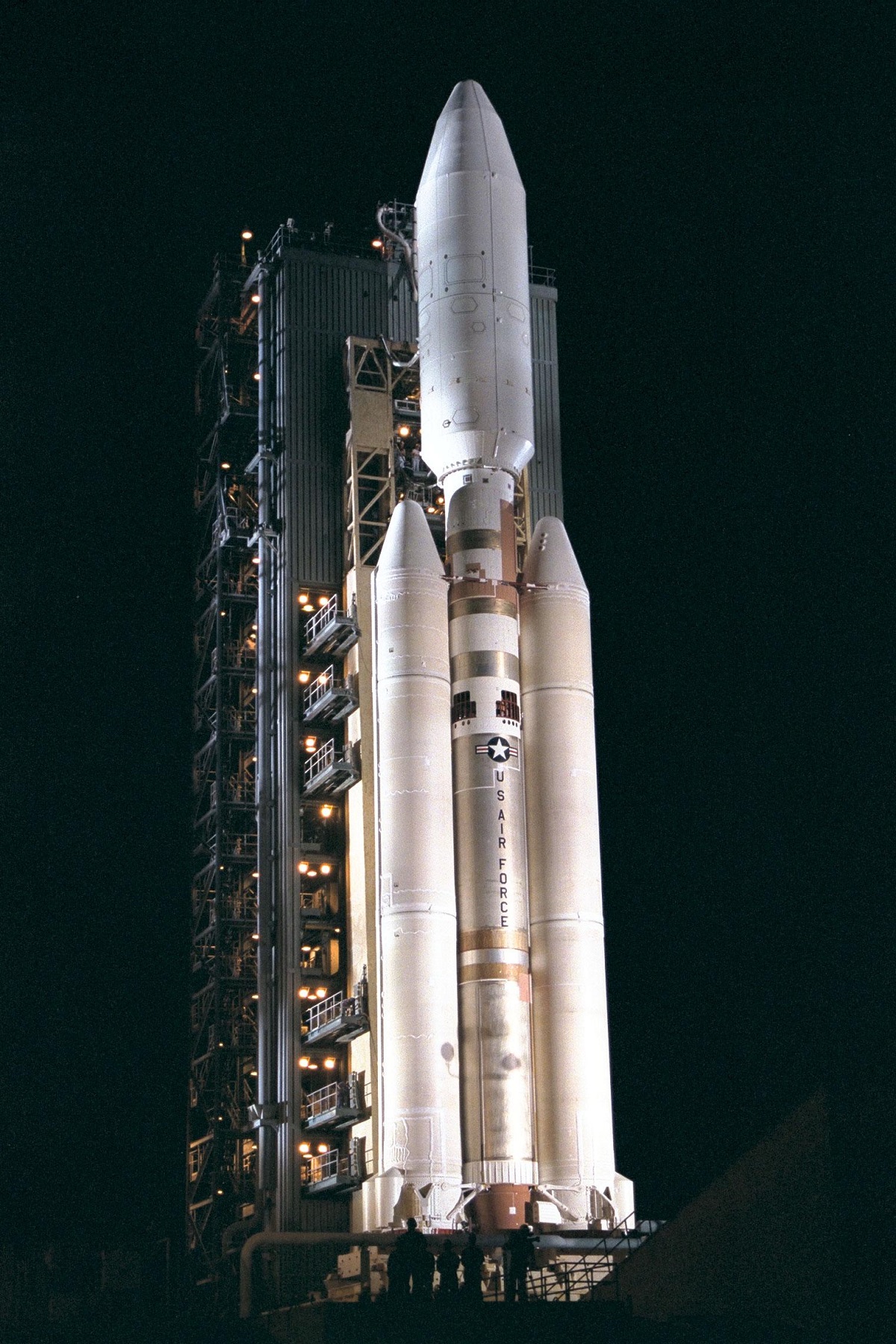
“October 12, 1997. Launch Complex 40: The second Titan IVB/Centaur (Model 401), with Cassini/Huygens on board. At Launch Complex 40 on Cape Canaveral Air Station, the Mobile Service Tower has been retracted away from the Titan IVB/Centaur carrying the Cassini spacecraft, marking a major milestone in the launch countdown sequence. Retraction of the structure began about an hour later than scheduled due to minor problems with ground support equipment. The launch vehicle, Cassini spacecraft and attached Centaur stage encased in a payload fairing, altogether stand about 183 feet tall; mounted at the base of the launch vehicle are two upgraded solid rocket motors. Liftoff of Cassini on the journey to Saturn and its moon Titan is slated to occur during a window opening at 4:55 a.m. EDT, Oct. 13, and extending through 7:15 a.m.”

“After almost 20 years in space, NASA’s Cassini spacecraft begins the final chapter of its remarkable story of exploration: its Grand Finale. Between April and September 2017, Cassini will undertake a daring set of orbits that is, in many ways, like a whole new mission. Following a final close flyby of Saturn’s moon Titan, Cassini will leap over the planet’s icy rings and begin a series of 22 weekly dives between the planet and the rings.

No other mission has ever explored this unique region. What we learn from these final orbits will help to improve our understanding of how giant planets – and planetary systems everywhere – form and evolve.

On the final orbit, Cassini will plunge into Saturn’s atmosphere, sending back new and unique science to the very end. After losing contact with Earth, the spacecraft will burn up like a meteor, becoming part of the planet itself.

Cassini’s Grand Finale is about so much more than the spacecraft’s final dive into Saturn. That dramatic event is the capstone of six months of daring exploration and scientific discovery. (And those six months are the thrilling final chapter in a historic 20-year journey.)”

Image credit: NASA


  • Facebook
  • Google
  • Slashdot
  • Reddit
  • Live
  • TwitThis


Credits: NASA/JPL

The Mars Reconnaissance Orbiter (MRO) has completed the first phase of its science mission. During this phase, the orbiter returned seventy-three terabits of science data to Earth, which is more than all earlier Mars missions combined. The next phase of the MRO mission will take two years.


The list of scientific discoveries and observations made by MRO is stunning. We know now that Mars has a long history of climate change and that water was present in liquid form on its surface for hundreds of millions of years.


Signatures of a variety of watery environments have been observed, so future missions will be aware of locations that might reveal evidence of past life on Mars, if it ever existed.


MRO has imaged nearly forty percent of the Martian surface at such a high resolution that house-sized objects can be seen in detail. MRO has also conducted a mineral survey of the planet, covering sixty percent of its surface. Global weather maps were assembled using the data returned by MRO, and profiles of the subsurface and the polar caps have been put together using the radar mounted on MRO.


Credits: NASA/KSC

“These observations are now at the level of detail necessary to test hypotheses about when and where water has changed Mars and where future missions will be most productive as they search for habitable regions on Mars,” said Richard Zurek, Mars Reconnaissance Orbiter project scientist.


The images returned by MRO have been used by the Phoenix team to change the spacecraft’s landing site, and will help the NASA scientists select landing sites for future missions, like the Mars Science Laboratory (MSL).


Another role played by MRO was to relay commands to and to return data from the Phoenix lander during the five months the lander was operational on the Martian surface. MRO shared this task with the Mars Odyssey Orbiter.


MRO lifted off on August 12, 2005, from launch Complex 41 at Cape Canaveral Air Force Station. The cruise phase of the mission lasted seven months, the spacecraft reaching Mars orbit on March 10, 2006, after traveling on an outbound arc intercept trajectory.


MRO entered the final low orbit suited for science-data collection on November 2006, after slowing down in the Martian atmosphere by using aerobraking for five months. The first phase of the mission consisted in gathering information about Mars, and the remaining time left of its operational life will be dedicated mainly to using the spacecraft as a communication relay.


Credits: NASA/KSC

The declared goals of the MRO mission are: to determine whether life ever arose on Mars, to characterize the climate of Mars, to characterize the geology of Mars, and to prepare for human exploration.


The launcher of choice for the MRO mission was the Atlas V-401 launch vehicle, the smallest of the Atlas V family. This was the first launch of an Atlas V on an interplanetary mission.


The Atlas V-401 is a two-stage launch vehicle that does not use solid rocket boosters. The Atlas V-401 is fifty-seven meters tall and has a total mass at liftoff of 333,000 kg. Out of this, about 305,000 kg is fuel. In order to reach Mars orbit, MRO was accelerated to 11 km per second.


The first stage of the Atlas V, the Common Core Booster, is powered by liquid oxygen and RP-1. For the MRO mission, the first stage used a RD-180 engine. The RD-180 engine has an interesting story. It is a Russian-developed rocket engine, derived from the RD-170 used for the Zenit rockets.


Credits: NASA/JPL/KSC/Lockheed Martin Space Systems

Rights to use the RD-180 engine were acquired by General Dynamics Space Systems Division (later purchased by Lockheed Martin) in the early 1990s. The engine is co-produced by Pratt & Whitney and all production to date has been in Russia. According to Pratt & Whitney, RD-180 delivers a ten percent performance increase over current operational U.S. booster engines.


The stage weighs approximately 305,000 kg at launch and it provides about four million Newton of thrust for four minutes.


The upper stage of the Atlas V is the Centaur Upper Stage Booster. The Centaur is powered by liquid oxygen and liquid hydrogen. In the case of the MRO mission, it provided the remaining energy necessary to send the spacecraft to Mars.


The payload fairing used for the MRO mission was four meters in diameter. The role of the payload fairing was to protect the spacecraft from the weather on the ground as well as from the dynamic pressure during the atmospheric phase of the launch.


Lockheed Martin Commercial Launch Services developed the Atlas V as part of the US Air Force Evolved Expendable Launch Vehicle (EELV) program.


There are six science instruments, three engineering instruments, and two science-facility experiments carried by the MRO. The low orbit on which MRO is operating allowed the observation of the surface, atmosphere, and subsurface of Mars in unprecedented detail.


The science instruments are the HiRISE camera (High Resolution Imaging Science Experiment), the CTX camera (Context Camera), the MARCI camera (Mars Color Imager), the CRISM spectrometer (Compact Reconnaissance Imaging Spectrometer for Mars), the MCS radiometer (Mars Climate Sounder), and the SHARAD radar (SHAllow RADar).


Credits: HiRISE/MRO/LPL/NASA


The HiRISE camera provided the highest-resolution images from orbit to date, while the SHARAD can probe the subsurface using radar waves in the 15-25 MHz frequency band (these waves can penetrate the Martian crust up to one kilometer).


The engineering instruments assist the spacecraft navigation and communication. The Electra UHF Communications and Navigation Package is used as a communication relay between the Earth and landed crafts on Mars. The Optical Navigation Camera serves as a high-precision camera to guide incoming spacecrafts as they approach Mars. The Ka-band Telecommunications Experiment Package demonstrated the use of the Ka-band for power effective communications.


The science facility experiments are the Gravity Field Investigation Package, used for mapping the gravity field of Mars, and the Atmospheric Structure Investigation Accelerometers, which helped scientists understand the structure of the Martian atmosphere.


For more details on the MRO scientific payload, you can check out the dedicated page on the MRO mission web site.


The MRO was built by Lockheed Martin for NASA’s Jet Propulsion Laboratory in California. Fully loaded, the spacecraft had a mass of almost two tons. The spacecraft carried 1,149 kg of propellant for trajectory correction maneuvers and for the burns needed for the Mars capture.


Credits: NASA/JPL


The main bus of the spacecraft presents two massive solar arrays that can generate 2,000 W of power. On top, the high-gain antenna is the main means of communication with both Earth and other spacecrafts. The SHARAD antenna is the long pole behind the bus.


Other visible features are the HiRISE camera, the Electra telecommunications package, and the Context Imager (CTX).


You can visit the home page of the MRO mission on the NASA web site.


  • Facebook
  • Google
  • Slashdot
  • Reddit
  • Live
  • TwitThis