OrbitalHub

The place where space exploration, science, and engineering meet

Domain is for sale. $50,000,000.00 USD. Direct any inquiries to contact@orbitalhub.com.


Wikipedia dixit:

“The Cassini–Huygens (commonly called Cassini) mission was a collaboration between NASA, the European Space Agency (ESA), and the Italian Space Agency (ASI) to send a probe to study the planet Saturn and its system, including its rings and natural satellites. The Flagship-class unmanned robotic spacecraft comprised both NASA’s Cassini probe, and ESA’s Huygens lander which would be landed on Saturn’s largest moon, Titan. Cassini was the fourth space probe to visit Saturn and the first to enter its orbit. The craft were named after astronomers Giovanni Cassini and Christiaan Huygens.

Launched aboard a Titan IVB/Centaur on October 15, 1997, Cassini was active in space for more than 19 years, with 13 years spent orbiting Saturn, studying the planet and its system after entering orbit on July 1, 2004. The voyage to Saturn included flybys of Venus (April 1998 and July 1999), Earth (August 1999), the asteroid 2685 Masursky, and Jupiter (December 2000). Its mission ended on September 15, 2017, when Cassini was commanded to fly into Saturn’s upper atmosphere and burn up in order to prevent any risk of contaminating Saturn’s moons, which may offer habitable environments to stowaway terrestrial microbes on the spacecraft. (At that point Cassini lacked sufficient impulse to leave the Saturn system, so it could only be left in orbit, where it might collide with a moon, or be destroyed.) The mission is widely perceived to have been successful beyond expectation. Cassini-Huygens has been described by NASA’s Planetary Science Division Director as a “mission of firsts”, that has revolutionized human understanding of the Saturn system, including its moons and rings, and our understanding of where life might be found in the Solar System.

Cassini’s original mission was planned to last for four years, from June 2004 to May 2008. The mission was extended for another two years until September 2010, branded the Cassini Equinox Mission. The mission was extended a second and final time with the Cassini Solstice Mission, lasting another seven years until September 15, 2017, on which date Cassini was de-orbited to burn up in Saturn’s upper atmosphere.

The Huygens module traveled with Cassini until its separation from the probe on December 25, 2004; it was successfully landed by parachute on Titan on January 14, 2005. It successfully returned data to Earth for around 90 minutes, using the orbiter as a relay. This was the first landing ever accomplished in the outer Solar System and the first landing on a moon other than our own. Cassini continued to study the Saturn system in the following years.

At the end of its mission, the Cassini spacecraft executed the “Grand Finale” of its mission: a number of risky passes through the gaps between Saturn and Saturn’s inner rings. The purpose of this phase was to maximize Cassini’s scientific outcome before the spacecraft was destroyed. The atmospheric entry of Cassini effectively ended the mission.”

Video credit: NASA


  • Facebook
  • Google
  • Slashdot
  • Reddit
  • Live
  • TwitThis
09-20-17

Goodbye Cassini

Posted by


Wikipedia dixit:

“The Cassini–Huygens (commonly called Cassini) mission was a collaboration between NASA, the European Space Agency (ESA), and the Italian Space Agency (ASI) to send a probe to study the planet Saturn and its system, including its rings and natural satellites. The Flagship-class unmanned robotic spacecraft comprised both NASA’s Cassini probe, and ESA’s Huygens lander which would be landed on Saturn’s largest moon, Titan. Cassini was the fourth space probe to visit Saturn and the first to enter its orbit. The craft were named after astronomers Giovanni Cassini and Christiaan Huygens.

Launched aboard a Titan IVB/Centaur on October 15, 1997, Cassini was active in space for more than 19 years, with 13 years spent orbiting Saturn, studying the planet and its system after entering orbit on July 1, 2004. The voyage to Saturn included flybys of Venus (April 1998 and July 1999), Earth (August 1999), the asteroid 2685 Masursky, and Jupiter (December 2000). Its mission ended on September 15, 2017, when Cassini was commanded to fly into Saturn’s upper atmosphere and burn up in order to prevent any risk of contaminating Saturn’s moons, which may offer habitable environments to stowaway terrestrial microbes on the spacecraft. (At that point Cassini lacked sufficient impulse to leave the Saturn system, so it could only be left in orbit, where it might collide with a moon, or be destroyed.) The mission is widely perceived to have been successful beyond expectation. Cassini-Huygens has been described by NASA’s Planetary Science Division Director as a “mission of firsts”, that has revolutionized human understanding of the Saturn system, including its moons and rings, and our understanding of where life might be found in the Solar System.

Cassini’s original mission was planned to last for four years, from June 2004 to May 2008. The mission was extended for another two years until September 2010, branded the Cassini Equinox Mission. The mission was extended a second and final time with the Cassini Solstice Mission, lasting another seven years until September 15, 2017, on which date Cassini was de-orbited to burn up in Saturn’s upper atmosphere.

The Huygens module traveled with Cassini until its separation from the probe on December 25, 2004; it was successfully landed by parachute on Titan on January 14, 2005. It successfully returned data to Earth for around 90 minutes, using the orbiter as a relay. This was the first landing ever accomplished in the outer Solar System and the first landing on a moon other than our own. Cassini continued to study the Saturn system in the following years.

At the end of its mission, the Cassini spacecraft executed the “Grand Finale” of its mission: a number of risky passes through the gaps between Saturn and Saturn’s inner rings. The purpose of this phase was to maximize Cassini’s scientific outcome before the spacecraft was destroyed. The atmospheric entry of Cassini effectively ended the mission.”

Video credit: NASA


  • Facebook
  • Google
  • Slashdot
  • Reddit
  • Live
  • TwitThis
03-30-09

ESA Conference On Space Debris

Posted by


Credits: ESA


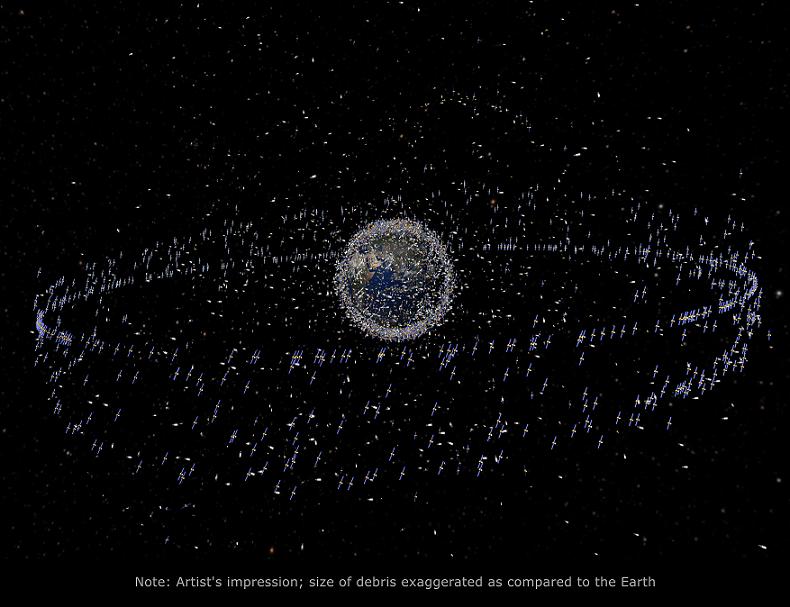
The Fifth European Conference on Space Debris is hosted by ESA. The conference takes place at ESA’s Space Operations Centre (ESOC) in Darmstadt, Germany, for four days beginning March 30.


The space debris in Earth orbit has been attracting attention due to the direct threat that it poses to current and future space missions. Long-term protection of the low-Earth and geosynchronous orbital zones is essential for the development of commercial activities in space.


“Our ability to safely use outer space in the long term is not guaranteed,” said Gerard Brachet, a past Chairman of the UN Committee on the Peaceful Uses of Outer Space (UNCOPUOS), speaking during today’s opening speech. He added that: “Increased crowding in low Earth orbits as well as the geostationary orbit creates new challenges.”


The first artificial satellite was launched in 1957 by the Soviet Union. Since then, almost 5000 launches have placed around 6000 satellites into orbit. Today, the 800 operational satellites count for only six percent of the catalogued orbit population. Decommissioned satellites, spent upper stages, mission-related objects, and fragments make up the rest. More than half of the debris originates from around 200 fragmentations that occurred in orbit. Except for few accidental collisions, these fragmentations were explosions of spacecraft and upper stages.


Mitigation measures have to be implemented. Among these, reducing the number of explosions, minimizing the number of objects released during spacecraft operations (also known as mission-related objects or MRO), re-orbiting satellites, and returning spacecraft and rocket stages to Earth after completion of their mission.


The main sponsor of the conference is ESA and co-sponsors are the Italian space agency (ASI), the British National Space Centre (BNSC), the French space agency (CNES), the German Aerospace Center (DLR), the Committee on Space Research (COSPAR), and the International Academy of Astronautics (IAA).


For more details about the conference, you can visit the ESA website.


  • Facebook
  • Google
  • Slashdot
  • Reddit
  • Live
  • TwitThis


Credits: NASA


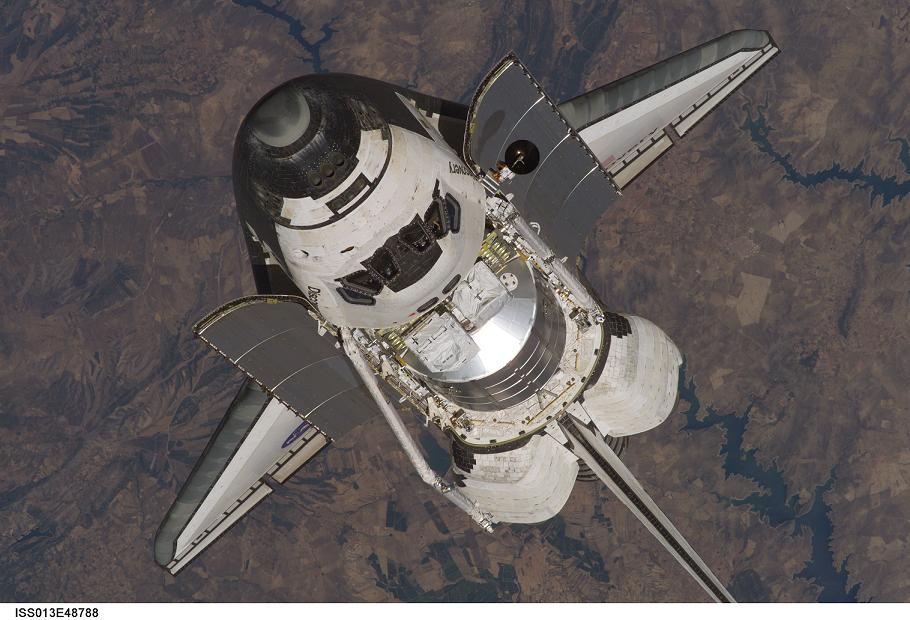
The Multi-Purpose Logistics Module (MPLM) is a pressurized module that is used on Space Shuttle missions to transfer cargo to and from the International Space Station (ISS).


A typical MPLM mission starts in the cargo bay of a Space Shuttle. The MPLM is carried to the ISS and berthed to one of the docking modules by the Canadian robotic arm. The supplies are offloaded and then finished experiments and waste are loaded on to the module. At the end of the mission, the MPLM is moved to the Space Shuttle cargo bay and returned to Earth.


The Italian Space Agency (ASI) provides the modules to NASA. Three MPLMs have been built and delivered to NASA thus far. NASA owns the MPLMs and ASI receives research time on ISS in exchange. The MPLMs were named after great figures in Italian history: Leonardo, Raffaello, and Donatello. However, some of the mission badges display the ninja turtles instead.


The construction of the first MPLM – Leonardo – began in April 1996. Leonardo was delivered to NASA in August 1998. Raffaello and Donatello followed in August 1999 and February 2001, respectively. Each MPLM can make 25 return trips to space.


Credits: NASA


The MPLM is 6.4 meters long and 4.6 meters in diameter. The module weighs 4.5 tons and it can deliver up to 10 tons to the ISS. The design of the module resembles the payload module that is part of the ATV. In addition, ATV has a service module that offers autonomy. Obviously, ATV was the direct beneficiary of the knowledge gained during the design and operational phases of the MPLM.


There is room for sixteen standard payload racks (International Standard Payload Racks – ISPR) in the MPLM. Even if it is not used to carry a human crew, MPLM has its own life-support system. Furthermore, it has a 3 KW internal power supply.


Credits: NASA


The current Space Shuttle mission – STS 126 – has delivered the MPLM Leonardo to the ISS. Leonardo is on its fifth spaceflight and hauled over 14,000 pounds of supplies and equipment to ISS.


Part (a small part) of the payload was turkey, candied yams, stuffing, and dessert for a Thanksgiving meal at the station.


A special piece of equipment, the GLACIER, was also delivered to the station. GLACIER stands for General Laboratory Active Cryogenic ISS Experiment Refrigerator. GLACIER is a double locker cryogenic freezer that will be used for transporting and preserving science experiments. The payload also included a galley for the Destiny laboratory, an advanced Resistive Exercise Device (aRED), and two new crew quarter racks for the expanded station crew.


Credits: NASA


There are two more MPLM missions scheduled before the Space Shuttle retires. STS-128 will carry Leonardo in July 2009, and Raffaello will be docked to ISS during the STS-131 mission in February 2010.


  • Facebook
  • Google
  • Slashdot
  • Reddit
  • Live
  • TwitThis