“Liftoff of Vega VV06 carrying LISA Pathfinder from Europe’s Spaceport, French Guiana, at 04:04 GMT/05:04 CET on 3 December 2015. Vega will place LISA Pathfinder into an elliptical orbit around our planet. Then, the spacecraft will use its own propulsion module to raise the highest point of the orbit in six stages. The last burn will propel the spacecraft towards its operational orbit, around a stable point called L1, some 1.5 million km from Earth towards the Sun.
Once on its final orbit, LISA Pathfinder will test key technologies for space-based observation of gravitational waves. These ripples in the fabric of spacetime are predicted by Albert Einstein’s general theory of relativity but have not yet been directly detected.
To demonstrate the fundamental approach that could be used by future missions to observe these elusive cosmic fluctuations, LISA Pathfinder will realize the best free-fall ever achieved in space. It will do so by reducing all the non-gravitational forces acting on two cubes and monitoring their motion and attitude to unprecedented accuracy.”
“Arianespace successfully launched two satellites [on November 10]: Arabsat-6B (BADR-7) for the operator Arabsat, and GSAT-15 for ISRO (Indian Space Research Organisation). The company’s tenth launch of the year from the Guiana Space Center (CSG), and sixth with the Ariane 5 heavy launcher, took place on November 10 at 6:34 pm local time in Kourou, French Guiana. Through this mission, the 69th successful launch in a row by Ariane 5, Arianespace is proud to deliver reliable, sustainable solutions to Arabsat and ISRO, two loyal customers for over 30 years.
Arabsat is the leading regional satellite telecommunications operator in the Middle East and Africa. Arabsat-6B (BADR 7) is the ninth satellite orbited by Arianespace for this operator since the launch of Arabsat-1A in 1985. This satellite is the first of the sixth generation of satellites in the Arabsat fleet. It will provide telecommunications and direct- to-home (DTH) TV broadcast services for the Middle East, Africa and Central Asia. In 2012 Arabsat also confirmed its goal of bolstering its position in the Europe-Middle East-Africa (EMEA) zone by acquiring the company Hellasat. Arianespace will be launching another Arabsat satellite, Hellasat-4.
GSAT-15 is the 19th satellite to be launched by Arianespace for ISRO (Indian Space Research Organisation). It will provide telecommunications services for the country, along with dedicated navigation-aid and emergency services. Arianespace has launched 91% of ISRO’s geostationary satellites that used non-Indian launch systems, dating back to the launch of the country’s experimental satellite APPLE on Flight L03 in 1981. The favored relationship between Arianespace and ISRO reflects the exemplary collaboration in the space sector between France and India, a partnership that will help ISRO realize its aim of using space to foster the development of the Indian sub-continent through a full range of satellite applications, for Earth observation, telecommunications, science and navigation.”
“Two telecommunications satellites that will provide expanded relay capacity for Australia and Argentina were orbited today on Arianespace’s ninth mission in 2015 – putting the company on track to perform a record 12 flights this year using its three-member launch vehicle family, which consists of the heavy-lift Ariane 5, medium-lift Soyuz and lightweight Vega. Lifting off exactly on time during a daylight departure from the Spaceport in French Guiana, the heavy-lift Ariane 5 utilized for today’s mission deployed its Sky Muster and ARSAT-2 satellite passengers during a 32-minute flight sequence. It marked the 82nd mission overall using Arianespace’s workhorse launcher, as well as the 68th consecutive Ariane 5 success. In post-launch comments, Chairman and CEO Stéphane Israël confirmed that Arianespace was on pace for a record-setting operational performance this year (12 flights from the Spaceport in 12 months), and also highlighted the company’s continued commitment to quality. The Ariane 5 ascends from the Spaceport in French Guiana with a dual-satellite payload of Sky Muster and ARSAT-2.
Further extending Ariane 5’s track record of highly accurate payload delivery, the estimated orbital parameters at injection of its cryogenic upper stage for Flight VA226 were:
– Perigee: 249.2 km. for a target of 249.5 km.
– Apogee: 35,911 km. for a target of 35,927 km.
– Inclination: 5.99 deg. for a target of 6.00 deg.
The first-released passenger on today’s mission was Sky Muster, which is the initial satellite to be operated by nbn™ – a service provider owned by the Commonwealth of Australia. This company’s objective is to ensure all Australians have access to fast broadband as soon as possible, at affordable prices and at the least cost to taxpayers. Built by Palo Alto-based SSL (Space Systems Loral), Sky Muster is scheduled to operate from geostationary orbit. It is designed to deliver broadband services to more than 200,000 rural and remote Australians, providing coverage to the entire country – including the Norfolk, Christmas, Macquarie and Cocos islands. Launch of nbn’s second spacecraft also has been entrusted to Arianespace. […]
Completing today’s mission was the deployment of ARSAT-2, which is the second of three geostationary satellites that will increase Argentina’s telecommunications capacity and guarantee the same level of connectivity quality across the country’s regions. Arianespace successfully orbited the first of these relay platforms – ARSAT-1 – on an Ariane 5 flight in October 2014. Built under the responsibility Argentina’s INVAP, ARSAT-2 will be operated by the state-owned Argentinian operator ARSAT (Empresa Argentina de Soluciones Satelitales Sociedad Anónima) to provide direct-to-home (DTH) television, Internet access services for reception on VSAT antennas, along with data transmission and IP telephony.”
Credits: ESA/CNES/Arianespace – Optique vidéo du CSG, L. Boyer
Arianespace was founded in 1980. With twenty-four shareholders from ten European countries (among which CNES holds 34% and EADS 30%), Arianespace is the world’s first commercial space transportation company.
The workhorse of Arianespace has been the Ariane launch vehicle.
Five versions of Ariane have served the company so far: Ariane 1, with the first successful launch on December 24, 1979, Ariane 2, launched for the first time on November 20, 1987, Ariane 3, starting its service on August 4, 1984, Ariane 4, launched on June 15, 1988, and Ariane 5, with the first successful flight on October 30, 1997.
The first launch of Ariane 5, a.k.a. Flight 501, ended with the vehicle being destroyed by its automated self-destruct system, after the high accelerations caused the inertial guidance system to crash. The crash was caused by, I quote, one of the most infamous computer bugs in history. If you like, you can take a look at the Ada code that caused the malfunction. But enough with the dark memories, this is an anniversary after all…
The challenges for 2010 are many, as Arianespace is planning up to seven Ariane 5 launches. Two new launch vehicles will join Ariane 5 as part of the Arianespace family of launchers: the Vega small launcher and the Soyuz medium launcher.
You can read more about Arianespace, its mission, and the solutions provided to customers around the world on the Arianespace website.
An updated version of the Soyuz launch vehicle will liftoff at the end of the year from the European Spaceport at Kourou in French Guyana.
Soyuz will complete the range of launchers operated by Arianespace, which already includes the Ariane 5, with the Vega small launcher soon to come.
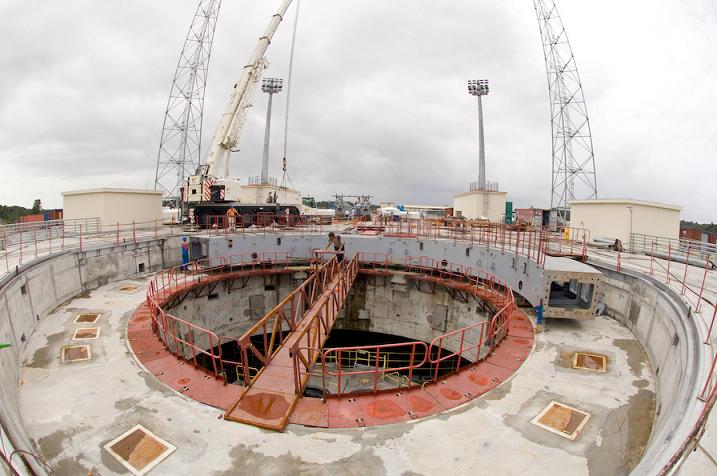
The construction of the Soyuz site in Guyana has reached a major milestone: the construction of the launch system has begun. The launch system supports and services the launch vehicle when it is erected for liftoff.
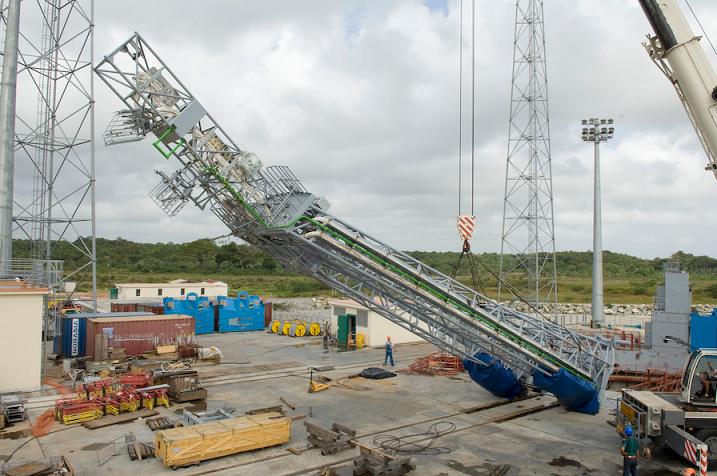
The concrete launch pad supports a multi-segment steel ring inset (known as the support crown). Two umbilical masts have also been positioned on top of the support crown. The masts, together with four support booms, will keep the launch vehicle in position on the launch pad. The two towers visible at the launch site will protect the Soyuz vehicle from lightning strikes.
Credits: Arianespace
One interesting detail about the launch site is that the support crown is fixed on the launch pad, in contrast to the launch pads built for Soyuz in Russia and Kazakhstan, as the updated Soyuz operated from Kourou is able to manage the launch azimuth during ascent.



 Subscribe to blog posts using RSS












