
OrbitalHub

The place where space exploration, science, and engineering meet

Domain is for sale. $50,000,000.00 USD. Direct any inquiries to contact@orbitalhub.com.


Wikipedia dixit:

“Rosetta was a space probe built by the European Space Agency launched on 2 March 2004. Along with Philae, its lander module, Rosetta performed a detailed study of comet 67P/Churyumov–Gerasimenko (67P). During its journey to the comet, the spacecraft flew by Mars and the asteroids 21 Lutetia and 2867 Å teins. It was launched as the third cornerstone mission of the ESA’s Horizon 2000 programme, after SOHO / Cluster and XMM-Newton.

On 6 August 2014, the spacecraft reached the comet and performed a series of manoeuvres to eventually orbit the comet at distances of 30 to 10 kilometres (19 to 6 mi). On 12 November, its lander module Philae performed the first successful landing on a comet, though its battery power ran out two days later. Communications with Philae were briefly restored in June and July 2015, but due to diminishing solar power, Rosetta’s communications module with the lander was turned off on 27 July 2016. On 30 September 2016, the Rosetta spacecraft ended its mission by hard-landing on the comet in its Ma’at region.

The probe is named after the Rosetta Stone, a stele of Egyptian origin featuring a decree in three scripts. The lander is named after the Philae obelisk, which bears a bilingual Greek and Egyptian hieroglyphic inscription.”

Video credit: ESA
 

  • Facebook
  • Google
  • Slashdot
  • Reddit
  • Live
  • TwitThis
11-10-14

Rosetta Story

Posted by


ESA dixit:

“This short movie tells the story of Rosetta’s journey through the Solar System and its exploration of Comet 67P/Churyumov–Gerasimenko so far, through the voices of some of the many people involved in this exciting mission.

ESA’s Rosetta spacecraft was launched in March 2004 and has chased down the comet for 10 years, reaching it on 6 August 2014. It is the first space mission to orbit a comet and to attempt a soft landing. It will also be the first mission to journey with a comet as they swing around the Sun throughout 2015.

In the last 10 years Rosetta has made three flybys of Earth and one of Mars, and passed by and imaged asteroids Steins and Lutetia. In June 2011, Rosetta was placed into deep-space hibernation as it cruised nearly 800 million kilometres from the warmth of the Sun, close to the orbit of Jupiter. This was necessary because not enough energy could be generated by the solar panels to keep all the spacecraft systems operating. On 20 January 2014, Rosetta woke up from hibernation and continued its journey towards the comet.

Rosetta first viewed its target from a distance in 2011. After the wake-up, the first sight of the comet came in March 2014. Since then, Rosetta scientists have been following the comet’s activity, studying it with various instruments on board. As Rosetta drew closer and closer in July, the complex shape of this double-lobed object was revealed.

After Rosetta arrived at the comet in August, it started mapping the surface in greater detail, leading to the selection of a target for the lander, Philae, in September 2014. The site, now named Agilkia after an island on the Nile river, is located on the smaller lobe of the comet.

Rosetta is scheduled to release Philae on 12 November and, seven hours later, the lander is expected to reach the comet’s surface.

Acknowledgements: The images of the comet were taken with the OSIRIS camera (ESA/Rosetta/MPS for OSIRIS Team MPS/UPD/LAM/IAA/SSO/INTA/UPM/DASP/IDA) and with the navigation camera (ESA/Rosetta/NavCam) on Rosetta; the self-portraits were taken with the CIVA instrument on Philae (ESA/Rosetta/Philae/CIVA); the ground-based images of the comet were taken using the European Southern Observatory’s Very Large Telescope in Chile. The images of asteroids Steins and Lutetia were also taken with the OSIRIS camera.”

Credit: ESA


  • Facebook
  • Google
  • Slashdot
  • Reddit
  • Live
  • TwitThis


ESA dixit:

“This short animation explains the relative sizes of the Rosetta spacecraft and comet 67P/Churyumov–Gerasimenko. Rosetta is 32 m from tip to tip of the solar wings. Assuming the comet measures about 4 km across, that’s 125 times the width of Rosetta. Unlike typical artist’s impressions, this image is scaled to convey the vast difference in size between Rosetta and the comet, even when the spacecraft is in a close 10 km orbit, as depicted here. Rosetta arrives at the comet at an altitude of 100 km in the first week of August, and will move progressively closer over the following two months, with the intention to orbit at an altitude of just 10 km, depending on the comet’s activity. For Philae’s deployment in November, Rosetta will come to within a few kilometres of the surface. The comet depicted in this animation is an artist’s impression.”

Credit: ESA


  • Facebook
  • Google
  • Slashdot
  • Reddit
  • Live
  • TwitThis


Credits: ESA OSIRIS Team MPS/UPD/LAM/IAA/RSSD/INTA/UPM/DASP/IDA


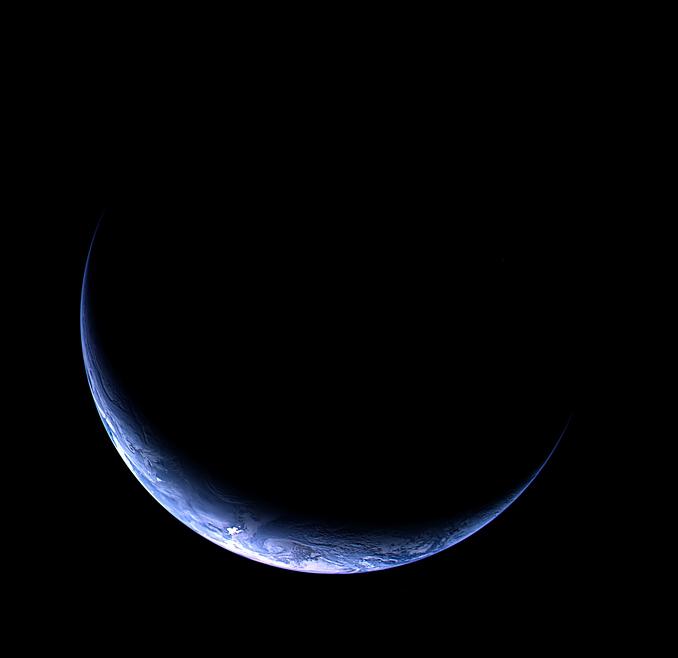
On November 13, 2009, at 8:45 AM CET, ESA’s comet chaser Rosetta swung by Earth. Rosetta passed just South of the Indonesian island of Java at an altitude of 2481 km. Its speed relative to Earth was 13.34 km/s. The maneuver provided a boost of 3.6 km/s.


Rosetta’s OSIRIS (Optical Spectroscopic and Infrared Remote Imaging System) narrow-angle camera was used to image the Earth once every hour for 24 hours.


Rosetta will meet asteroid 21 Lutetia in 2010. The final destination of Rosetta is the comet 67P/Churyumov-Gerasimenko, which the spacecraft will reach in 2014. Rosetta will deploy a lander to the surface of the comet, and will also orbit the nucleus of the comet and fly alongside as it heads towards the inner Solar System. Most of the time, the probe will hibernate with the majority of its systems shut down in order to optimize the power consumption.


You can find more information about Rosetta’s swing by on ESA’s Rosetta Blog website.


  • Facebook
  • Google
  • Slashdot
  • Reddit
  • Live
  • TwitThis





