OrbitalHub

The place where space exploration, science, and engineering meet

Domain is for sale. $50,000,000.00 USD. Direct any inquiries to contact@orbitalhub.com.

10-2-16

Rosetta’s Final Path

Posted by


Wikipedia dixit:

“Rosetta was a space probe built by the European Space Agency launched on 2 March 2004. Along with Philae, its lander module, Rosetta performed a detailed study of comet 67P/Churyumov–Gerasimenko (67P). During its journey to the comet, the spacecraft flew by Mars and the asteroids 21 Lutetia and 2867 Å teins.

On 6 August 2014, the spacecraft reached the comet and performed a series of manoeuvres to be captured in its orbit. On 12 November, the lander module performed the first successful landing on a comet, though its battery power ran out two days later. Communications with Philae were briefly restored in June and July 2015, but due to diminishing solar power, Rosetta’s communications module with the lander was turned off on 27 July 2016. On 30 September 2016, the Rosetta spacecraft ended its mission by landing on the comet in its Ma’at region.

The probe is named after the Rosetta Stone, a stele of Egyptian origin featuring a decree in three scripts. The lander is named after the Philae obelisk, which bears a bilingual Greek and Egyptian hieroglyphic inscription. A comparison of its hieroglyphs with those on the Rosetta Stone catalysed the deciphering of the Egyptian writing system. Similarly, it is hoped that these spacecraft will result in better understanding of comets and the early Solar System. In a more direct analogy to its namesake, the Rosetta spacecraft also carries a micro-etched nickel alloy Rosetta disc donated by the Long Now Foundation inscribed with 13,000 pages of text in 1,200 languages.”

Video credit: ESA


  • Facebook
  • Google
  • Slashdot
  • Reddit
  • Live
  • TwitThis
07-9-10

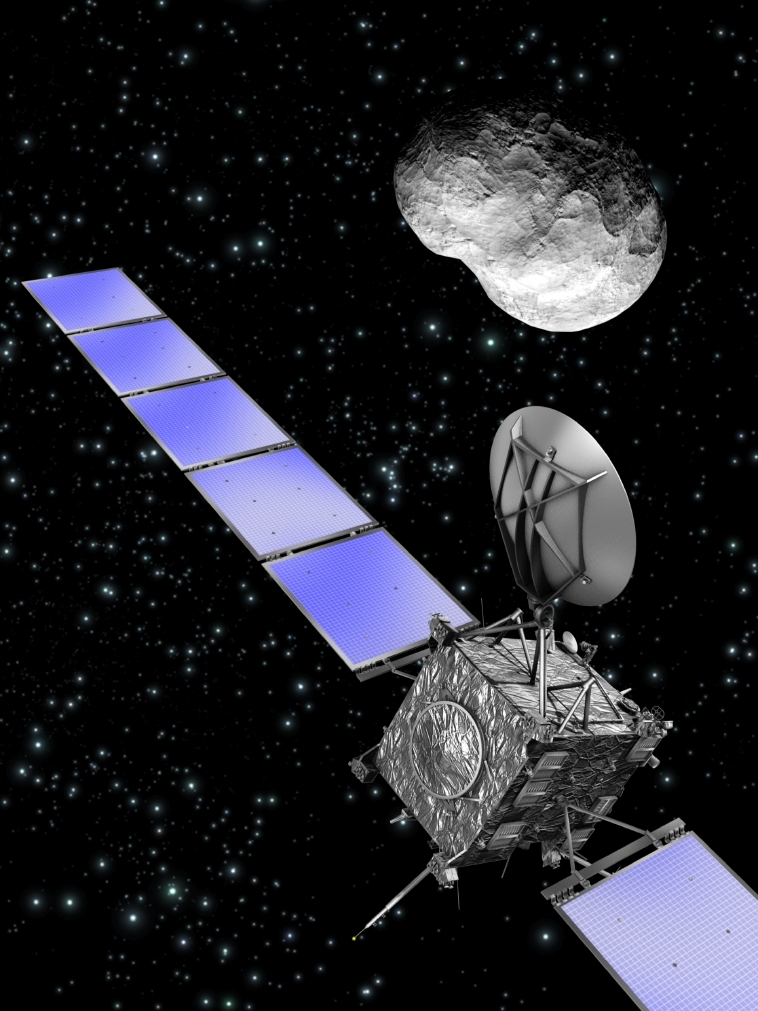
Rosetta and 21 Lutetia

Posted by


Credits: ESA


On July 10, 2010, the European comet chaser Rosetta will perform the second asteroid flyby of its mission. The first flyby was performed on September 6, 2008, when Rosetta had a close encounter with the asteroid 2867 Steins. Rosetta will skim by the asteroid 21 Lutetia at approximately 3,000 km. The speed of the spacecraft relative to the asteroid will be around 54,000 km/h.


The asteroid Lutetia was discovered on November 15, 1852, by the German astronomer Hermann Goldschmidt. Besides the characteristics of its trajectory, few things are known about the asteroid. From the preliminary observations made by Rosetta, scientists were able to estimate the diameter of the asteroid to 134 km, but the actual shape and composition still remain to be determined.


During the flyby, the spacecraft will operate in a special Asteroid Flyby Mode. This will allow the spacecraft to control its attitude and keep the asteroid in the field of view of the imaging instruments carried onboard.


Rosetta has to follow a complicated trajectory that includes three Earth gravity assists and one at Mars, in order to accelerate to the speed needed for reaching its final destination. The last gravity assist maneuver occurred on November 13, 2009, when Rosetta swung by Earth.


After 6 years into the mission, the systems on the spacecraft are doing very well, and the best is yet to come: the rendezvous with the comet 67/P Churyumov-Gerasimenko in 2014. Rosetta will deploy a small lander on the surface of the comet, and it will continue to fly alongside the nucleus of the comet for more than one year.


OrbitalHub will re-cast the live webstream from ESOC, ESA’s European Space Operations Center, in Darmstadt, Germany. The program starts July 10, 2010, at 20:00 GMT. The closest approach will occur at 20:10:07 GMT. Come back and watch the events unfold!


  • Facebook
  • Google
  • Slashdot
  • Reddit
  • Live
  • TwitThis