OrbitalHub

The place where space exploration, science, and engineering meet

Domain is for sale. $50,000,000.00 USD. Direct any inquiries to contact@orbitalhub.com.

07-30-17

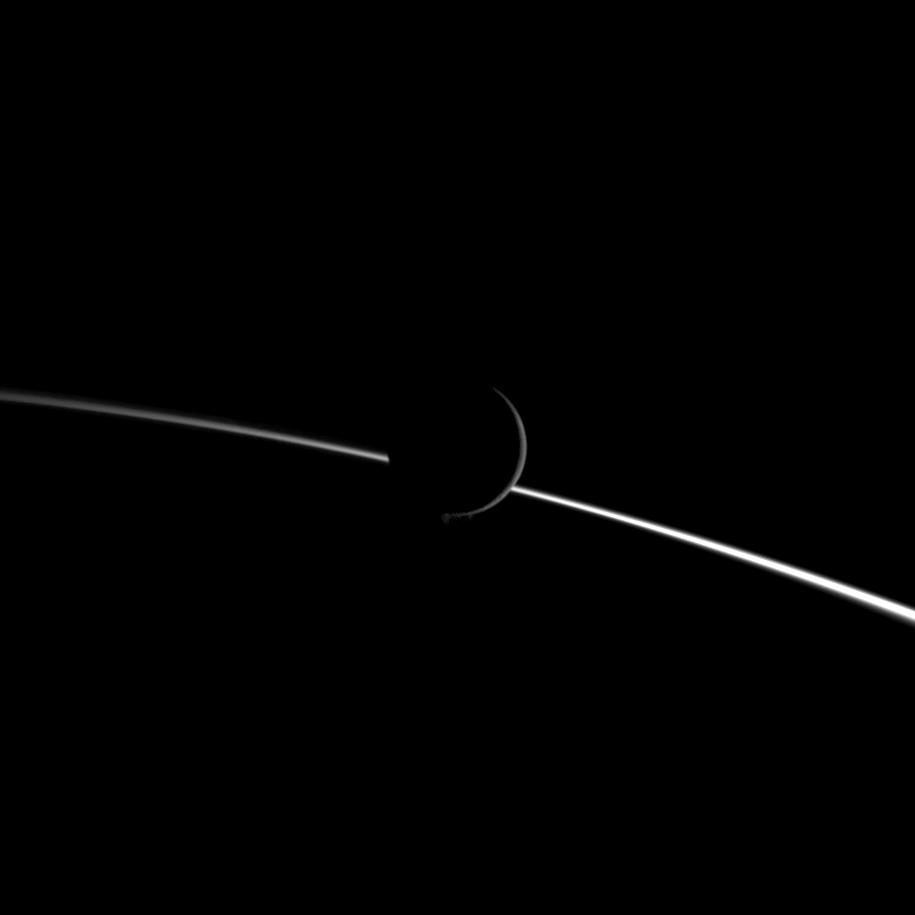
Before Saturn’s Limb

Posted by


NASA dixit:

“August 13, 2010. Jets of water ice particles spew from Saturn’s moon Enceladus in this image obtained by NASA’s Cassini spacecraft. A crescent of the moon appears dimly illuminated in front of the bright limb of Saturn. This view looks toward the night side of Saturn, which occupies the lower half of the image. Enceladus, in the center of the image, is closer to the spacecraft than the planet is in this view. Sunlight scatters through the planet’s atmosphere and forms the bright diagonal line running from the left to right of the image. Lit terrain seen on Enceladus (504 kilometers, 313 miles across) is on the leading hemisphere of the moon. North on Enceladus is up. The jets erupting from the south polar region appear faint here, but can be seen at the bottom of the crescent of the moon.

The image was taken in visible light with the Cassini spacecraft wide-angle camera. The view was acquired at a distance of approximately 61,000 kilometers (38,000 miles) from Enceladus and at a sun-Enceladus-spacecraft, or phase, angle of 155 degrees. Image scale is 4 kilometers (2 miles) per pixel.”

“After almost 20 years in space, NASA’s Cassini spacecraft begins the final chapter of its remarkable story of exploration: its Grand Finale. Between April and September 2017, Cassini will undertake a daring set of orbits that is, in many ways, like a whole new mission. Following a final close flyby of Saturn’s moon Titan, Cassini will leap over the planet’s icy rings and begin a series of 22 weekly dives between the planet and the rings.

No other mission has ever explored this unique region. What we learn from these final orbits will help to improve our understanding of how giant planets – and planetary systems everywhere – form and evolve.

On the final orbit, Cassini will plunge into Saturn’s atmosphere, sending back new and unique science to the very end. After losing contact with Earth, the spacecraft will burn up like a meteor, becoming part of the planet itself.

Cassini’s Grand Finale is about so much more than the spacecraft’s final dive into Saturn. That dramatic event is the capstone of six months of daring exploration and scientific discovery. And those six months are the thrilling final chapter in a historic 20-year journey.”

Image credit: NASA


  • Facebook
  • Google
  • Slashdot
  • Reddit
  • Live
  • TwitThis
06-18-17

Bursting at the Seams

Posted by


NASA dixit:

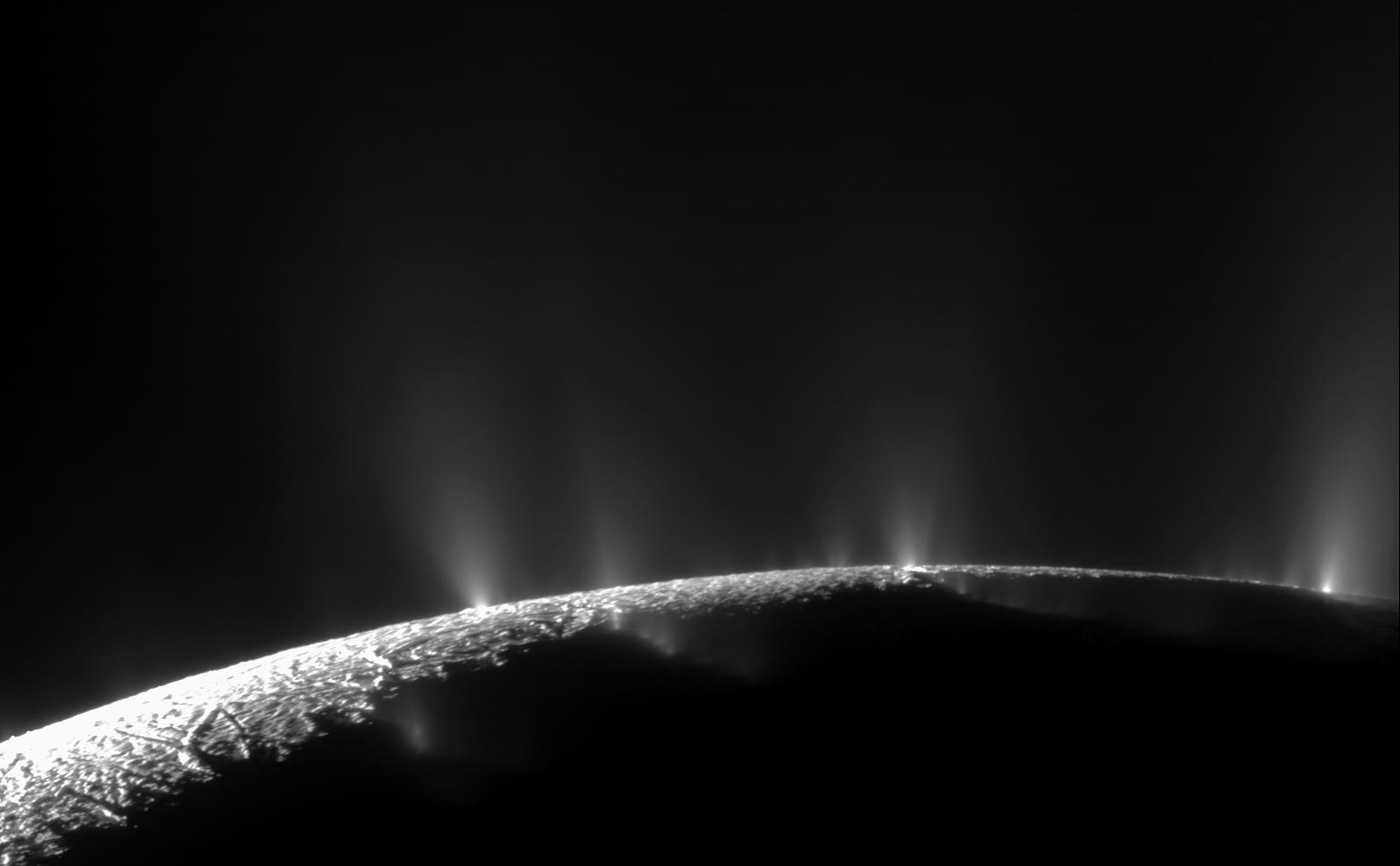
“November 21, 2009. Dramatic plumes, both large and small, spray water ice and vapor from many locations along the famed “tiger stripes” near the south pole of Saturn’s moon Enceladus. The tiger stripes are four prominent, approximately 84-mile- (135-kilometer-) long fractures that cross the moon’s south polar terrain. This two-image mosaic is one of the highest resolution views acquired by Cassini during its imaging survey of the geyser basin capping the southern hemisphere of Saturn’s moon Enceladus. It clearly shows the curvilinear arrangement of geysers, erupting from the fractures. From left to right, the fractures are Alexandria, Cairo, Baghdad, and Damascus.

As a result of this survey, 101 geysers were discovered: 100 have been located on one of the tiger stripes, and the three-dimensional configurations of 98 of these geysers have also been determined. The source location of the remaining geyser could not be definitively established. These results, together with those of other Cassini instruments, now strongly suggest that the geysers have their origins in the sea known to exist beneath the ice underlying the south polar terrain.”

“After almost 20 years in space, NASA’s Cassini spacecraft begins the final chapter of its remarkable story of exploration: its Grand Finale. Between April and September 2017, Cassini will undertake a daring set of orbits that is, in many ways, like a whole new mission. Following a final close flyby of Saturn’s moon Titan, Cassini will leap over the planet’s icy rings and begin a series of 22 weekly dives between the planet and the rings.

No other mission has ever explored this unique region. What we learn from these final orbits will help to improve our understanding of how giant planets – and planetary systems everywhere – form and evolve.

On the final orbit, Cassini will plunge into Saturn’s atmosphere, sending back new and unique science to the very end. After losing contact with Earth, the spacecraft will burn up like a meteor, becoming part of the planet itself.

Cassini’s Grand Finale is about so much more than the spacecraft’s final dive into Saturn. That dramatic event is the capstone of six months of daring exploration and scientific discovery. And those six months are the thrilling final chapter in a historic 20-year journey.”

Image credit: NASA


  • Facebook
  • Google
  • Slashdot
  • Reddit
  • Live
  • TwitThis