OrbitalHub

The place where space exploration, science, and engineering meet

Domain is for sale. $50,000,000.00 USD. Direct any inquiries to contact@orbitalhub.com.


Credits: NASA/ESA


The Hubble Space Telescope (HST) is a joint creation of NASA, ESA, hundreds of industrial companies, government and university groups, and thousands of engineers and scientists. Since April 1990, when it was released into orbit from Discovery’s payload bay, Hubble has returned scientific data and stunning images of stars, nebulae, and distant galaxies.


The construction of the space telescope began in the 1980s, when the optics company Perkin-Elmer initiated the work on Hubble’s primary light-collecting mirror. The Hubble Space Telescope was completed in 1985, but was not deployed in Earth’s orbit for another five years.


In 1983, the Space Telescope Science Institute (STScI) was founded and it assumed from NASA the science management of the Hubble Space Telescope. STScI is located at Johns Hopkins University.


In its initial configuration, Hubble carried the Wide Field and Planetary Camera (WF/PC), the Goddard High Resolution Spectrograph (GHRS), the Faint Object Camera (FOC), and the Faint Object Spectrograph (FOS). It was soon to be discovered that the primary mirror had a flaw, and that the space telescope suffered from blurry vision.


The Hubble Servicing Mission 1 installed a corrective optics package, COSTAR, and replaced the original WF/PC with the Wide Field and Planetary Camera 2. Hubble Servicing Mission 2 replaced the GHRS and FOS with the Space Telescope Imaging Spectrograph (STIS) and the Near Infrared Camera and Multi-Object Spectrometer (NICMOS). Servicing Mission 3A replaced all six gyroscopes, a Fine Guidance Sensor, and the onboard computer. Servicing Mission 3B saw the installation of the Advanced Camera for Surveys (ACS), which replaced the FOC, and the revival of NICMOS through the installation of a new cooling system.


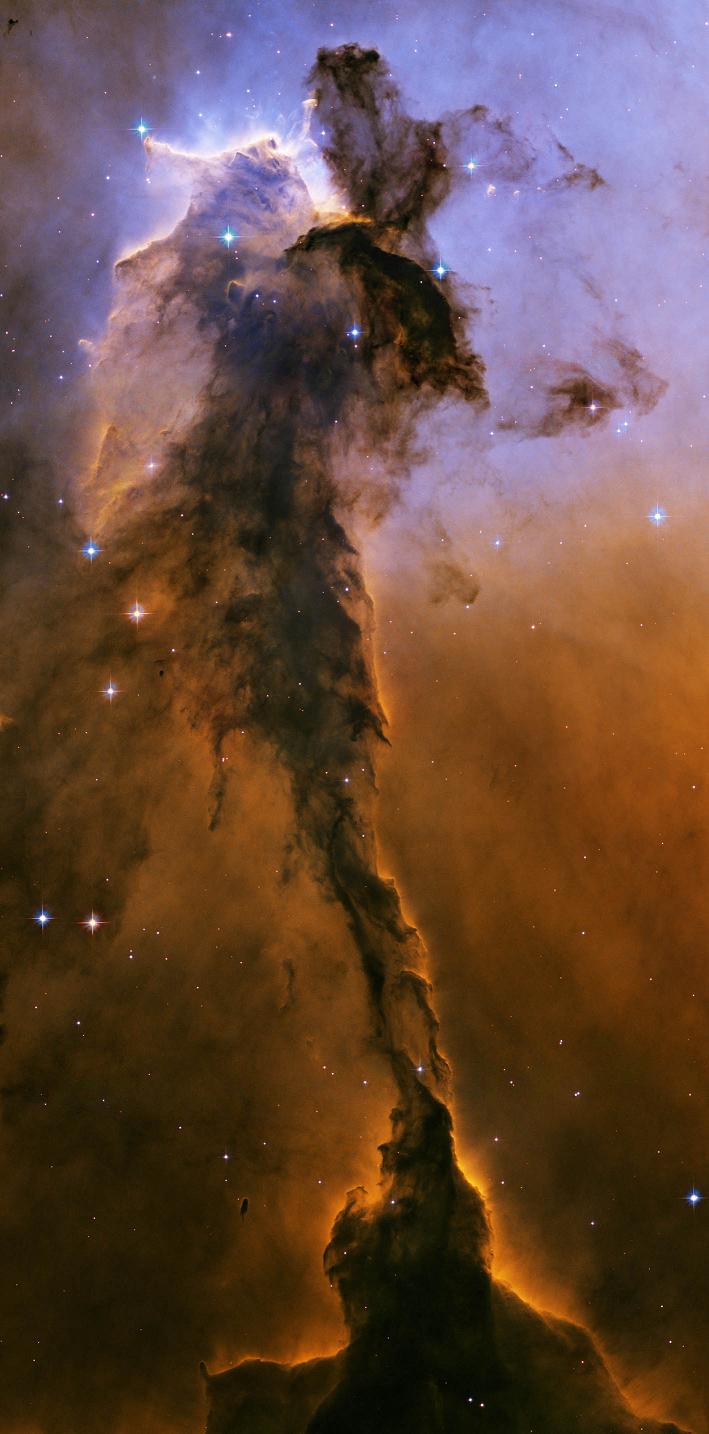
All this, and the history of astronomic discoveries beginning with Galileo Galilei in 1609 and continued by William Herschel, William Huggins, George Ellery Hale, and Edwin Hubble, are presented in Hubble – Imaging Space And Time, a book authored by David DeVorkin and Robert W. Smith. The book is replete with spectacular images captured by the Hubble Space Telescope. Images of Carina Nebula, Eagle Nebula, Orion Nebula, and Swan Nebula, just to name a few, are a celebration of color and convey the majestic beauty of the Cosmos.


David DeVorkin is curator of the history of astronomy and the space sciences at the National Air and Space Museum, Smithsonian Institution. Among other books he has authored are Beyond Earth: Mapping the Universe and The Hubble Space Telescope: Imaging the Universe.


Robert W. Smith is a professor of history and Director of the Science, Technology and Society Program at the University of Alberta. He is also the author of The Space Telescope: A Study of NASA, Science, Technology and Politics, The Hubble Space Telescope: Imaging the Universe, and The Expanding Universe.


  • Facebook
  • Google
  • Slashdot
  • Reddit
  • Live
  • TwitThis
05-27-09

STS-125 Recap

Posted by


Credits: NASA


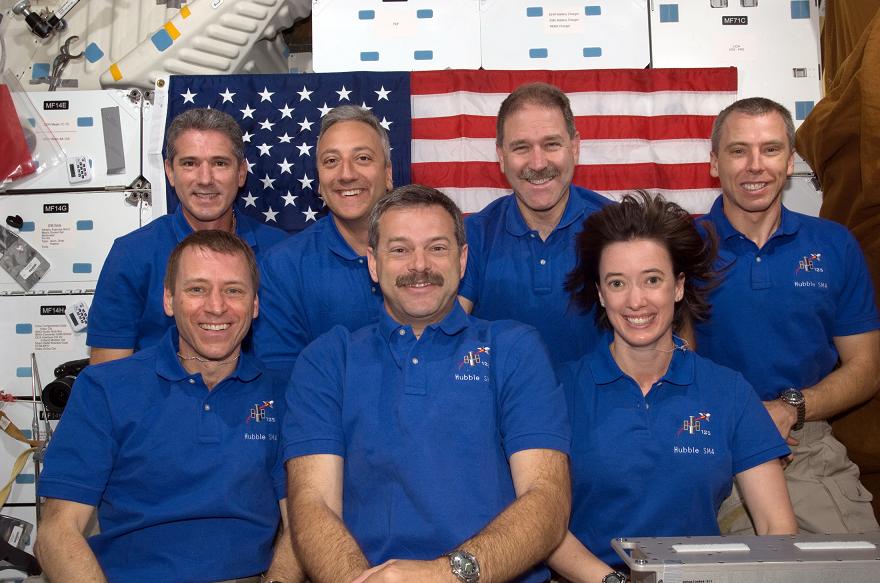
STS-125 Space Shuttle Atlantis was the final Hubble Space Telescope servicing mission (SM4). The STS-125 crew consisted of Gregory C. Johnson, pilot; Scott D. Altman, commander; Michael J. Massimino, Michael T. Good, K. Megan McArthur, John M. Grunsfeld, and Andrew J. Feustel, all mission specialists.


STS-125 has some history behind it. In 2004, NASA head Sean O’Keefe cancelled the long-planned Hubble Space Telescope Servicing Mission 4, invoking new safety rules that were applied to space shuttle flights after the Columbia disaster. By June 2004, NASA was considering a robotic servicing mission, which was also cancelled due to prohibitive costs. A change in NASA policy came with the new head of NASA, Michael Griffin. The risks associated with the SM4 mission were reassessed, and by 2008 SM4 was back on track.


On May 11, 2009, STS-125 Space Shuttle Atlantis launched at 2:01 PM EDT. There were no obvious debris events during launch and after going through the post-launch checklist, the crew prepared the orbiter for in-orbit operations and conducted a survey of the payload bay and the crew cabin using the robotic arm.


On May 13, 2009, at 17:14 UTC, flight day #3, Hubble Space Telescope was grappled and by 18:12 UTC, the telescope was berthed in the payload bay of Atlantis.


There were a total of five EVAs performed by the STS-125 crew. During EVA#1 (John Grunsfeld/ Andrew Feustel), the Wide Field and Planetary Camera 2 (WFPC2) was replaced with the new Wide Field Camera 3 (WFC3), and the Science Instrument Command and Data Handling Unit were replaced. A Soft Capture Mechanism (SCM) was also installed on Hubble. SCM will be used to capture and de-orbit Hubble at the end of its operational life. EVA#2 (Michael Massimino/ Michael Good) replaced all three gyroscope rate sensing units (RSUs) and one of the battery unit modules. EVA#3 (John Grunsfeld/ Andrew Feustel) removed and replaced COSTAR with the Cosmic Origins Spectrograph, and replaced faulty electronics cards from the Advanced Camera for Surveys. EVA#4 (Michael Massimino/ Michael Good) removed and replaced electronics cards for the Space Telescope Imaging Spectrograph (STIS). EVA#5 (John Grunsfeld/ Andrew Feustel) replaced the second battery unit module, installed the Fine Guidance Sensor #3, replaced degraded insulation panels with New Outer Blanket Layer (NOBL)s, and also replaced a protective cover around Hubble’s low-gain antenna.


Hubble was released on May 19, 2009 (flight day #9). The telescope was lifted out of the orbiter’s payload bay using the robotic arm. After running through the release checklist, the STS-125 crew released Hubble at 12:57 UTC. The new equipment and the upgrades installed on Hubble will be tested for several months before resuming operation in early September.


Due to weather, which was less than favorable for landing, STS-125 had to delay the return to Earth for two days. The de-orbit burn was initiated on May 24, 2009, at 14:24 UTC.

STS-125 Space Shuttle Atlantis landed at Edwards Air Force Base in California, on Sunday May 24, 2009, at 11:39 AM EDT.


  • Facebook
  • Google
  • Slashdot
  • Reddit
  • Live
  • TwitThis