OrbitalHub

The place where space exploration, science, and engineering meet

Domain is for sale. $50,000,000.00 USD. Direct any inquiries to contact@orbitalhub.com.

04-14-14

SpaceX-3 Launch Postponed

Posted by


NASA dixit:

“The SpaceX-3 launch to the International Space Station was scrubbed April 14, 2014 due to a helium leak on the Falcon 9 first stage. The next launch opportunity would be Friday, April 18 at 3:25pm EDT if the issue can be resolved.”

Credit: NASA/SpaceX


  • Facebook
  • Google
  • Slashdot
  • Reddit
  • Live
  • TwitThis


Credits: NASA


The adventure started on October 4, 1957, when the former Soviet Union successfully launched the first artificial satellite, Sputnik-1, using a rocket that was a modified Intercontinental Ballistic Missile (ICMB). Even if the political implications at that time were very important, as the launch ignited the Space Race within the Cold War, we can argue that the scientific accomplishments were more significant.


These accomplishments relied upon the theoretical work of scientists like Hermann Oberth and Konstantin Tsiolkovsky.


What followed this event, as mentioned above, was a race.


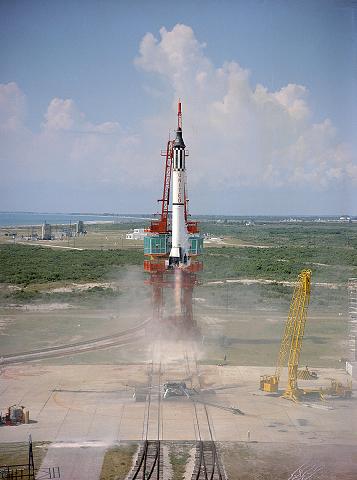
Explorer-1, the first American artificial satellite, was launched on January 31, 1958. Yuri Gagarin was the first human in outer space and the first to orbit the Earth on April 21, 1961. He was followed closely by Alan Shepard, who became the first American to travel into space onboard the Freedom-7 capsule, on May 5, 1961.


On August 19, 1964, the first geostationary communication satellite, Syncomm-3, was placed in orbit over the International Date Line. Syncomm-3 was used to relay the television coverage of the 1964 Summer Olympics in Tokyo, Japan, to the United States. The first to propose the concept of a communication satellite was Arthur C. Clarke, who in October 1945 published an article in the British magazine Wireless World that described the fundamental concepts behind the development of artificial satellites used to relay radio signals.


The first space station, Salyut-1, was launched on April 19, 1971. Even if the space station had a short operational life, as it re-entered the Earth atmosphere on October 11, 1971, it tested elements of the systems required on a space station and conducted scientific research and experiments. The construction of the first international research facility in Earth orbit, the International Space Station (ISS), began in 1998. The station is still under construction and it will be operational until at least 2015.


Where are we now, after 53 years of exploration of the space in the proximity of Earth? Since the launch of Sputnik on October 4, 1957, some 4,600 launches have orbited more than 6,000 satellites. All of these activities have created a cloud of orbiting particles around Earth. This new environment is referred to as space debris or orbital debris. Even if most of these particles are small in size (less than 1 cm), they are a source of great concern as the kinetic energies associated with impacts at orbital velocities, which are in the range 8-10 km/s or 28,800-36,000 km/h, are very high. It has been estimated that the total mass in orbit is 5,800 tons.



  • Facebook
  • Google
  • Slashdot
  • Reddit
  • Live
  • TwitThis
12-16-10

Orbital’s Space Plane

Posted by


Credits: Orbital Sciences Corporation


Orbital Sciences Corporation is proposing a blended lifting body vehicle that will launch atop an expendable launch vehicle in response to NASA’s Commercial Crew Development-2 contract solicitation. The proposed configuration will provide safe and affordable transportation services to and from the International Space Station. The vehicle will carry a crew of four astronauts, and will reenter the Earth’s atmosphere and land on a conventional runway similar to a Space Shuttle.


The launch vehicle proposed for the launch stack is the United Launch Alliance Atlas V rocket. Orbital’s press release mentions that the whole configuration is flexible enough to accommodate other launch vehicles as well.


Orbital is leading a team of world-class space system manufacturers. The pressurized crew compartment will be provided by Thales Alenia Space, the human-rated avionics will be the responsibility of Honeywell and Draper Laboratory, and the United Launch Alliance will supply the launch vehicle. Northrop Grumman will be the airframe structures designer.


  • Facebook
  • Google
  • Slashdot
  • Reddit
  • Live
  • TwitThis


Credits: NASA/CSA


Canadian astronaut Chris Hadfield will take command of the station during the second half of his third space mission. Hadfield will launch aboard a Soyuz rocket in December 2012, and spend six months on the station as part of the crew of Expedition 34/35. He will return to Earth in a Soyuz capsule in June 2013.


Hadfield is the only Canadian to board the Russian Mir space station, in 1995, during his first space flight, while he served as Mission Specialist 1 on STS-74. He is also the first Canadian mission specialist and the first Canadian to operate the Canadarm in orbit.


His second space flight was onboard STS-100, where he served as Mission Specialist 1. STS-100 was the International Space Station assembly flight 6A, which delivered and installed the Canadarm-2 on the station. During this mission, Hadfield performed two spacewalks.


Chris Hadfield also served as Director of Operations for NASA at the Yuri Gagarin Cosmonaut Training Centre in Star City, Russia; as Chief of Robotics for the NASA Astronaut Office at the Johnson Space Center in Houston, Texas; as Chief of International Space Station Operations; and as the Commander of NEEMO 14, a NASA undersea mission to test exploration concepts living in an underwater facility off the Florida coast.


The official announcement was made by the Canadian Space Agency. Chris Hadfield’s biography is also available here.


  • Facebook
  • Google
  • Slashdot
  • Reddit
  • Live
  • TwitThis
06-14-09

Node 3 Welcomed At KSC

Posted by


Credits: ESA


The Kennedy Space Center has officially welcomed Node 3. Node 3 is a European-built module for the International Space Station (ISS). The prime contractor chosen for the job was Thales Alenia Space, in Turin, Italy.


Node 3 was transported from Italy by an Airbus Beluga aircraft. The aircraft left Turin on May 17, and arrived in Florida on May 20.


Node 3 is now being prepared for the journey to the ISS in the Space Station Processing Facility (SSPF) at KSC.


Node 3 is a connecting module. With a length of 6.7 m and 4.4 m in diameter, Node 3 will have a total mass of 19,000 kg once berthed to the ISS. Node 3 will eventually house the life support system necessary for the permanent crew of six on the space station. On one of its berthing ports, Node 3 will accommodate the Cupola. Node 3 also provides room for eight refrigerator-size racks. Two of these racks will be used by avionics systems controlling the node.


Credits: ESA


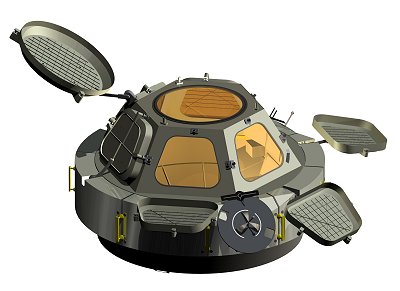
Cupola is an observation module. Once attached to Node 3, it will provide a pressurized observation and work area for two ISS crew members. Cupola will allow the crew to control the space station remote manipulator system through the robotic workstation. Cupola has a mass of 1,880 kg, a height of 1.5 m, and it has a maximum diameter of 2.9 m. The windows are protected by a Micro-meteorid and orbital Debris Protection System (MDPS), which consists of shutters made out of aluminum coated with Kevlar.


Node 3 will be launched inside the Orbiter cargo bay, mounted on a pallet via a Manual Berthing Mechanism, and transferred to the Node location using the Shuttle Remote Manipulator System.


“Node 3 represents a turning point for the International Space Station,” said Simonetta Di Pippo, ESA Director of Human Spaceflight. “By having accomplished the development of the ISS modules and by completing its assembly in the months to come we open a new avenue of cooperation and exploration that will take humankind back to the Moon and beyond to other destinations while continuing to exploit the enormous possibilities in low Earth orbit.”


Credits: ESA


NASA has chosen the name Tranquility for Node 3, after the Sea of Tranquility, landing site of Apollo 11 in 1969. Colbert had to settle for having one of the treadmills onboard ISS named after him.


Node 3 and Cupola are scheduled to be delivered to the ISS by STS-130 Space Shuttle Endeavour in early 2010.


You can find out more about Node 3 and Cupola on the page dedicated to the ISS on ESA’s web site.


  • Facebook
  • Google
  • Slashdot
  • Reddit
  • Live
  • TwitThis


Credits: SpaceX


The Draco thruster and the Draco propulsion tank completed qualification tests at the SpaceX Test Facility in McGregor, Texas.


The certification test included 42 firings with over 4,600 pulses of varying lengths. The tests are performed in a vacuum test chamber in order to simulate the space environment. The total firing time on a single thruster was over 50 minutes.


“The Draco thrusters allow Dragon to maneuver in close proximity to the ISS in preparation for berthing or docking,” said Tom Mueller VP Propulsion, SpaceX. “Maximum control during these procedures is critical for the safety of the station and its inhabitants.”


The Dragon spacecraft utilizes 18 Draco thrusters for maneuvering, attitude control, and to initiate the return to Earth. One important characteristic of the thrusters is that they are powered by storable propellants with long on-orbit lifetimes. This will allow the Dragon spacecraft to remain berthed at the International Space Station for up to a year.


The inaugural flight of Falcon 9 is scheduled for late 2009 from SpaceX’s launch site in Cape Canaveral, Florida.


  • Facebook
  • Google
  • Slashdot
  • Reddit
  • Live
  • TwitThis