
OrbitalHub

The place where space exploration, science, and engineering meet

Domain is for sale. $50,000,000.00 USD. Direct any inquiries to contact@orbitalhub.com.

08-15-17

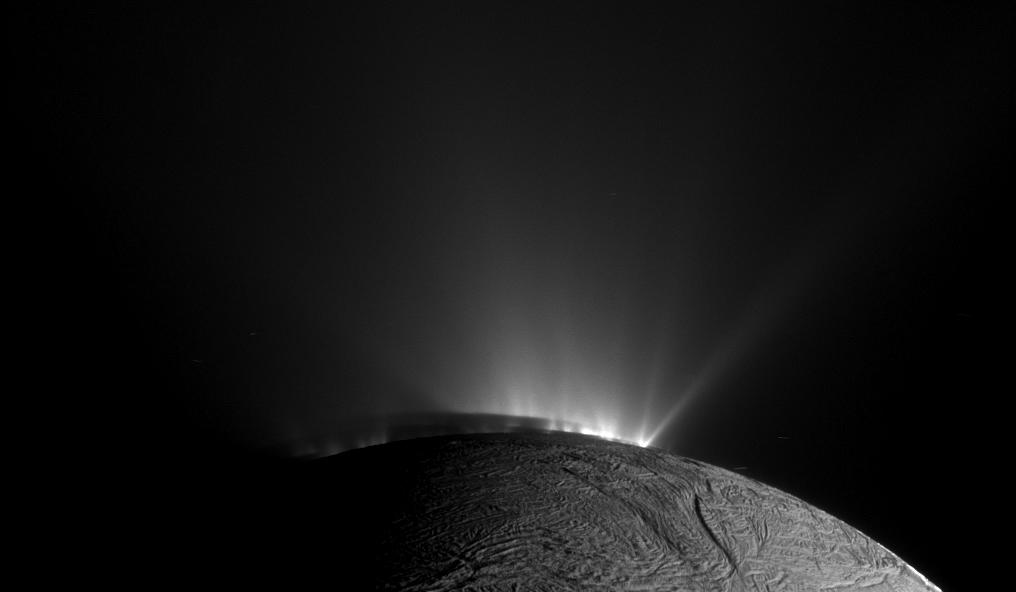
Encroaching Shadow

Posted by


NASA dixit:

“November 30, 2010. This Cassini narrow-angle camera image — one of those acquired in the survey conducted by the Cassini imaging science team of the geyser basin at the south pole of Enceladus — was taken as Cassini was looking across the moon’s south pole. At the time, the spacecraft was essentially in the moon’s equatorial plane. The image scale is 1280 feet (390 meters) per pixel and the sun-Enceladus-spacecraft, or phase, angle is 162.5 degrees. The image was taken through the clear filter of the narrow angle camera, 1.4 years after southern autumnal equinox. The shadow of the body of Enceladus on the lower portions of the jets is clearly seen.

Post-equinox images like this, clearly showing the different projected locations of the intersection between the shadow and the curtain of jets from each fracture, were useful for scientists in checking the triangulated positions of the geysers.”

“After almost 20 years in space, NASA’s Cassini spacecraft begins the final chapter of its remarkable story of exploration: its Grand Finale. Between April and September 2017, Cassini will undertake a daring set of orbits that is, in many ways, like a whole new mission. Following a final close flyby of Saturn’s moon Titan, Cassini will leap over the planet’s icy rings and begin a series of 22 weekly dives between the planet and the rings.

No other mission has ever explored this unique region. What we learn from these final orbits will help to improve our understanding of how giant planets – and planetary systems everywhere – form and evolve.

On the final orbit, Cassini will plunge into Saturn’s atmosphere, sending back new and unique science to the very end. After losing contact with Earth, the spacecraft will burn up like a meteor, becoming part of the planet itself.

Cassini’s Grand Finale is about so much more than the spacecraft’s final dive into Saturn. That dramatic event is the capstone of six months of daring exploration and scientific discovery. And those six months are the thrilling final chapter in a historic 20-year journey.”

Image credit: NASA


  • Facebook
  • Google
  • Slashdot
  • Reddit
  • Live
  • TwitThis
08-15-17

SpaceX CRS-12 Launch

Posted by


NASA dixit:

“A SpaceX Falcon 9 rocket launched from NASA’s Kennedy Space Center in Florida Aug. 14, sending an unpiloted Dragon cargo spacecraft on a delivery run to the International Space Station. Loaded with more than three tons of supplies and scientific investigations, the Dragon is scheduled to arrive at the station Aug. 16 where it will be captured by Expedition 52 crewmembers Jack Fischer of NASA and Paolo Nespoli of ESA (European Space Agency) operating the station’s Canadarm2 robotic arm. Dragon will spend about a month attached to the Earth-facing port of the Harmony module.”

Video credit: NASA


  • Facebook
  • Google
  • Slashdot
  • Reddit
  • Live
  • TwitThis
08-13-17

Sun Shreds Its Own Eruption

Posted by


Wikipedia dixit:

“A solar flare is a sudden flash of brightness observed near the Sun’s surface. It involves a very broad spectrum of emissions, an energy release of typically 1 × 10²⁰ joules of energy for a well-observed event. A major event can emit up to 1 × 1025 joules (the latter is roughly the equivalent of 1 billion megatons of TNT, or over 400 times more energy than released from the impact of Comet Shoemaker–Levy 9 with Jupiter). Flares are often, but not always, accompanied by a coronal mass ejection. The flare ejects clouds of electrons, ions, and atoms through the corona of the sun into space. These clouds typically reach Earth a day or two after the event. The term is also used to refer to similar phenomena in other stars, where the term stellar flare applies.

Solar flares affect all layers of the solar atmosphere (photosphere, chromosphere, and corona), when the plasma medium is heated to tens of millions kelvins, while the cosmic-ray-like electrons, protons, and heavier ions are accelerated to near the speed of light. They produce radiation across the electromagnetic spectrum at all wavelengths, from radio waves to gamma rays, although most of the energy is spread over frequencies outside the visual range and for this reason the majority of the flares are not visible to the naked eye and must be observed with special instruments. Flares occur in active regions around sunspots, where intense magnetic fields penetrate the photosphere to link the corona to the solar interior. Flares are powered by the sudden (timescales of minutes to tens of minutes) release of magnetic energy stored in the corona. The same energy releases may produce coronal mass ejections (CME), although the relation between CMEs and flares is still not well established.

X-rays and UV radiation emitted by solar flares can affect Earth’s ionosphere and disrupt long-range radio communications. Direct radio emission at decimetric wavelengths may disturb the operation of radars and other devices that use those frequencies.

Solar flares were first observed on the Sun by Richard Christopher Carrington and independently by Richard Hodgson in 1859 as localized visible brightenings of small areas within a sunspot group. Stellar flares can be inferred by looking at the lightcurves produced from the telescope or satellite data of variety of other stars.

The frequency of occurrence of solar flares varies, from several per day when the Sun is particularly “active” to less than one every week when the Sun is “quiet”, following the 11-year cycle (the solar cycle). Large flares are less frequent than smaller ones. On July 23, 2012, a massive, and potentially damaging, solar superstorm (solar flare, coronal mass ejection, solar EMP) barely missed Earth, according to NASA. According to NASA, there may be as much as a 12% chance of a similar event occurring between 2012 and 2022, although because this particular figure was based on an extreme extrapolation of the calculated frequency of future storms, the actual probability of this is quite uncertain.”

Video credit: NASA’s Goddard Space Flight Center/Genna Duberstein


  • Facebook
  • Google
  • Slashdot
  • Reddit
  • Live
  • TwitThis
08-11-17

RS-25 Rocket Engine Test

Posted by


NASA dixit:

“The 8.5-minute test conducted at NASA’s Stennis Space Center is part of a series of tests designed to put the upgraded former space shuttle engines through the rigorous temperature and pressure conditions they will experience during a launch. The tests also support the development of a new controller, or “brain,†for the engine, which monitors engine status and communicates between the rocket and the engine, relaying commands to the engine and transmitting data back to the rocket.”

Video credit: NASA


  • Facebook
  • Google
  • Slashdot
  • Reddit
  • Live
  • TwitThis
08-7-17

A Guide to Gale Crater

Posted by


Wikipedia dixit:

“Gale is a crater, and probable dry lake, on Mars near the northwestern part of the Aeolis quadrangle at 5.4°S 137.8°E. It is 154 km (96 mi) in diameter and estimated to be about 3.5-3.8 billion years old. The crater was named after Walter Frederick Gale, an amateur astronomer from Sydney, Australia, who observed Mars in the late 19th century. Aeolis Mons is a mountain in the center of Gale and rises 5.5 km (18,000 ft) high. Aeolis Palus is the plain between the northern wall of Gale and the northern foothills of Aeolis Mons. Peace Vallis, a nearby outflow channel, ‘flows’ down from the Gale crater hills to the Aeolis Palus below and seems to have been carved by flowing water. The NASA Mars rover, Curiosity, of the Mars Science Laboratory (MSL) mission, landed in “Yellowknife” Quad 51 of Aeolis Palus in Gale at 05:32 UTC August 6, 2012. NASA named the landing location Bradbury Landing on August 22, 2012. Curiosity is exploring Aeolis Mons and surrounding areas.

Gale crater, named for Walter F. Gale (1865-1945), an amateur astronomer from Australia, spans 154 km (96 mi) in diameter and holds a mountain, Aeolis Mons (informally named “Mount Sharp” to pay tribute to geologist Robert P. Sharp) rising 18,000 ft (5,500 m) from the crater floor, higher than Mount Rainier rises above Seattle. Gale is roughly the size of Connecticut and Rhode Island.

The crater formed when a meteor hit Mars in its early history, about 3.5 to 3.8 billion years ago. The meteor impact punched a hole in the terrain, and the subsequent explosion ejected rocks and soil that landed around the crater. Layering in the central mound (Aeolis Mons) suggests it is the surviving remnant of an extensive sequence of deposits. Some scientists believe the crater filled in with sediments and, over time, the relentless Martian winds carved Aeolis Mons, which today rises about 5.5 km (3.4 mi) above the floor of Gale—three times higher than the Grand Canyon is deep.

At 10:32 p.m. PDT on Aug. 5, 2012 (1:32 a.m. EDT on Aug. 6, 2012), the Mars Science Laboratory rover, Curiosity, landed on Mars at 4.5°S 137.4°E, at the foot of the layered mountain inside Gale crater. Curiosity landed within a landing ellipse approximately 7 km (4.3 mi) by 20 km (12 mi). The landing ellipse is about 4,400 m (14,400 ft) below Martian “sea level” (defined as the average elevation around the equator). The expected near-surface atmospheric temperatures at the landing site during Curiosity’s primary mission (1 Martian year or 687 Earth days) are from −90 °C (−130 °F) to 0 °C (32 °F).

Scientists chose Gale as the landing site for Curiosity because it has many signs that water was present over its history. The crater’s geology is notable for containing both clays and sulfate minerals, which form in water under different conditions and may also preserve signs of past life. The history of water at Gale, as recorded in its rocks, is giving Curiosity lots of clues to study as it pieces together whether Mars ever could have been a habitat for microbes. Gale Crater contains a number of fans and deltas that provide information about lake levels in the past, including: Pancake Delta, Western Delta, Farah Vallis delta and the Peace Vallis Fan.”

Video credit: NASA Jet Propulsion Laboratory


  • Facebook
  • Google
  • Slashdot
  • Reddit
  • Live
  • TwitThis


Wikipedia dixit:

“Sunspots are temporary phenomena on the Sun’s photosphere that appear as spots darker than the surrounding areas. They are regions of reduced surface temperature caused by concentrations of magnetic field flux that inhibit convection. Sunspots usually appear in pairs of opposite magnetic polarity. Their number varies according to the approximately 11-year solar cycle. Individual sunspots may last anywhere from a few days to a few months, but eventually decay. Sunspots expand and contract as they move across the surface of the Sun, with diameters ranging from 16 km (10 mi) to 160,000 km (100,000 mi). The larger variety are visible from Earth without the aid of a telescope. They may travel at relative speeds, or proper motions, of a few hundred meters per second when they first emerge.

Indicating intense magnetic activity, sunspots accompany secondary phenomena such as coronal loops, prominences, and reconnection events. Most solar flares and coronal mass ejections originate in magnetically active regions around visible sunspot groupings. Similar phenomena indirectly observed on stars other than the Sun are commonly called starspots, and both light and dark spots have been measured.

Although they are at temperatures of roughly 3,000–4,500 K (2,700–4,200 °C), the contrast with the surrounding material at about 5,780 K (5,500 °C) leaves sunspots clearly visible as dark spots. This is because the luminance (which is essentially “brightness” in visible light) of a heated black body (closely approximated by the photosphere) at these temperatures varies extremely with temperature—considerably more so than the (temperature to the fourth power) variation in the total black-body radiation at all wavelengths (see Stefan–Boltzmann law). Isolated from the surrounding photosphere a sunspot would be brighter than the Moon.

Sunspots have two parts: the central umbra, which is the darkest part, where the magnetic field is approximately vertical (normal to the Sun’s surface) and the surrounding penumbra, which is lighter, where the magnetic field is more inclined.

Although the details of sunspot generation are still a matter of research, it appears that sunspots are the visible counterparts of magnetic flux tubes in the Sun’s convective zone that get “wound up” by differential rotation. If the stress on the tubes reaches a certain limit, they curl up and puncture the Sun’s surface. Convection is inhibited at the puncture points; the energy flux from the Sun’s interior decreases; and with it surface temperature.

The Wilson effect implies that sunspots are depressions on the Sun’s surface. Observations using the Zeeman effect show that prototypical sunspots come in pairs with opposite magnetic polarity. From cycle to cycle, the polarities of leading and trailing (with respect to the solar rotation) sunspots change from north/south to south/north and back. Sunspots usually appear in groups.

Magnetic pressure should tend to remove field concentrations, causing the sunspots to disperse, but sunspot lifetimes are measured in days to weeks. In 2001, observations from the Solar and Heliospheric Observatory (SOHO) using sound waves traveling below the photosphere (local helioseismology) were used to develop a three-dimensional image of the internal structure below sunspots; these observations show that a powerful downdraft underneath each sunspot, forms a rotating vortex that sustains the concentrated magnetic field.”

Video credit: NASA Goddard


  • Facebook
  • Google
  • Slashdot
  • Reddit
  • Live
  • TwitThis





