OrbitalHub

The place where space exploration, science, and engineering meet

Domain is for sale. $50,000,000.00 USD. Direct any inquiries to contact@orbitalhub.com.


NASA dixit:

“NASA scientists and engineers named their new CubeSat after the mythological Norse god of the dawn. Now, just days from launch, they are confident the shoebox-sized satellite Dellingr will live up to its name and inaugurate a new era for scientists wanting to use small, highly reliable satellites to carry out important, and in some cases, never-before-tried science. Dellingr will study how the ionosphere, a region in Earth’s upper atmosphere, interacts with the Sun. Before launch, Dellingr is required to visit to the Magnetic Test Facility at NASA Goddard to test the spacecraft’s magnetometers – key instruments for measuring the direction and strength of the magnetic fields that surround Earth. The spacecraft is scheduled to launch this August aboard a SpaceX Falcon 9 rocket to the International Space Station where it will be deployed later into a low-Earth orbit.

Music credit: ‘Cycle of Life’ by Philippe Lhommet [SACEM] from Killer Tracks”

Video credit: NASA’s Goddard Space Flight Center/Joy Ng


  • Facebook
  • Google
  • Slashdot
  • Reddit
  • Live
  • TwitThis
10-4-17

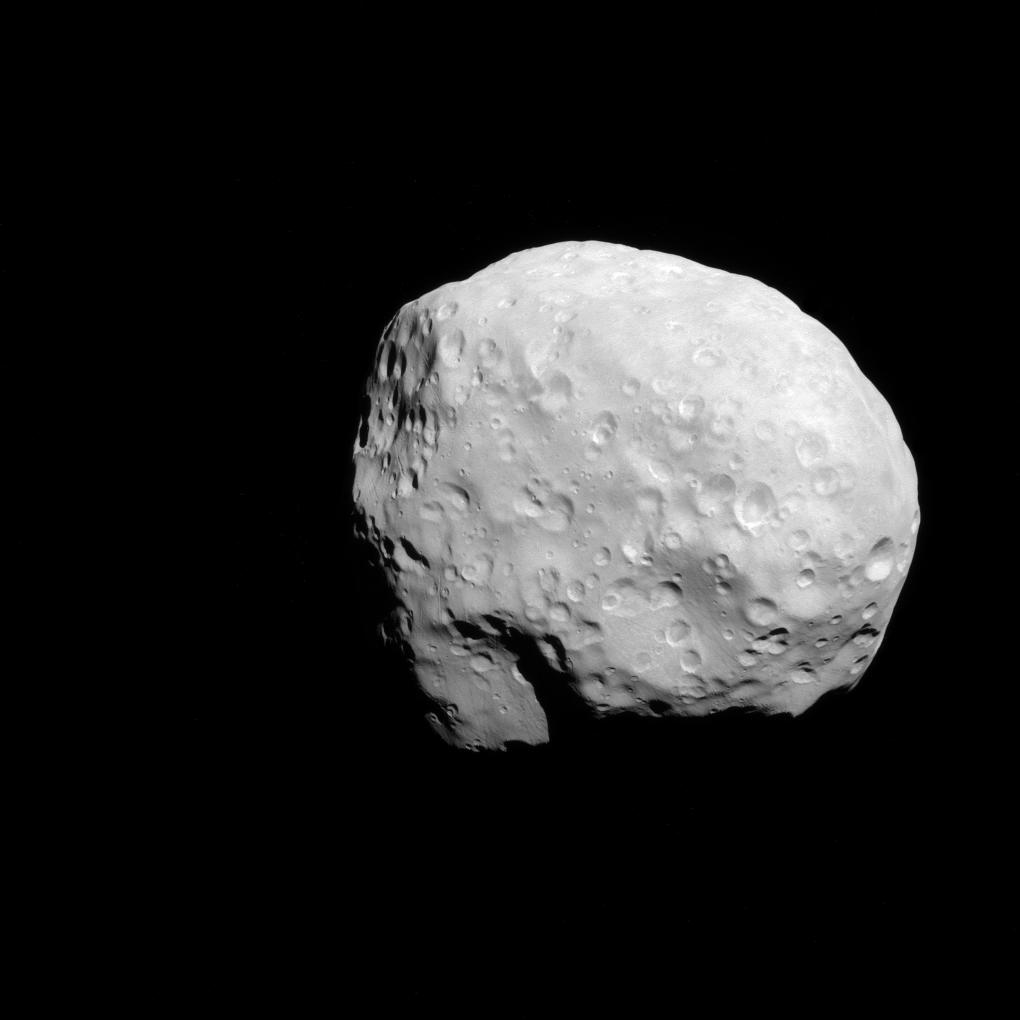
Examining Epimetheus

Posted by


NASA dixit:

“December 6, 2015. NASA’s Cassini spacecraft captured this view of Saturn’s moon Epimetheus (116 kilometers, or 72 miles across) during a moderately close flyby. This is one of Cassini’s highest resolution views of the small moon. This view looks toward the Saturn facing side of Epimetheus. North on Epimetheus is up. The image was taken in green polarized light with the Cassini spacecraft narrow-angle camera.

The view was acquired at a distance of approximately 22,000 miles (35,000 kilometers) from Epimetheus and at a Sun-Epimetheus-spacecraft, or phase, angle of 28 degrees. Image scale is 697 feet (212 meters) per pixel.”

Image credit: NASA/JPL-Caltech/Space Science Institute


  • Facebook
  • Google
  • Slashdot
  • Reddit
  • Live
  • TwitThis
10-3-17

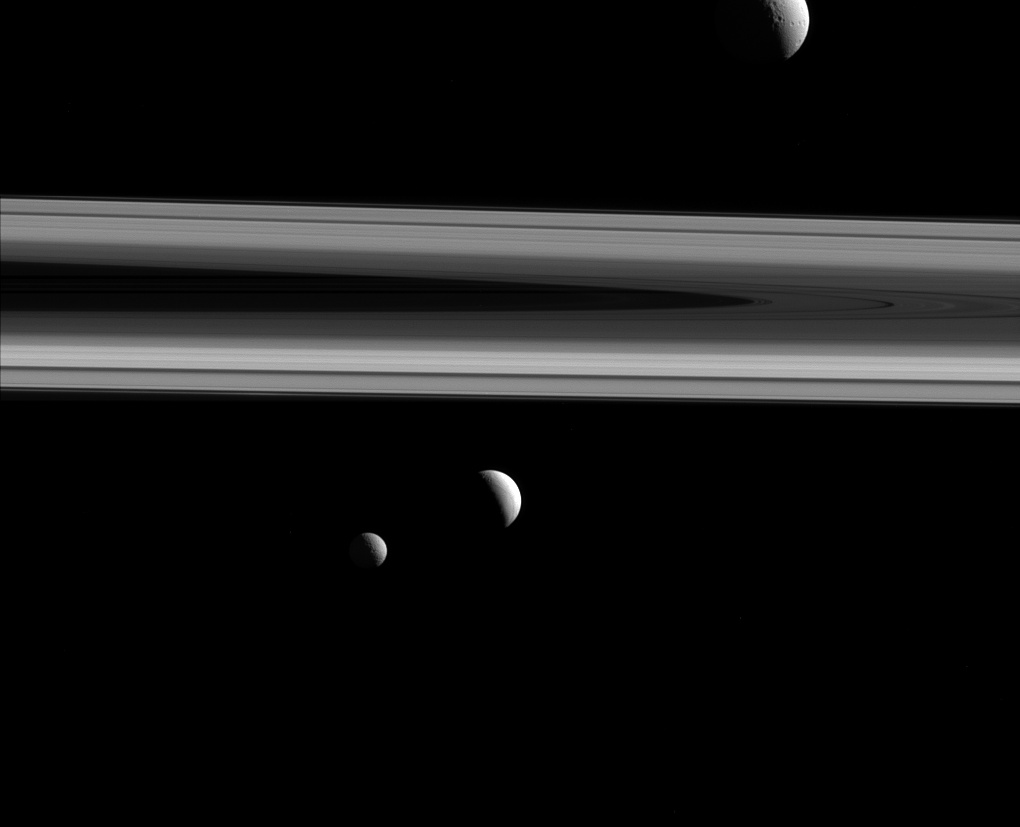
Three Times the Fun

Posted by


NASA dixit:

“December 3, 2015. Three of Saturn’s moons, Tethys, Enceladus, and Mimas, are captured in this group photo from NASA’s Cassini spacecraft. Tethys (660 miles or 1062 kilometers across) appears above the rings, while Enceladus (313 miles or 504 kilometers across) sits just below center. Mimas (246 miles or 396 kilometers across) hangs below and to the left of Enceladus.

This view looks toward the sunlit side of the rings from about 0.4 degrees above the ring plane. The image was taken in visible light with the Cassini spacecraft narrow-angle camera. The view was acquired at a distance of approximately 837,000 miles (1.35 million kilometers) from Enceladus, with an image scale of 5 miles (8 kilometers) per pixel. Tethys was approximately 1.2 million miles (1.9 million kilometers) away with an image scale of 7 miles (11 kilometers) per pixel. Mimas was approximately 1.1 million miles (1.7 million kilometers) away with an image scale of 6 miles (10 kilometers) per pixel.”

Image credit: NASA/JPL-Caltech/Space Science Institute


  • Facebook
  • Google
  • Slashdot
  • Reddit
  • Live
  • TwitThis


NASA dixit:

“On August 30, engineers at our Stennis Space Center wrapped up a summer of hot fire testing for flight controllers on RS-25 engines that will help power the new Space Launch System rocket being built to carry astronauts to deep-space destinations, including Mars. The 500-second hot fire of a flight controller or “brain†of the engine marked another step toward the nation’s return to human deep-space exploration missions. Four RS-25 engines, equipped with flight-worthy controllers will help power the first integrated flight of our Space Launch System rocket with our Orion spacecraft, known as Exploration Mission One.”

Video credit: NASA


  • Facebook
  • Google
  • Slashdot
  • Reddit
  • Live
  • TwitThis


NASA dixit:

“This animation of NOAA’s GOES East satellite imagery from Sept. 21 at 7:45 a.m. EDT (1145 UTC) to Sept. 23 ending at 7:45 a.m. EDT (1145 UTC) shows Jose becoming a post-tropical storm winding down near New England while Hurricane Maria moved over Puerto Rico and toward the Bahamas.”

Video credit: NASA


  • Facebook
  • Google
  • Slashdot
  • Reddit
  • Live
  • TwitThis
09-26-17

A Slingshot from Earth

Posted by


NASA dixit:

“OSIRIS-REx is NASA’s mission to explore near-earth asteroid Bennu, collect a sample, and return it to Earth. To get to Bennu, however, OSIRIS-REx must first leave the plane of Earth’s orbit and match the orbital tilt of its target. On September 22, 2017, OSIRIS-REx approached Earth and flew over its southern hemisphere, passing within 11,000 miles of Antarctica. This gravitational slingshot will bend its trajectory by six degrees, sending the spacecraft on a path to intercept Bennu. Shortly after the flyby, OSIRIS-REx looked back at Earth and took images and spectra, ensuring that its instruments are ready for arrival at Bennu in 2018.”

Video credit: NASA’s Goddard Space Flight Center/Dan Gallagher


  • Facebook
  • Google
  • Slashdot
  • Reddit
  • Live
  • TwitThis