Today we are joined by Yasunori Yamazaki, Chief Business Officer at Axelspace. Axelspace are pioneers of microsatellite technology advancing the frontiers of space business, reimagining traditional ways of using space, and creating a society where everyone on our planet can make space part of their life.
Orbital Hub: Axelspace’s goal is to advance the frontiers of space business. How is Axelspace making space more accessible?
Yasunori Yamazaki: Our vision is to bring the space technology down to earth for universal access, empowering everyone with actionable earth observation data to make smart decisions.
O.H.: Could you share any details about innovative technologies used by Axelspace when designing and building satellites?
Yasu: We have been developing satellites for more than 11 years now, experimenting with various methods and implementing new technology to constantly improve and innovate. This trial and error itself is a new concept in our industry as the cost of making a mistake is prohibitive from an investment perspective.
O.H.: What is the approach used by Axelspace for microsatellite design? Do you use custom designs specific to each mission or a modular design that allows reuse and minimal mission specific customization?
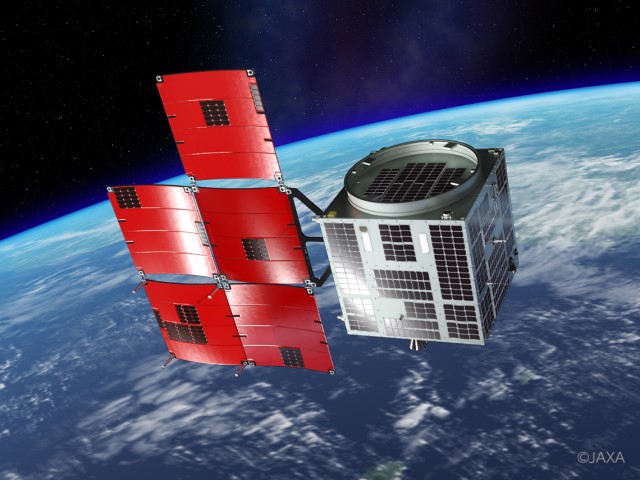
Yasu: The designing process depends on the mission. For unique purposes, we will start with a whiteboard, deep diving into the problem and figuring out the most efficient and effective way of delivering the solution. We are also in the process of constructing an orbital infrastructure, based on proprietary modulated satellite, GRUS, to bring down the cost of manufacturing, thus passing on the savings to the users of the data.
O.H.: What payload types can be integrated with Axelspace microsatellites?
Yasu: Most anything can be carried by our microsatellites, as we can build from small to large satellites. The largest we have successfully deployed into space is a 200 kg satellite, which is a fantastic platform to carry most any payloads, but in a radically cost effective way.
O.H.: What type of stabilization is used by Axelspace microsatellites?
Yasu: We don’t comment on specific internal technology.
O.H.: What type of propulsion systems are integrated with Axelspace microsatellites? Are they mission specific?
Yasu: We don’t comment on specific internal technology.
O.H.: Is Axelspace designing and manufacturing only remote sensing microsatellites?
Yasu: We have been focusing on perfecting our expertise on remote sensing microsatellites. As we are market driven company, our limitation is not technology, but true market demand. Our business team is constantly monitoring the trends in the market and ready to dive into any direction when the time is ripe.
O.H.: Any plans for deep space exploration missions? Could the current bus be repurposed for a deep space mission?
Yasu: We are open for any mission, as long as there is a concrete market and sustainable paying clients. The company never works on a technology, without concrete business visibility.
O.H.: Remote sensing satellites are usually deployed on Sun-synchronous polar orbits. This leads to crowded LEO and increased collision risks above the polar regions. What end-of-life strategies are Axelspace missions using?
Yasu: As a constellation player, we are conscious of EOL operation and complies with the international guidelines on securing the sustainable usage of our orbits.
O.H.: What is AxelGlobe?
Yasu: AxelGlobe is a web based platform to access earth observation data from our proprietary satellite, GRUS, to empower anyone with actionable data to make smart decision.
O.H.: Launching and managing a fleet of 50+ microsatellites in LEO must be a challenging endeavour. Can you elaborate on some of these challenges? How is Axelspace tackling them?
Yasu: Absolutely! There is no shortcut in implementing space technology. To be successful in this business, these are the 4 most important simple, yet critical points to cover:
1. Transformational IDEA to bring value to the market
2. Proven Engineering to bring IDEA into product
3. Solid Financial Resource to bring product into reality
4. Paying clients to have a sustainable business model
To achieve the above, we have inspiring leadership team that brings IDEA to the table, experienced engineer team that can convert anything into a product, insightful finance team to secure the funding and powerful business team to generate revenue for the TEAM.
O.H.: What does the future hold for Axelspace holding? Any exciting plans to share with our readers?
Yasu: When we started the company 11 years ago, no one believed that a startup can actually do anything meaningful in the space industry. Now, after years of hard work, we have 5 operating satellites in space. Next year, we have 4 more confirmed launches and will continue to deploy every year. As a pioneer in the commercial microsatellite world, we will keep working hard and focus on engineering for good.



 Subscribe to blog posts using RSS











