


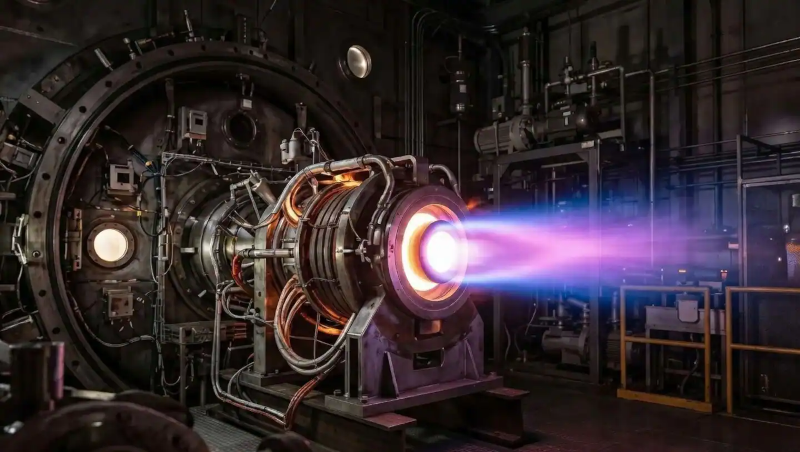
On February 24, 2026, inside a specialized vacuum chamber at NASA’s Jet Propulsion Laboratory in Pasadena, California, a team of engineers and scientists ignited a prototype thruster that had been more than two and a half years in development. The device, a lithium-fed magnetoplasmadynamic thruster, produced a plasma plume that glowed incandescent red as it pushed against the simulated void of space. Over five separate ignitions, the thruster operated at power levels reaching 120 kilowatts, exceeding by more than 25 times the power output of the highest-performance electric thrusters currently operating on any NASA spacecraft. The test marked the first time in the United States that an electric propulsion system had operated at power levels this high, representing a step change in the technology readiness of systems needed to send humans to Mars.
Electric propulsion differs fundamentally from the chemical rockets that have powered virtually every human spaceflight to date. Chemical rockets achieve high thrust by burning fuel and oxidizer in a combustion chamber, expelling the resulting gases at high velocity through a nozzle. The energy comes from the chemical reaction itself. Electric propulsion instead uses external energy sources, typically solar panels or nuclear reactors, to accelerate a propellant to velocities far exceeding those achievable chemically, albeit at much lower thrust levels. The tradeoff enables spacecraft to use propellant far more efficiently. NASA’s Psyche spacecraft, currently operating its solar-electric propulsion system on a journey to the main-belt asteroid of the same name, uses approximately 90 percent less propellant per unit of thrust than an equivalent chemical system would require.
The magnetoplasmadynamic thruster tested at JPL pushes this principle further by relying on electromagnetic acceleration rather than electrostatic forces. A high electrical current passes through the lithium plasma, interacting with the self-generated magnetic field to produce a Lorentz force that accelerates the plasma out of the thruster’s nozzle. The lithium metal, chosen because it vaporizes at manageable temperatures and has a low atomic mass suitable for high exhaust velocities, serves as the propellant. The system requires extraordinarily high power to generate meaningful thrust, which is why the 120-kilowatt demonstration represents a meaningful milestone.
James Polk, a senior research scientist at JPL who has worked on lithium-fed MPD thrusters since the 1990s, observed the first firing through a small viewport in the eight-meter-long water-cooled vacuum chamber. The tungsten electrode at the center of the thruster glowed white-hot, reaching temperatures above 5,000 degrees Fahrenheit. “We not only showed the thruster works, but we also hit the power levels we were targeting,” Polk said in a JPL statement. The test provided data on electrode erosion, thermal management, and plasma stability that will inform the next round of engineering development.
The long-term goal of NASA’s Space Nuclear Propulsion project, which funds the MPD thruster work through the Space Technology Mission Directorate, is to develop thruster systems capable of operating at 500 kilowatts to one megawatt per unit. A crewed Mars mission would require two to four megawatts of electric propulsion power, meaning multiple thrusters operating in concert. The system would need to run for more than 23,000 hours over the course of a Mars mission, exposing components to the extreme temperatures and particle bombardment that such operation entails. Proving that hardware can survive these conditions is the central challenge facing the program.
The 120-kilowatt test at JPL falls well short of megawatt-class operation, but it establishes the foundational physics and engineering that later systems will build upon. The CoMeT vacuum facility, formally the Condensable Metal Propellant vacuum facility, is a unique national asset capable of testing metal-vapor thrusters at power levels up to megawatt-class. The facility’s ability to safely contain lithium metal vapor in a vacuum environment is essential to the program, as lithium is highly reactive and requires specialized handling procedures that differ from those of conventional electric propulsion propellants like xenon.
NASA Administrator Jared Isaacman, who has overseen a significant expansion of the agency’s technology development portfolio since taking office, characterized the test as evidence that the agency is maintaining its commitment to Mars even as current missions capture public attention. “This marks the first time in the United States that an electric propulsion system has operated at power levels this high,” Isaacman said. “We will continue to make strategic investments that will propel that next giant leap.” The remarks reflect an acknowledgment that crewed Mars missions remain decades away in capability terms, even as the political rhetoric around them intensifies.
The development of high-power electric propulsion for Mars has been a stated objective of NASA’s human exploration program for years, but progress has been uneven. The Psyche mission, launched in October 2023, validated solar-electric propulsion at the power levels needed for deep space missions but used xenon as its propellant rather than lithium. Xenon is heavier than lithium and cannot be stored as densely, making it less suitable for the high-throughput, long-duration missions that Mars architectures envision. The lithium-fed approach addresses the propellant storage and performance issues but introduces new engineering challenges related to material compatibility and thermal management that the current test program is working to resolve.
The broader architecture for Mars exploration that NASA has discussed involves nuclear electric propulsion, in which a fission reactor provides the electrical power needed to run multiple high-power thrusters simultaneously. This approach differs from chemical propulsion systems in that the reactor provides continuous power generation over months or years of operation, while the thrusters convert that power into incremental velocity changes that add up over time. The resulting trajectories to Mars are slower than those achievable with chemical propulsion but consume far less mass in propellant, potentially enabling spacecraft with large crew habitats and cargo to reach Mars without the mass penalties that chemical systems would impose.
Magnetoplasmadynamic thrusters operate on principles derived from plasma physics and electromagnetic theory. When an electrical current flows through a plasma, the moving charges generate a magnetic field that surrounds the current path. That magnetic field interacts with the current itself, producing a Lorentz force that acts on the charged particles in the plasma. In a self-field MPD thruster, the current flows from an electrode at the thruster’s center through the plasma to an outer electrode, and the magnetic field generated by that current drives the plasma toward the exhaust end of the device.
The thrust produced by the thruster scales with the square of the current and inversely with the distance between electrodes. This relationship means that achieving high thrust requires either very high currents or very small electrode gaps, both of which present engineering challenges. As current increases, the electrodes experience greater resistive heating and erosion from ion bombardment. The electrode gap cannot be made arbitrarily small without restricting the flow of propellant through the thruster.
The lithium propellant enters the system as a solid or liquid metal that is vaporized before entering the discharge chamber. The vapor is introduced near the electrodes, where it is ionized by the high current flowing through the plasma. The resulting lithium ions and electrons constitute the conducting medium through which the electromagnetic acceleration occurs. The choice of lithium over other propellants like xenon or argon reflects its low ionization potential, which reduces the energy required to create the plasma, and its low atomic mass, which means that each ion carries less momentum for a given kinetic energy but the exhaust velocity can be made higher.
The efficiency of an MPD thruster depends on how effectively the electrical power is converted into kinetic energy of the exhaust plume rather than being lost to heat, radiation, or electrode erosion. At the power levels demonstrated in February 2026, the thruster achieved efficiencies that justify continued development but fall short of the performance projections for megawatt-class systems. The difference arises because electrode processes, plasma instabilities, and boundary layer effects that are manageable at lower power become more significant at higher power densities.


 Subscribe to blog posts using RSS












