On January 22, 2011, the H-IIB F2 launch vehicle lifted off from the Tanegashima Space Center with HTV2, the Japanese cargo spacecraft to the International Space Station.
Read more about the International Space Station…



On January 22, 2011, the H-IIB F2 launch vehicle lifted off from the Tanegashima Space Center with HTV2, the Japanese cargo spacecraft to the International Space Station.
Read more about the International Space Station…


On January 20, 2011, a Zenit-2SB/Fregat-SB launch vehicle lifted off from the Baikonur Cosmodrome with Electro-L. Electro-L is a Russian Earth-science satellite.
 |
| Credits: NASA |
Space debris, also known as orbital debris, consist of artificial objects in orbit around Earth that no longer serve any useful purpose.
Most of the space debris population consists of fragments resulted from explosions and collisions, but some are spent rocket stages and satellites that are no longer operational. Fragmentations occur during a satellite breakup or an anomalous event.
A satellite breakup is a destructive disassociation of a payload, rocket body, or structure. Most of the time, breakups generate ejecta with a wide range of velocities, and this affects the evolution of the particle cloud following the breakup. As the ejected particles spread out from the point of breakup with different initial conditions, some of them may remain well correlated for a long time, while others may disperse into dissimilar orbits. Satellite breakups are accidental, but there are exceptions when they are deliberate, as in the case of a space weapon test. An anomalous event is the unplanned separation of one or more detectable objects from the satellite. These separations happen at low velocities and the satellite remains intact. As an example, the separation caused by the deterioration of a thermal blanket or a protective shield is classified as an anomalous event. Clearly, a satellite breakup generates more debris than an anomalous event.
As the space debris are associated with spacecraft launches, the highest densities are found on the most popular altitudes and inclinations. While the altitudes are characteristic to mission types, the orbital inclinations correspond to the latitudes of the current launching facilities.
There are numerous characterizations of the space debris environment. A common method used for describing it is the spatial density of resident space objects, which is a representation of the effective number of spacecraft and other objects as a function of altitude. On such a representation there are several high-density regions that are evident: near 890 km due to Fengyun-1C event, around 780 km where the Iridium constellation of satellites resides, and the region around 1,400 km, inhabited by the GLOBALSTAR constellation. There are certain differences in the distribution in the low Earth orbit region (altitudes of 160-2,000 km) and the distribution in the geosynchronous orbit region (altitudes of 35,000 km). These are caused by the fact that high inclination orbits, characteristic to the LEO region, yield a greater collision rate because objects in these high inclination orbits can collide in the overlapping regions with other objects on complementary orbits, and also the GEO environment is characterized by lower collision velocities.
Another method of characterization is the population distribution by object type (e.g. spacecraft, rocket stage) and by source (e.g. United States, People’s Republic of China). For example, on August 1st, 2007, the U.S. Satellite Catalog presented the following Source vs. Type statistic for on-orbit objects.
Source vs. Type Accounting (on-orbit objects) / 1 August 2007 U.S. Satellite Catalog
| US | CIS | France | PRC | India | Japan | ESA | Other | Total | |
| Payloads | 1,063 | 1,324 | 44 | 61 | 33 | 103 | 36 | 387 | 3,051 |
| Rocket bodies | 542 | 837 | 97 | 37 | 8 | 35 | 6 | 27 | 1,589 |
| Mission related debris | 779 | 507 | 92 | 62 | 1 | 36 | 12 | 5 | 1,494 |
| Breakup debris | 1,666 | 1,524 | 126 | 2,315 | 97 | 2 | 18 | 35 | 5,783 |
| Anomalous debris | 144 | 82 | 3 | 0 | 0 | 0 | 0 | 0 | 229 |
| Totals | 4,194 | 4,274 | 362 | 2,475 | 139 | 176 | 72 | 454 | 12,146 |
It is interesting to see that debris is dominant among all sources, and they are mostly due to space activities of the United States, Commonwealth of Independent States, and People’s Republic of China.
Two major collision events in Earth’s orbit are mentioned in the scientific literature: the Chinese Fengyun-1C anti-satellite (ASAT) test in 2007, and the first accidental collision between two large intact satellites, Iridium 33 and Cosmos 2251, in 2009.
Fengyun-1C, a box shaped satellite weighing 950 kg, was launched in May 1999. The satellite was intercepted and destroyed at an altitude of 860 km on January 11, 2007, by a kinetic kill vehicle at a relative speed of approximately 12 km/s. The debris cloud formed as a result of the Chinese ASAT test represents the worst contamination of low Earth orbit in history. It was estimated that the impact generated more than 2,300 trackable objects, and more than 1,000,000 objects 1 mm in diameter or larger. More than half of the fragments created during the impact and identified by ground measurements have present orbits exceeding a mean altitude of 850 km, which means that they will be part of the debris population for decades. As a result of this test, an increase of the population of 69% has been observed. The Fengyun-1C ASAT test was not a first, though. The first artificial satellite used as a target in an ASAT test was Solwind (P78-1), a scientific spacecraft used for coronal research. Launched in February 1999, the P78-1 was experiencing automatic shutdown of the scientific payload due to degradation of the power systems, and it was destroyed by an ASM-135 ASAT suborbital rocket on September 13, 1985.
It is important to mention the details of the collision between the Iridium 33 and the Cosmos 2251 satellites. The event got a lot of media coverage and it seems that it was the catalyst of a number of new initiatives related to the space debris environment in the space industry. Iridium 33 was an operational communication satellite, one of the Iridium Constellation satellites. Cosmos 2251 was a Russian communication satellite, retired at the time of time of the collision. This was the first major collision of two satellites in Earth orbit.
From May 2003 to August 2007, there are twenty-one on-orbit fragmentations and seven anomalous events recorded. The historical total, recorded starting in October 1957, is 194 fragmentations and fifty-one anomalous events.
 |
| Credits: NASA |
The adventure started on October 4, 1957, when the former Soviet Union successfully launched the first artificial satellite, Sputnik-1, using a rocket that was a modified Intercontinental Ballistic Missile (ICMB). Even if the political implications at that time were very important, as the launch ignited the Space Race within the Cold War, we can argue that the scientific accomplishments were more significant.
These accomplishments relied upon the theoretical work of scientists like Hermann Oberth and Konstantin Tsiolkovsky.
What followed this event, as mentioned above, was a race.
Explorer-1, the first American artificial satellite, was launched on January 31, 1958. Yuri Gagarin was the first human in outer space and the first to orbit the Earth on April 21, 1961. He was followed closely by Alan Shepard, who became the first American to travel into space onboard the Freedom-7 capsule, on May 5, 1961.
On August 19, 1964, the first geostationary communication satellite, Syncomm-3, was placed in orbit over the International Date Line. Syncomm-3 was used to relay the television coverage of the 1964 Summer Olympics in Tokyo, Japan, to the United States. The first to propose the concept of a communication satellite was Arthur C. Clarke, who in October 1945 published an article in the British magazine Wireless World that described the fundamental concepts behind the development of artificial satellites used to relay radio signals.
The first space station, Salyut-1, was launched on April 19, 1971. Even if the space station had a short operational life, as it re-entered the Earth atmosphere on October 11, 1971, it tested elements of the systems required on a space station and conducted scientific research and experiments. The construction of the first international research facility in Earth orbit, the International Space Station (ISS), began in 1998. The station is still under construction and it will be operational until at least 2015.
Where are we now, after 53 years of exploration of the space in the proximity of Earth? Since the launch of Sputnik on October 4, 1957, some 4,600 launches have orbited more than 6,000 satellites. All of these activities have created a cloud of orbiting particles around Earth. This new environment is referred to as space debris or orbital debris. Even if most of these particles are small in size (less than 1 cm), they are a source of great concern as the kinetic energies associated with impacts at orbital velocities, which are in the range 8-10 km/s or 28,800-36,000 km/h, are very high. It has been estimated that the total mass in orbit is 5,800 tons.
On Friday, December 17, 2010, NASA conducted a test fire of the liquid-fueled AJ26 engine. Two AJ26 engines will power the first stage of the Orbital’s Taurus II launch vehicle. The engine test ran for fifty-five seconds. The Aerojet AJ26 engines are derived from the Russian NK-33 engines. The NK-33 engines, after spending four decades in storage, are being refurbished by Aerojet and qualified for U.S. propellants.
Read more about the Taurus II launch vehicle…
 |
| Credits: NASA/ESA/A.Zezas/JPL/Caltech/GALEX Team/J.Huchra et al. |
One thing that I find fascinating about astronomy is the ingenious ways astronomers have come up with to solve the puzzles laid out in the skies. You cannot travel to distant stars and galaxies to study them… so what do you do? Well, you use all of the knowledge that mathematics and physics give you and find out anything you want to know (or pretty much everything) about them.
Eratosthenes (276-194 BC) was the chief librarian of the Library of Alexandria (the same library that Julius Caesar burned to the ground in 48 BC). He knew that every year on June 21 at noon the Sun was 7.2 degrees off the vertical in Alexandria, while in Syene the Sun stood directly overhead. Knowing the distance between the two locations and using basic geometry, he was able to determine the circumference of the Earth to be around 40,000 km. Pretty amazing for that time, don’t you think?
Closer to our time, the astronomer Edwin Hubble (1889-1953) has devised methods for finding distances to other galaxies. Hubble was also able to measure the radial velocities of galaxies using the redshift in their spectral lines. His findings proved not just that the Universe is expanding, but also determined that it all began about 13.7 billion years ago.
Have you ever been able to visualize in terms of relative size or scale the planets and the moons of our solar system? How big do you think the Earth is compared to Mercury or Mars? Which one do you think is a bigger moon, the Earth’s Moon or Saturn’s Titan? How many times do you think the Grand Canyon would fit inside the Valles Marineris on Mars? How big is, let us say, the asteroid Itokawa compared to the International Space Station? Is our own Milky Way galaxy bigger than Andromeda?
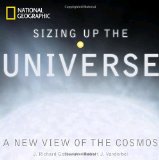

I found many other interesting stories and had the above questions answered in a new book, Sizing Up The Universe. I would say that the unifying theme of the book is size comparison. Numerous charts capture a fresh vision of the Universe, introducing an original way of comparing objects in the heavens.
Browsing through Sizing Up The Universe, I could not help thinking about my high school astronomy textbook. The author of the textbook was definitely not into visual arts, as the pages were flooded with math formulas and only a few sketches were present here and there. I did not mind it at that time, but I realize now that stunning images of planets, stars, and galaxies, such as those found in Sizing Up The Universe, would make the learning process much more enjoyable. Moreover, the real stories behind groundbreaking discoveries in astronomy that are sprinkled throughout the text make it captivating and easy to read.
The authors of Sizing Up The Universe are J. Richard Gott III and Robert J. Vanderbei. J. Richard Gott III is professor of astrophysics at Princeton University. He has written articles for Time, Scientific American, and New Scientist. He is also the author of Time Travel in Einstein’s Universe. Robert J. Vanderbei is professor and chair of the Department of Operations Research and Financial Engineering at Princeton University. He is an amateur astronomer and has taken from his own backyard many images of astronomical objects, some of which can be found in the book.












 Subscribe to blog posts using RSS