OrbitalHub

The place where space exploration, science, and engineering meet

Domain is for sale. $50,000,000.00 USD. Direct any inquiries to contact@orbitalhub.com.

September 28, 2017

The Colors of Tethys

Posted by


NASA dixit:

“April 11, 2015. This enhanced-color mosaic of Saturn’s icy moon Tethys shows a range of features on the moon’s trailing hemisphere. Tethys is tidally locked to Saturn, so the trailing hemisphere is the side of the moon that always faces opposite its direction of motion as it orbits the planet. Images taken using clear, green, infrared and ultraviolet spectral filters were combined to create the view, which highlights subtle color differences across Tethys’ surface at wavelengths not visible to human eyes. The moon’s surface is fairly uniform in natural color.

The color of the surface changes conspicuously across the disk, from yellowish hues to nearly white. These broad color changes are affected by a number of external processes. First, Saturn’s diffuse E-ring preferentially bombards Tethys’ leading hemisphere, toward the right side of this image, with ice bright ice grains. At the same time, charged particles from Saturn’s radiation belt bombard the surface on the trailing side, causing color changes due to chemical alteration of the materials there. The albedo — a measure of the surface’s reflectivity — drops by 10 to 15 percent from the moon’s leading side to the trailing side. Similar global color patterns exist on other Saturnian moons.

On a much smaller scale, enigmatic, arc-shaped, reddish streaks also are faintly visible across the heavily-cratered surface, particularly if one enhances color saturation in the image. The origin of this localized color contrast is not yet understood. Mountains on the floor of the 280 mile- (450 kilometer-) wide Odysseus impact basin are visible at upper right, around the two o’clock position.

This mosaic is an orthographic projection constructed from 52 Cassini images obtained with the Cassini spacecraft narrow-angle camera. Resolution is about 1,000 feet (300 meters) per pixel. The images were obtained at a distance of approximately 33,000 miles (53,000 kilometers) from Tethys.

Image credit: NASA/JPL-Caltech/Space Science Institute


  • Facebook
  • Google
  • Slashdot
  • Reddit
  • Live
  • TwitThis
September 28, 2017

Stunning Aurora as Seen from the Space Station

Posted by


ESA dixit:

“On 15 September 2017, 711 photos were taken by ESA astronaut Paolo Nespoli to create this time-lapse of a stunning aurora. “

Video credit: ESA


  • Facebook
  • Google
  • Slashdot
  • Reddit
  • Live
  • TwitThis
September 27, 2017

Red Arcs on Tethys

Posted by


NASA dixit:

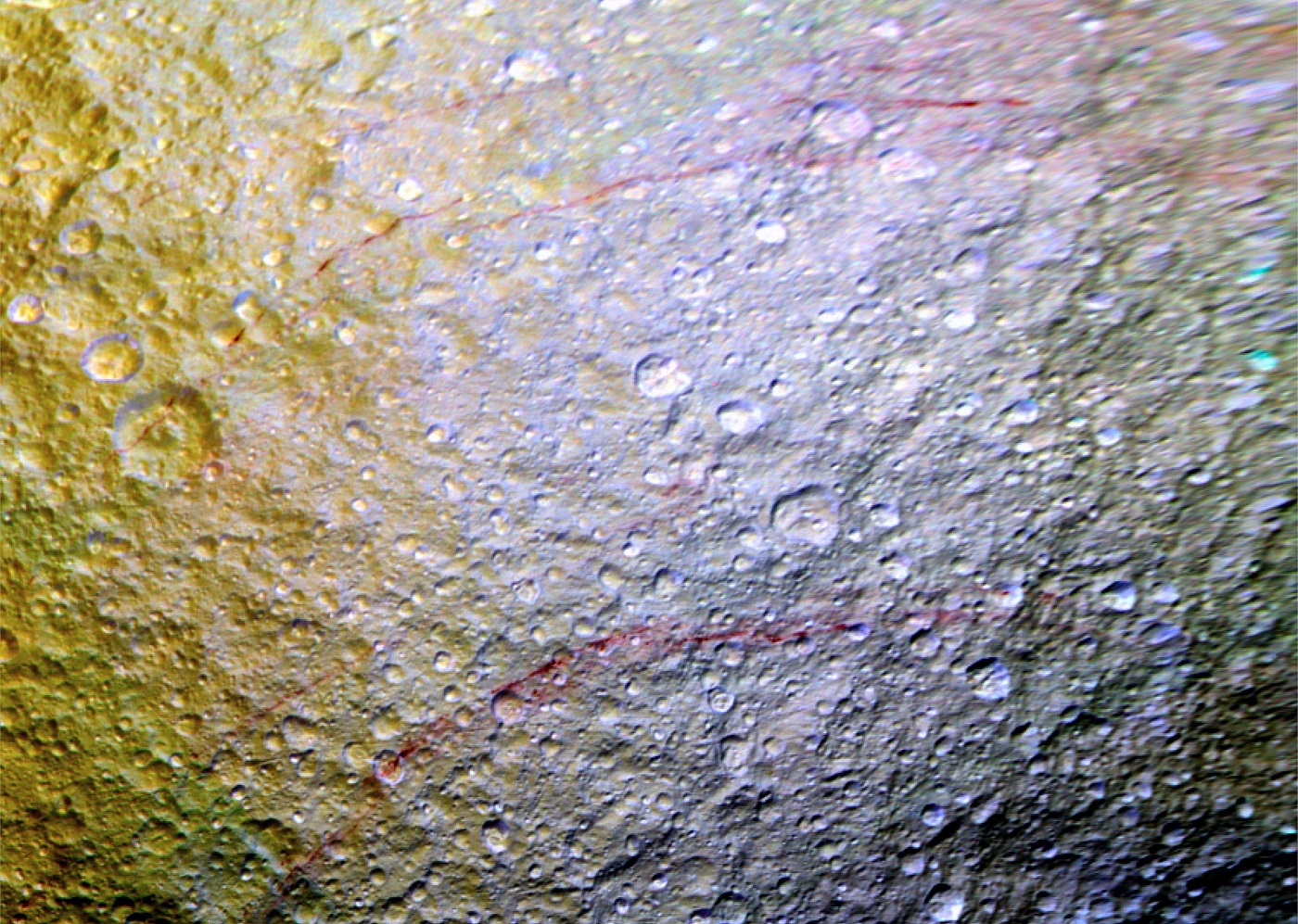
“April 11, 2015. Unusual arc-shaped, reddish streaks cut across the surface of Saturn’s ice-rich moon Tethys in this enhanced-color mosaic. The red streaks are narrow, curved lines on the moon’s surface, only a few miles (or kilometers) wide but several hundred miles (or kilometers) long. The red streaks are among the most unusual color features on Saturn’s moons to be revealed by Cassini’s cameras.

A few of the red arcs can be faintly seen in Cassini imaging observations made earlier in the mission, but the color images for this observation, which were obtained in April 2015, were the first to show large northern areas of Tethys under the illumination and viewing conditions necessary to see the features clearly. As the Saturn system moved into its northern hemisphere summer over the past few years, northern latitudes have become increasingly well illuminated. As a result, the red arc features have become clearly visible for the first time.

The origin of the features and their reddish color is currently a mystery to Cassini scientists. Possibilities being studied include ideas that the reddish material is exposed ice with chemical impurities, or the result of outgassing from inside Tethys. The streaks could also be associated with features like fractures that are below the resolution of the available images.

Except for a few small craters on Dione, reddish tinted features are rare on other moons of Saturn. However, many reddish features are observed on the geologically young surface of Jupiter’s moon Europa.

Images taken using clear, green, infrared and ultraviolet spectral filters were combined to create the view, which highlights subtle color differences across Tethys’ surface at wavelengths not visible to human eyes. The moon’s surface is fairly uniform in natural color. The yellowish tones on the left side of the view are a result of alteration of the moon’s surface by high-energy particles from Saturn’s magnetosphere. This particle radiation slams into the moon’s trailing hemisphere, modifying it chemically and changing its appearance in enhanced-color views like this one.

The area of Tethys shown here is centered on 30 degrees north latitude, 187 degrees west longitude, and measures 305 by 258 miles (490 by 415 kilometers) across. The original color images were obtained at a resolution of about 2,300 feet (700 meters) per pixel. This is a mosaic of images that have been photometrically calibrated and map-projected.”

Image credit: NASA/JPL-Caltech/Space Science Institute


  • Facebook
  • Google
  • Slashdot
  • Reddit
  • Live
  • TwitThis
September 27, 2017

Satellite Animation Shows Hurricanes

Posted by


NASA dixit:

“This animation of NOAA’s GOES East satellite imagery from Sept. 21 at 7:45 a.m. EDT (1145 UTC) to Sept. 23 ending at 7:45 a.m. EDT (1145 UTC) shows Jose becoming a post-tropical storm winding down near New England while Hurricane Maria moved over Puerto Rico and toward the Bahamas.”

Video credit: NASA


  • Facebook
  • Google
  • Slashdot
  • Reddit
  • Live
  • TwitThis
September 26, 2017

Subtle Colors on Iapetus

Posted by


NASA dixit:

“March 27, 2015. Cassini stared toward Saturn’s two-toned moon Iapetus (914 miles or 1,471 kilometers across) for about a week in early 2015, in a campaign motivated in part to investigate subtle color differences within the moon’s bright terrain. This distant flyby represents Cassini’s second-closest approach to Iapetus in the current mission phase. It is the only set of observations with a good view of the bright terrain in the moon’s north polar area.

The large basin at lower right, within the dark terrain, is named Turgis. The slightly smaller crater at the nine o’clock position is Falsaron. The two prominent craters just above image center are Roland and Turpin. At the limb around the three o’clock position is the darkened rim of the crater Naimon. Images taken using red, green and blue spectral filters were combined to create this natural-color view. The moon’s brightness has been enhanced in order to make the dark terrain visible. The image also was enlarged by a factor of two compared to the original data.

The view was obtained by the Cassini spacecraft narrow-angle camera at a distance of approximately 621,000 miles (1 million kilometers) from Iapetus and at a Sun-Iapetus-spacecraft, or phase, angle of 38 degrees. Image scale on Iapetus is about 4 miles (6 kilometers).

The image was produced by Tilmann Denk at Freie Universität in Berlin.”

Image credit: NASA/JPL-Caltech/Space Science Institute


  • Facebook
  • Google
  • Slashdot
  • Reddit
  • Live
  • TwitThis
September 26, 2017

A Slingshot from Earth

Posted by


NASA dixit:

“OSIRIS-REx is NASA’s mission to explore near-earth asteroid Bennu, collect a sample, and return it to Earth. To get to Bennu, however, OSIRIS-REx must first leave the plane of Earth’s orbit and match the orbital tilt of its target. On September 22, 2017, OSIRIS-REx approached Earth and flew over its southern hemisphere, passing within 11,000 miles of Antarctica. This gravitational slingshot will bend its trajectory by six degrees, sending the spacecraft on a path to intercept Bennu. Shortly after the flyby, OSIRIS-REx looked back at Earth and took images and spectra, ensuring that its instruments are ready for arrival at Bennu in 2018.”

Video credit: NASA’s Goddard Space Flight Center/Dan Gallagher


  • Facebook
  • Google
  • Slashdot
  • Reddit
  • Live
  • TwitThis