OrbitalHub

The place where space exploration, science, and engineering meet

Domain is for sale. $50,000,000.00 USD. Direct any inquiries to contact@orbitalhub.com.

October 1, 2017

Janus and Tethys

Posted by


NASA dixit:

“October 27, 2015. Janus and Tethys demonstrate the main difference between small moons and large ones. It’s all about the moon’s shape. Moons like Tethys (660 miles or 1,062 kilometers across) are large enough that their own gravity is sufficient to overcome the material strength of the substances they are made of (mostly ice in the case of Tethys) and mold them into spherical shapes. But small moons like Janus (111 miles or 179 kilometers across) are not massive enough for their gravity to form them into a sphere. Janus and its like are left as irregularly shaped bodies.

Saturn’s narrow F ring and the outer edge of its A ring slice across the scene. This view looks toward the unilluminated side of the rings from about 0.23 degrees below the ring plane. The image was taken in visible green light with the Cassini spacecraft narrow-angle camera. The view was obtained at a distance of approximately 593,000 miles (955,000 kilometers) from Janus. Image scale at Janus is 3.7 miles (6 kilometers) per pixel. Tethys was at a distance of 810,000 miles (1.3 million kilometers) for an image scale of 5 miles (8 kilometers) per pixel.”

Image credit: NASA/JPL-Caltech/Space Science Institute


  • Facebook
  • Google
  • Slashdot
  • Reddit
  • Live
  • TwitThis
October 1, 2017

Final RS-25 Engine Test of the Summer

Posted by


NASA dixit:

“On August 30, engineers at our Stennis Space Center wrapped up a summer of hot fire testing for flight controllers on RS-25 engines that will help power the new Space Launch System rocket being built to carry astronauts to deep-space destinations, including Mars. The 500-second hot fire of a flight controller or “brain†of the engine marked another step toward the nation’s return to human deep-space exploration missions. Four RS-25 engines, equipped with flight-worthy controllers will help power the first integrated flight of our Space Launch System rocket with our Orion spacecraft, known as Exploration Mission One.”

Video credit: NASA


  • Facebook
  • Google
  • Slashdot
  • Reddit
  • Live
  • TwitThis
September 30, 2017

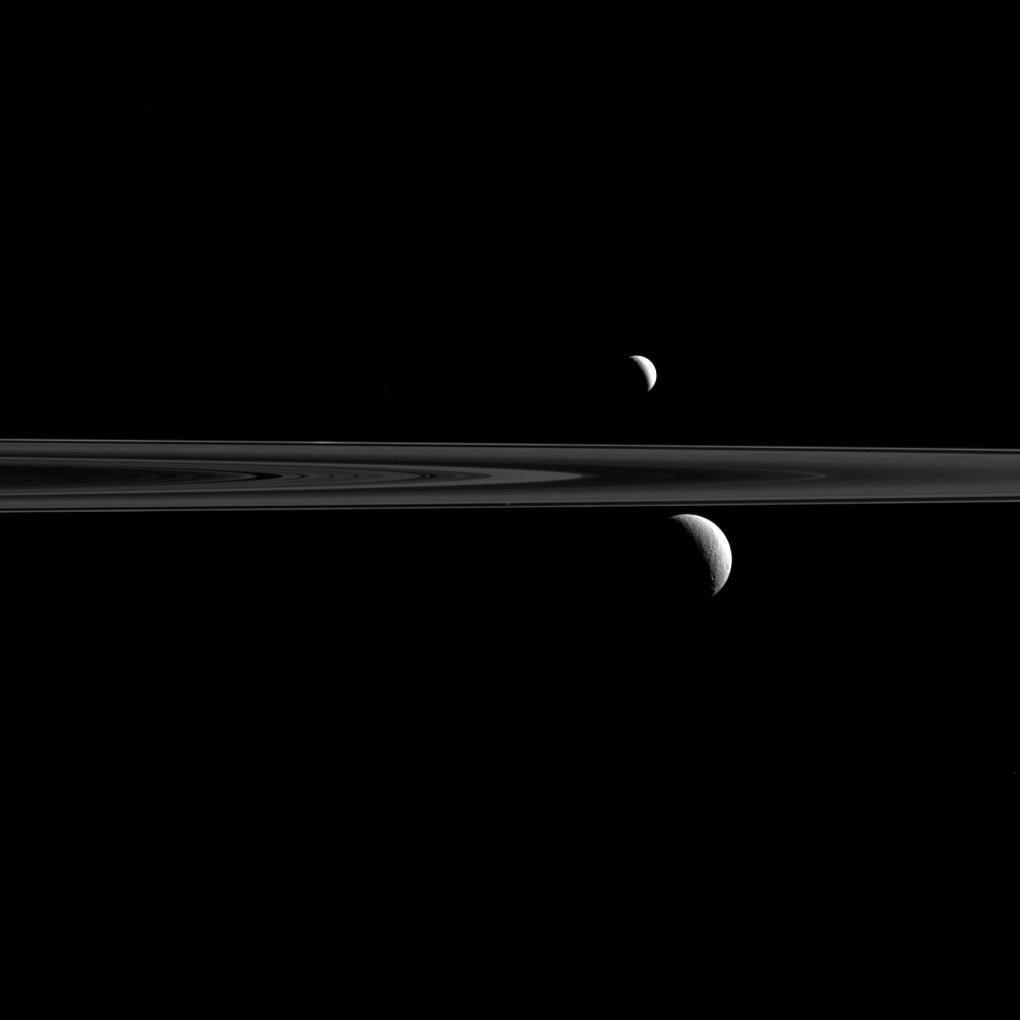
Triple Play

Posted by


NASA dixit:

“September 24, 2015. What looks like a pair of Saturnian satellites is actually a trio upon close inspection. Here, Cassini has captured Enceladus (313 miles or 504 kilometers across) above the rings and Rhea (949 miles or 1,527 kilometers across) below. The comparatively tiny speck of Atlas (19 miles or 30 kilometers across) can also be seen just above and to the left of Rhea, and just above the thin line of Saturn’s F ring. This view looks toward the unilluminated side of the rings from about 0.34 degrees below the ring plane.

The image was taken in visible light with the Cassini spacecraft narrow-angle camera. The view was obtained at a distance of approximately 1.8 million miles (2.8 million kilometers) from Rhea. Image scale on Rhea is 10 miles (16 kilometers) per pixel. The distance to Enceladus was 1.3 million miles (2.1 million kilometers) for a scale of 5 miles (8 kilometers) per pixel. The distance to Atlas was 1.5 million miles (2.4 million) kilometers) for an image scale at Atlas of 9 miles (14 kilometers) per pixel.”

Image credit: NASA/JPL-Caltech/Space Science Institute


  • Facebook
  • Google
  • Slashdot
  • Reddit
  • Live
  • TwitThis


Wikipedia dixit:

“Rosetta was a space probe built by the European Space Agency launched on 2 March 2004. Along with Philae, its lander module, Rosetta performed a detailed study of comet 67P/Churyumov–Gerasimenko (67P). During its journey to the comet, the spacecraft flew by Mars and the asteroids 21 Lutetia and 2867 Å teins. It was launched as the third cornerstone mission of the ESA’s Horizon 2000 programme, after SOHO / Cluster and XMM-Newton.

On 6 August 2014, the spacecraft reached the comet and performed a series of manoeuvres to eventually orbit the comet at distances of 30 to 10 kilometres (19 to 6 mi). On 12 November, its lander module Philae performed the first successful landing on a comet, though its battery power ran out two days later. Communications with Philae were briefly restored in June and July 2015, but due to diminishing solar power, Rosetta’s communications module with the lander was turned off on 27 July 2016. On 30 September 2016, the Rosetta spacecraft ended its mission by hard-landing on the comet in its Ma’at region.

The probe is named after the Rosetta Stone, a stele of Egyptian origin featuring a decree in three scripts. The lander is named after the Philae obelisk, which bears a bilingual Greek and Egyptian hieroglyphic inscription.”

Video credit: ESA


  • Facebook
  • Google
  • Slashdot
  • Reddit
  • Live
  • TwitThis
September 29, 2017

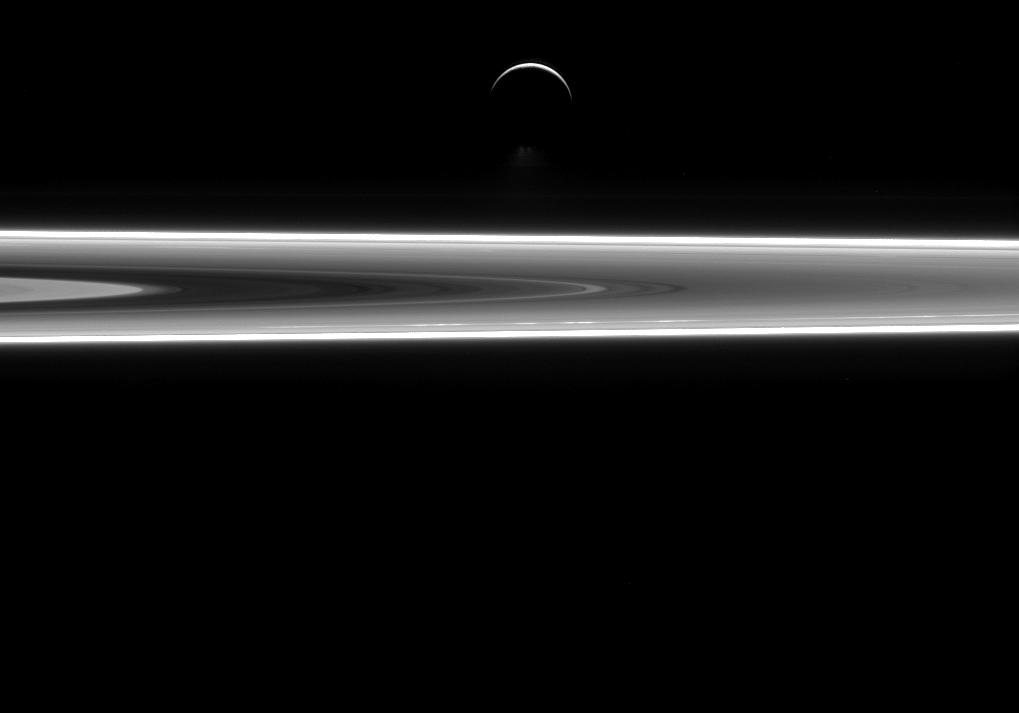
Water World

Posted by


NASA dixit:

“July 29, 2015. Although Enceladus and Saturn’s rings are largely made up of water ice, they show very different characteristics. The small ring particles are too tiny to retain internal heat and have no way to get warm, so they are frozen and geologically dead. Enceladus, on the other hand, is subject to forces that heat its interior to this very day. This results in its famous south polar water jets, which are just visible above the moon’s dark, southern limb, along with a sub-surface ocean.

Work by Cassini scientists suggests that Enceladus (313 miles or 504 kilometers across) has a global ocean of liquid water under its surface. This discovery increases scientists’ interest in Enceladus and the quest to understand the role of water in the development of life in the solar system.

This view looks toward the unilluminated side of the rings from about 0.3 degrees below the ring plane. The image was taken in visible light with the Cassini spacecraft narrow-angle camera. The view was acquired at a distance of approximately 630,000 miles (1.0 million kilometers) from Enceladus and at a Sun-Enceladus-spacecraft, or phase angle of 155 degrees. Image scale is 4 miles (6 kilometers) per pixel.”

Image credit: NASA/JPL-Caltech/Space Science Institute


  • Facebook
  • Google
  • Slashdot
  • Reddit
  • Live
  • TwitThis
September 29, 2017

ISS Expedition 52/53 Aurora Australis

Posted by


ESA dixit:

“On 20 August 2017, 919 photos were taken by ESA astronaut Paolo Nespoli to create this timelapse of the Aurora Australis at 25 frames per second.”

Video credit: ESA


  • Facebook
  • Google
  • Slashdot
  • Reddit
  • Live
  • TwitThis