OrbitalHub

The place where space exploration, science, and engineering meet

Domain is for sale. $50,000,000.00 USD. Direct any inquiries to contact@orbitalhub.com.

Archive for 2017

October 20, 2017

NASA Test Launch from Wallops

Posted by


NASA dixit:

“NASA tested a parachute platform during the flight of a Terrier-Black Brant IX suborbital sounding rocket on October 4, from the agency’s Wallops Flight Facility in Virginia. The rocket carried the Advanced Supersonic Parachute Inflation Research Experiment (ASPIRE) from NASA’s Jet Propulsion Laboratory in Pasadena, California. The mission will evaluate the performance of the ASPIRE payload, which is designed to test parachute systems in a low-density, supersonic environment.”

Video credit: NASA


  • Facebook
  • Google
  • Slashdot
  • Reddit
  • Live
  • TwitThis
October 19, 2017

Propeller in Saturn’s A Ring

Posted by


NASA dixit:

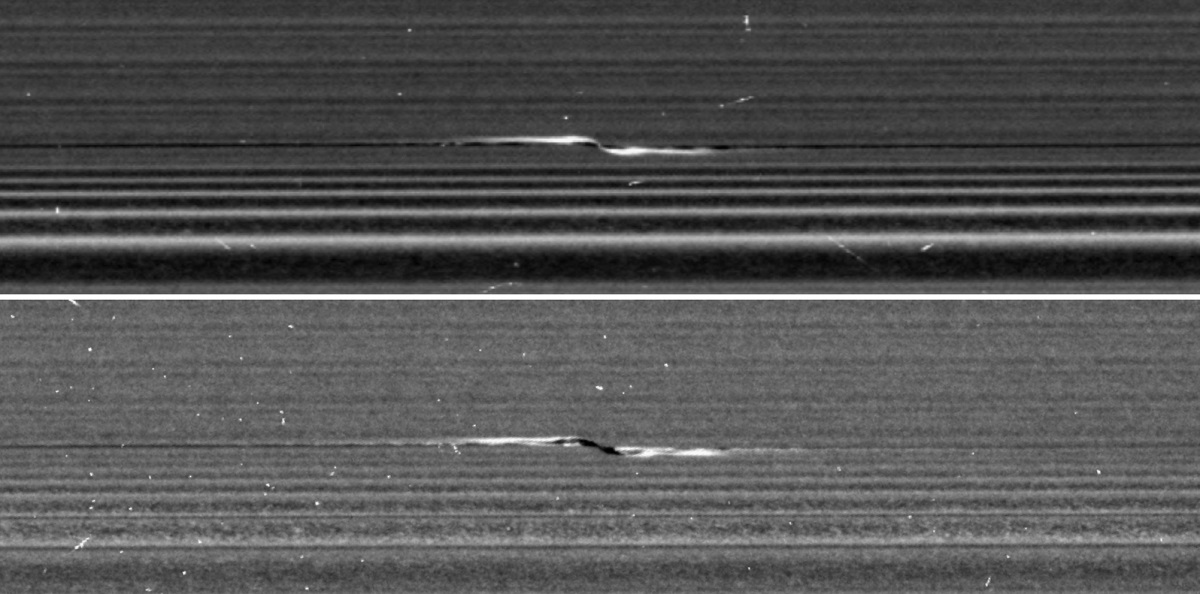
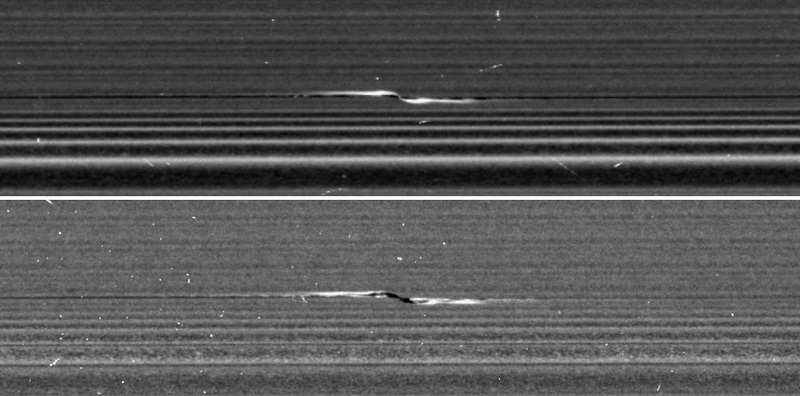
“February 21, 2017. NASA’s Cassini spacecraft captured these remarkable views of a propeller feature in Saturn’s A ring. These are the sharpest images taken of a propeller so far, and show an unprecedented level of detail. The propeller is nicknamed “Santos-Dumont,” after the pioneering Brazilian-French aviator. This observation was Cassini’s first targeted flyby of a propeller. The views show the object from vantage points on opposite sides of the rings. The top image looks toward the rings’ sunlit side, while the bottom image shows the unilluminated side, where sunlight filters through the backlit ring.

The two images are reprojected at the same scale (0.13 mile or 207 meters per pixel) in order to facilitate comparison. Cassini scientists have been tracking the orbit of this object for the past decade, tracing the effect that the ring has upon it. Now, as Cassini has moved in close to the ring as part of its ring-grazing orbits, it was able to obtain this extreme close-up view of the propeller, enabling researchers to examine its effects on the ring. These views, and others like them, will inform models and studies in new ways going forward.

Like a frosted window, Saturn’s rings look different depending on whether they are seen fully sunlit or backlit. On the lit side, the rings look darker where there is less material to reflect sunlight. On the unlit side, some regions look darker because there is less material, but other regions look dark because there is so much material that the ring becomes opaque. Observing the same propeller on both the lit and unlit sides allows scientists to gather richer information about how the moonlet affects the ring. For example, in the unlit-side view, the broad, dark band through the middle of the propeller seems to be a combination of both empty and opaque regions. The propeller’s central moonlet would only be a couple of pixels across in these images, and may not actually be resolved here. The lit-side image shows that a bright, narrow band of material connects the moonlet directly to the larger ring, in agreement with dynamical models. That same thin band of material may also be obscuring the moonlet from view. Lengthwise along the propeller is a gap in the ring that the moonlet has pried open. The gap appears dark on both the lit and unlit sides. Flanking the gap near the moonlet are regions of enhanced density, which appear bright on the lit side and more mottled on the unlit side.

One benefit of the high resolution of these images is that, for the first time, wavy edges are clearly visible in the gap. These waves are also expected from dynamical models, and they emphasize that the gap must be sharp-edged. Furthermore, the distance between the wave crests tells scientists the width of the gap (1.2 miles or 2 kilometers), which in turn reveals the mass of the central moonlet. From these measurements, Cassini imaging scientists deduce that the moonlet’s mass is comparable to that of a snowball about 0.6 mile (1 kilometer) wide.”

Image credit: NASA/JPL-Caltech/Space Science Institute

 

  • Facebook
  • Google
  • Slashdot
  • Reddit
  • Live
  • TwitThis
October 19, 2017

Timelapse over Canada and Northern America

Posted by


ESA dixit:

“On 20 September 2017, ESA astronaut Paolo Nespoli shot this amazing timelapse showing Earth by night while travelling on board the Space Station from British Columbia to the Great Lakes: coast to coast in 20 seconds! Paolo Nespoli in currently working and living aboard the International Space Station as part of his long-duration VITA mission.”

Video credit: ESA


  • Facebook
  • Google
  • Slashdot
  • Reddit
  • Live
  • TwitThis
October 18, 2017

The Realm of Daphnis

Posted by


NASA dixit:

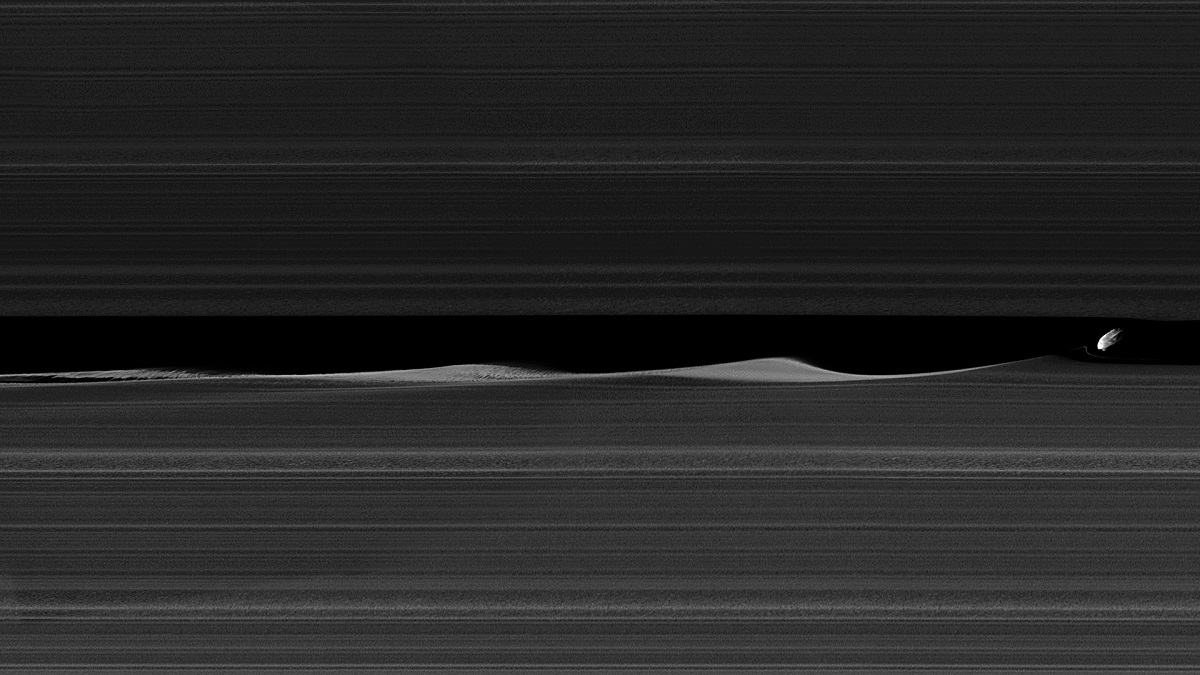
“February 14, 2017. Daphnis, one of Saturn’s ring-embedded moons, is featured in this view, kicking up waves as it orbits within the Keeler gap. The mosaic combines several images to show more waves in the gap edges. Daphnis is a small moon at 5 miles (8 kilometers) across, but its gravity is powerful enough to disrupt the tiny particles of the A ring that form the Keeler gap’s edge. As the moon moves through the Keeler gap, wave-like features are created in both the horizontal and vertical plane.

Images like this provide scientists with a close-up view of the complicated interactions between a moon and the rings, as well as the interactions between the ring particles themselves, in the wake of the moon’s passage. Three wave crests of diminishing sizes trail Daphnis here. In each subsequent crest, the shape of the wave evolves, as the ring particles within the crests collide with one another.

Close examination of Daphnis’ immediate vicinity also reveals a faint, thin strand of ring material that almost appears to have been directly ripped out of the A ring by Daphnis. The images in this mosaic were taken in visible light, using the Cassini spacecraft narrow-angle camera at a distance of approximately 17,000 miles (28,000 kilometers) from Daphnis and at a Sun-Daphnis-spacecraft, or phase, angle of 71 degrees. Image scale is 551 feet (168 meters) per pixel.”

Image credit: NASA/JPL-Caltech/Space Science Institute


  • Facebook
  • Google
  • Slashdot
  • Reddit
  • Live
  • TwitThis
October 18, 2017

NASA Pushing the Envelope

Posted by


NASA dixit:

“The first generation X-1 aircraft changed aviation history in numerous ways, and not simply because they were the first aircraft to fly faster than the speed of sound. Rather, they established the concept of the research aircraft, built solely for experimental purposes. NASA continues this legacy of experimental aircraft today.”

Video credit: NASA


  • Facebook
  • Google
  • Slashdot
  • Reddit
  • Live
  • TwitThis
October 17, 2017

Farewell to Mimas

Posted by


NASA dixit:

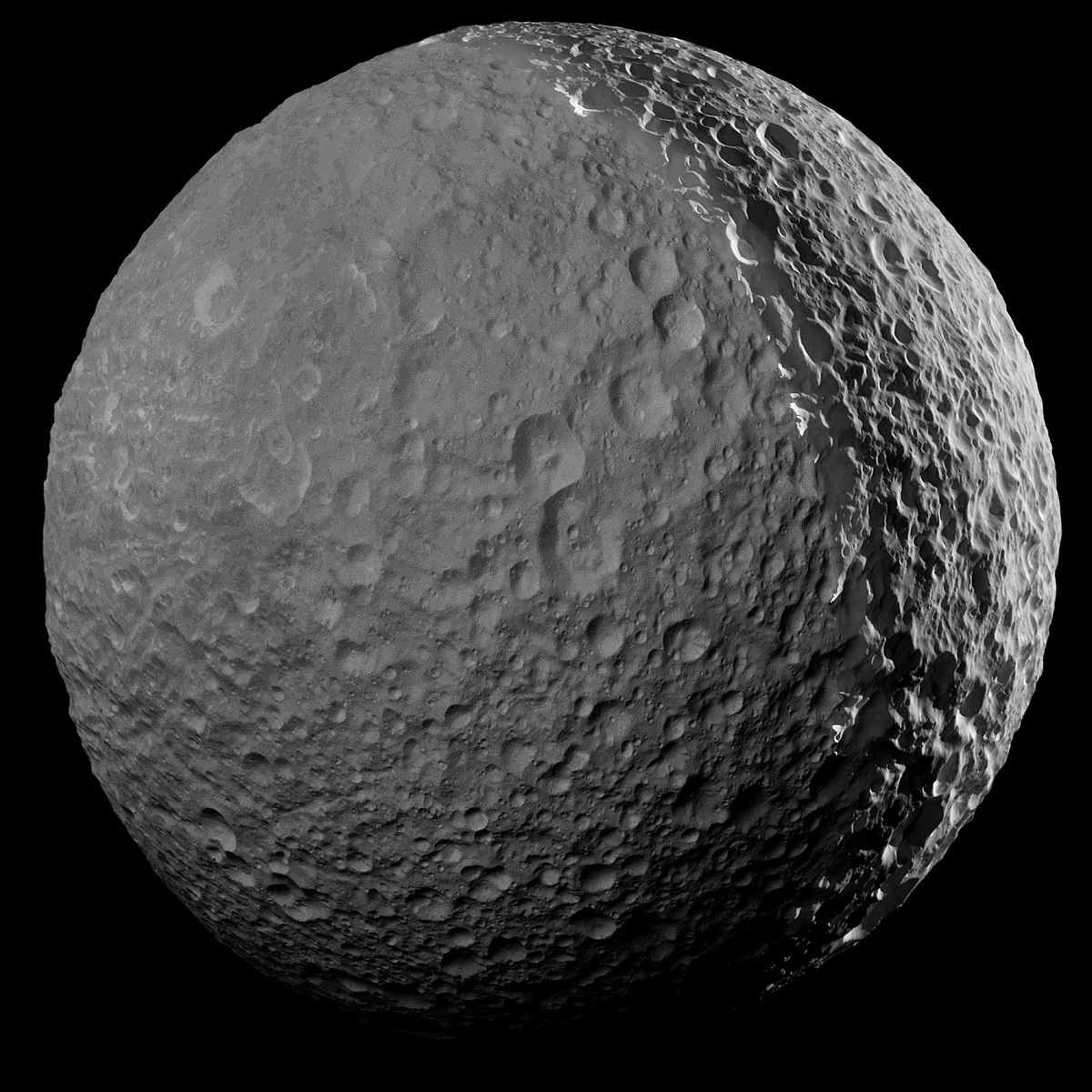
“January 30, 2017. In its season of “lasts,” NASA’s Cassini spacecraft made its final close approach to Saturn’s moon Mimas. At closest approach, Cassini passed 25,620 miles (41,230 kilometers) from Mimas. This mosaic is one of the highest resolution views ever captured of the icy moon. Close approaches to Mimas have been somewhat rare during Cassini’s mission, with only seven flybys at distances of less than 31,000 miles (50,000 kilometers).

Mimas’ surface is pockmarked with countless craters, the largest of which gives the icy moon its distinctive appearance. The left side, which is lit by reflected light from Saturn, has been enhanced in brightness in order to show the full surface. Imaging scientists combined ten narrow-angle camera images to create this mosaic view. The scene is an orthographic projection centered on terrain at 17.5 degrees south latitude, 325.4 degrees west longitude on Mimas. An orthographic view is most like the view seen by a distant observer looking through a telescope.

This mosaic was acquired at a distance of approximately 28,000 miles (45,000 kilometers) from Mimas. Image scale is approximately 820 feet (250 meters) per pixel. The images were taken in visible light with the Cassini spacecraft narrow-angle camera.”

Image credit: NASA/JPL-Caltech/Space Science Institute


  • Facebook
  • Google
  • Slashdot
  • Reddit
  • Live
  • TwitThis