“As NASA’s Cassini spacecraft made its first-ever dive through the gap between Saturn and its rings on April 26, 2017, one of its imaging cameras took a series of rapid-fire images that were used to make this movie sequence. The video begins with a view of the vortex at Saturn’s north pole, then heads past the outer boundary of the planet’s hexagon-shaped jet stream and continues further southward.”
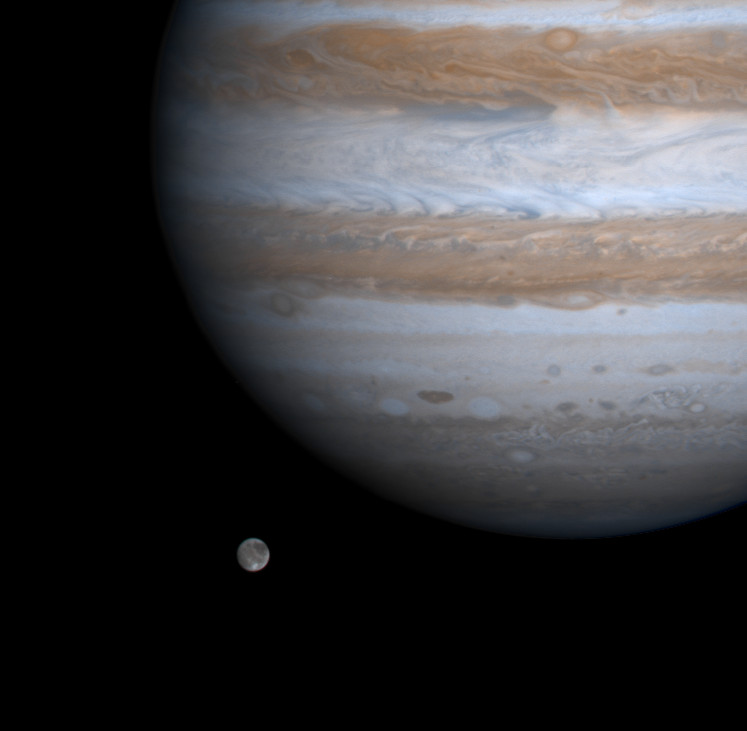
“December 3, 2000. The solar system’s largest moon, Ganymede, is captured here alongside the planet Jupiter in a color picture taken by NASA’s Cassini spacecraft. Ganymede is larger than the planets Mercury and Pluto and Saturn’s largest moon, Titan. Both Ganymede and Titan have greater surface area than the entire Eurasian continent on our planet. Cassini was 26.5 million kilometers (16.5 million miles) from Ganymede when this image was taken. The smallest visible features are about 160 kilometers (about 100 miles) across.
The bright area near the south (bottom) of Ganymede is Osiris, a large, relatively new crater surrounded by bright icy material ejected by the impact, which created it. Elsewhere, Ganymede displays dark terrains that NASA’s Voyager and Galileo spacecraft have shown to be old and heavily cratered. The brighter terrains are younger and laced by grooves. Various kinds of grooved terrains have been seen on many icy moons in the solar system. These are believed to be the surface expressions of warm, pristine, water-rich materials that moved to the surface and froze.
Ganymede has proven to be a fascinating world, the only moon known to have a magnetosphere, or magnetic environment, produced by a convecting metal core. The interaction of Ganymede’s and Jupiter’s magnetospheres may produce dazzling variations in the auroral glows in Ganymede’s tenuous atmosphere of oxygen.”
“After almost 20 years in space, NASA’s Cassini spacecraft begins the final chapter of its remarkable story of exploration: its Grand Finale. Between April and September 2017, Cassini will undertake a daring set of orbits that is, in many ways, like a whole new mission. Following a final close flyby of Saturn’s moon Titan, Cassini will leap over the planet’s icy rings and begin a series of 22 weekly dives between the planet and the rings.
No other mission has ever explored this unique region. What we learn from these final orbits will help to improve our understanding of how giant planets – and planetary systems everywhere – form and evolve.
On the final orbit, Cassini will plunge into Saturn’s atmosphere, sending back new and unique science to the very end. After losing contact with Earth, the spacecraft will burn up like a meteor, becoming part of the planet itself.
Cassini’s Grand Finale is about so much more than the spacecraft’s final dive into Saturn. That dramatic event is the capstone of six months of daring exploration and scientific discovery. (And those six months are the thrilling final chapter in a historic 20-year journey.)”
“On January 14, 2005, ESA’s Huygens probe made its descent to the surface of Saturn’s hazy moon, Titan. Carried to Saturn by NASA’s Cassini spacecraft, Huygens made the most distant landing ever on another world, and the only landing on a body in the outer solar system. This video uses actual images taken by the probe during its two-and-a-half hour fall under its parachutes.
Huygens was a signature achievement of the international Cassini-Huygens mission, which will conclude on September 15, 2017, when Cassini plunges into Saturn’s atmosphere.”
“CisLunar – the space between Earth and the moon – holds vast opportunities for humans. Reliable, accessible, affordable access to space will help open economic opportunities. ULA’s ability to provide reliable, affordable access to space, which will provide critical infrastructure to supporting a space economy.”
“Originally proposed as the Advanced Cryogenic Evolved Stage by Boeing in 2006 as a concept for use as a new Delta IV second stage — and subsequently, the Advanced Common Evolved Stage by its corporate successor, United Launch Alliance by 2010 — ACES was intended to boost satellite payloads to geosynchronous orbit or, in the case of an interplanetary space probe, to or near to escape velocity. Other alternative uses included a proposal to provide in-space propellant depots in LEO or at L2 that could be used as way-stations for other rockets to stop and refuel on the way to beyond-LEO or interplanetary missions, and to provide the high-energy technical capacity for the cleanup of space debris.
The late-2000s ACES proposal by ULA also had a predecessor at Lockheed Martin, prior to the merger of Boeing and Lockheed Martin launch vehicle manufacturing and operations to form ULA in 2006. Known then as the Lockheed Martin common-stage concept, the upper stage was intended to “provide efficient, robust in-space transportation”, and take advantage of the high-mass fraction that is enabled by Centaur’s design and its common bulkhead to minimize combined LO2/LH2 boil off. A study funded by NASA led to the development of the Lockheed Martin concept known as ACES, under the original name of Advanced Cryogenic Evolved Stage as of 2006.
In April 2015, after ULA had announced the end of production of the Delta IV Medium in 2019 and the Delta IV Heavy in the mid-2020s, ULA renamed the stage the Advanced Cryogenic Evolved Stage, as ACES would in this case serve as the second stage on only a single launch vehicle, the Vulcan, beginning no earlier than 2023.
After the formation of ULA in 2006, the ACES concept became one that would provide a common stage that would be evolved from both Atlas and Delta rocket technology and could be used on both launch vehicles — thus “common”. The concept by 2010 was to utilize the new high-performance upper stage, if built, on both Atlas V and Delta IV/Delta IV Heavy launch vehicles. As further refined in a 2010 conference paper, ACES was intended to be a lower-cost, more-capable and more-flexible upper stage that would supplement, and perhaps replace, the existing ULA Centaur and Delta Cryogenic Second Stage (DCSS) upper stage vehicles.
In April 2015, ULA renamed the stage the Advanced Cryogenic Evolved Stage, and announced conceptual plans to complete development of the ACES technology for the Vulcan launch vehicle, flying no earlier than 2023, but currently planned for 2024-25. No plans to develop the stage for the Atlas V or Delta IV launch vehicle lines remain. However, just like earlier ACES concept proposals, ACES would continue to blend technical aspects of both Delta and Atlas technologies and manufacturing processes, as well as use ULA’s proprietary Integrated Vehicle Fluids (IVF) technology to significantly extend the ability of the upper stage to operate in space long term. The IVF technology utilizes a lightweight internal combustion engine to use propellant boiloff (normally wasted when boiloff gasses are vented to space) to operate the stage including production of power, maintaining stage attitude, and keeping the propellant tanks autogenously pressurized, eliminating the need for hydrazine fuel and liquid helium.
The ACES vehicle is “based on a simple modular design” where the “use of multiple barrel panels, similar to Centaur, provides a straightforward means to building multiple-length (propellant load) stages that are otherwise common. The common equipment shelf accommodates one, two, or four RL10 engines. While ACES can start with existing Centaur and Delta pneumatic, avionics and propulsion systems it is intended to transition to lower-cost and higher capability systems founded on the Integrated Vehicle Fluids (IVF) system concept. IVF eliminates all hydrazine, helium, and nearly all batteries from the vehicle. It consumes waste hydrogen and oxygen to produce power, generate settling and attitude control thrust, and autogenously pressurize the vehicle tanks. IVF is optimal for depot operations since only LH2 and LO2 need be transferred, and it extends mission lifetimes from the present dozen hours to multiple days.” With the addition of a solar power system, the vehicle can remain in space and operate indefinitely.”
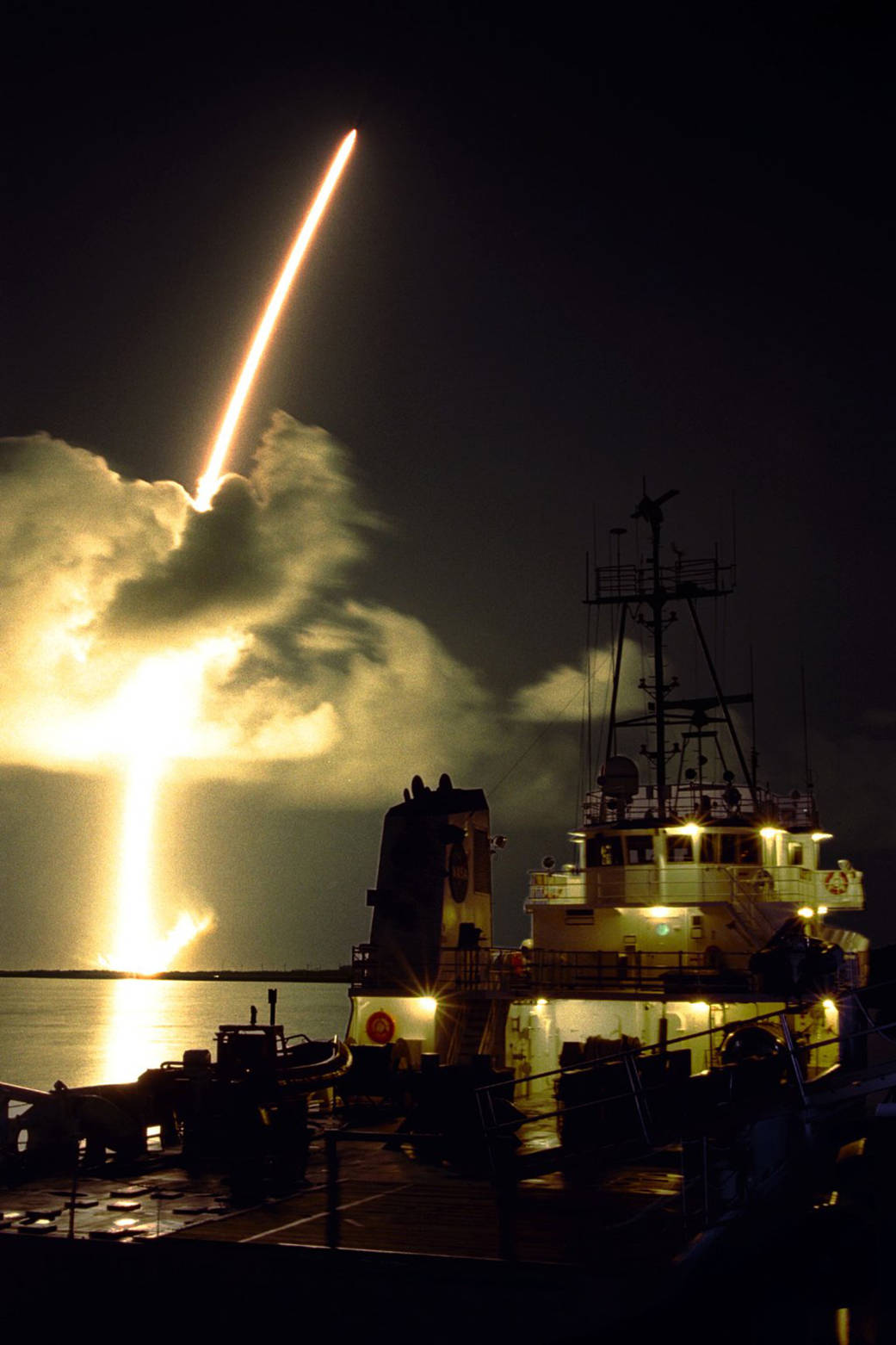
“On October 15, 1997, a seven-year journey to the ringed planet Saturn began with the liftoff of a Titan IVB/Centaur carrying the Cassini orbiter and its attached Huygens probe. This spectacular streak shot was taken from Hangar AF on Cape Canaveral Air Force Station, with a solid rocket booster retrieval ship in the foreground. Launch occurred at 4:43 a.m. EDT from Launch Complex 40. After a nearly 2.2-billion mile journey, the spacecraft arrived in the Saturn system on June 30, 2004.”
“After almost 20 years in space, NASA’s Cassini spacecraft begins the final chapter of its remarkable story of exploration: its Grand Finale. Between April and September 2017, Cassini will undertake a daring set of orbits that is, in many ways, like a whole new mission. Following a final close flyby of Saturn’s moon Titan, Cassini will leap over the planet’s icy rings and begin a series of 22 weekly dives between the planet and the rings.
No other mission has ever explored this unique region. What we learn from these final orbits will help to improve our understanding of how giant planets – and planetary systems everywhere – form and evolve.
On the final orbit, Cassini will plunge into Saturn’s atmosphere, sending back new and unique science to the very end. After losing contact with Earth, the spacecraft will burn up like a meteor, becoming part of the planet itself.
Cassini’s Grand Finale is about so much more than the spacecraft’s final dive into Saturn. That dramatic event is the capstone of six months of daring exploration and scientific discovery. (And those six months are the thrilling final chapter in a historic 20-year journey.)”
“NASA’s Cassini spacecraft arrived at Kennedy Space Center 20 years ago to begin processing for launch on a mission that would see it deliver spectacular images and data from the ringed planet Saturn. As the massive spacecraft begins its final chapter, engineers at Kennedy took a look back to how their contributions to the mission began.”



 Subscribe to blog posts using RSS












