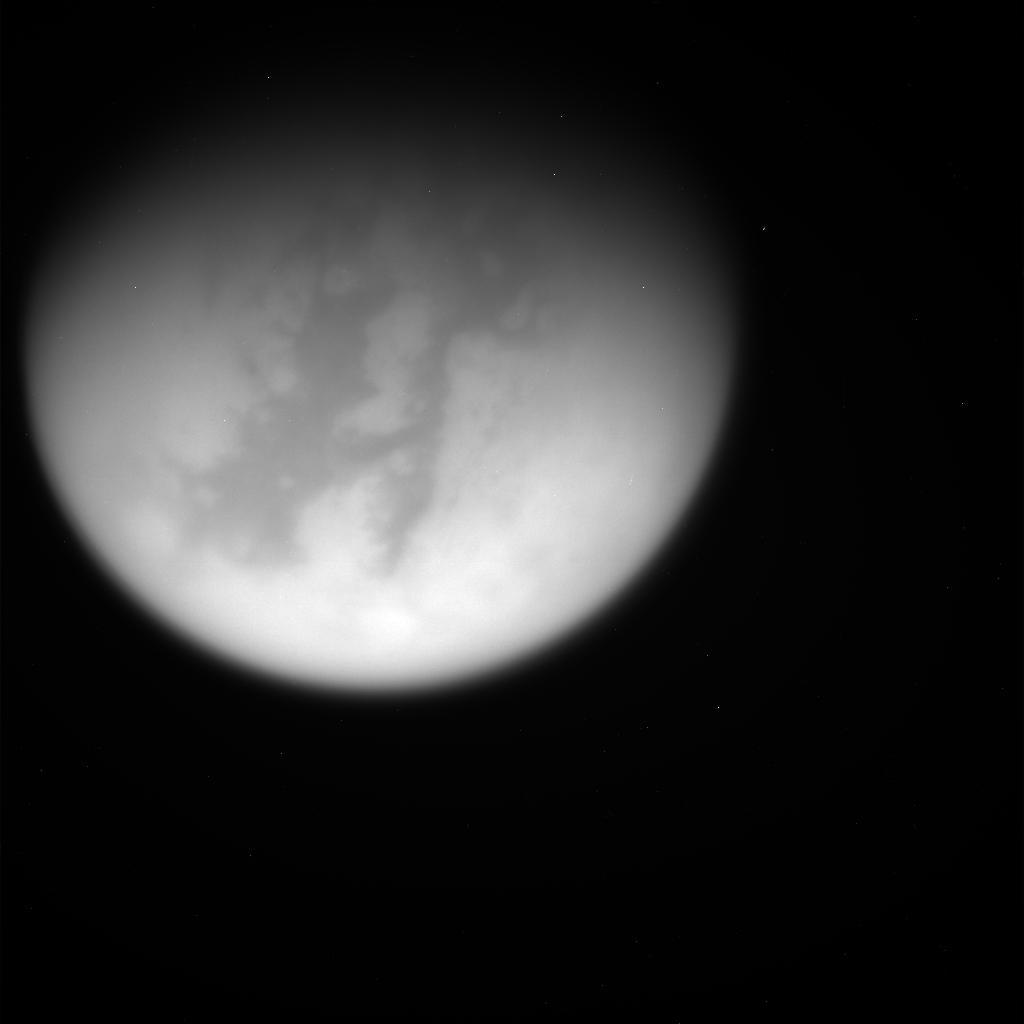
“March 31, 2005. NASA’s Cassini spacecraft successfully flew by Saturn’s largest moon, Titan, at about 2,400 kilometers (1,500 miles) above the surface.”
“After almost 20 years in space, NASA’s Cassini spacecraft begins the final chapter of its remarkable story of exploration: its Grand Finale. Between April and September 2017, Cassini will undertake a daring set of orbits that is, in many ways, like a whole new mission. Following a final close flyby of Saturn’s moon Titan, Cassini will leap over the planet’s icy rings and begin a series of 22 weekly dives between the planet and the rings.
No other mission has ever explored this unique region. What we learn from these final orbits will help to improve our understanding of how giant planets – and planetary systems everywhere – form and evolve.
On the final orbit, Cassini will plunge into Saturn’s atmosphere, sending back new and unique science to the very end. After losing contact with Earth, the spacecraft will burn up like a meteor, becoming part of the planet itself.
Cassini’s Grand Finale is about so much more than the spacecraft’s final dive into Saturn. That dramatic event is the capstone of six months of daring exploration and scientific discovery. And those six months are the thrilling final chapter in a historic 20-year journey.”
“The JUpiter ICy moons Explorer (JUICE) is the first L-class mission within ESA’s Cosmic Vision programme. It aims at a comprehensive exploration of the Jovian system with particular emphasis on Jupiter, its environment, and Galilean moons Ganymede, Europa and Callisto by investigating them as planetary bodies and potential habitats.
Scheduled for launch in 2022, with arrival in the Jovian system in 2029, JUICE will spend three-and-a-half years examining the giant planet’s turbulent atmosphere, enormous magnetosphere, its set of tenuous dark rings and its satellites. It will study the large icy moons Ganymede, Europa and Callisto, which are thought to have oceans of liquid water beneath their icy crusts – perhaps even harbouring habitable environments. The mission will culminate in a dedicated, eight-month tour around Ganymede, the first time any moon beyond our own has been orbited by a spacecraft.
JUICE will be equipped with 10 state-of-the-art instruments, including cameras, an ice-penetrating radar, an altimeter, radio-science experiments, and sensors to monitor the magnetic fields and charged particles in the Jovian system. In order to ensure it can address these goals in the challenging Jovian environment, the spacecraft’s design has to meet stringent requirements. An important milestone was reached earlier this month, when the preliminary design of JUICE and its interfaces with the scientific instruments and the ground stations were fixed, which will now allow a prototype spacecraft to be built for rigorous testing. The review also confirmed that the 5.3 tonne spacecraft will be compatible with its Ariane 5 launcher.
Operating in the outer Solar System, far from the Sun, means that JUICE needs a large solar array: two wings of five panels each are foreseen, which will cover a total surface area of nearly 100 m², capable of providing 820 W at Jupiter by the end of the mission. After launch, JUICE will make five gravity-assist flybys in total: one each at Mars and Venus, and three at Earth, to set it on course for Jupiter. Its solar panels will have to cope with a range of temperatures such that when it is flying closer to the Sun during the Venus flyby, the solar wings will be tilted to avoid excessive temperatures damaging the solar cells.
The spacecraft’s main engine will be used to enter orbit around the giant planet, and later around Jupiter’s largest moon, Ganymede. As such, the engine design has also been critically reviewed at this stage. Special measures will allow JUICE to cope with the extremely harsh radiation that it must endure for several years around Jupiter. This means careful selection of components and materials, as well as radiation shielding. One particularly important topic is JUICE’s electromagnetic ‘cleanliness’. Because a key goal is to monitor the magnetic fields and charged particles at Jupiter, it is imperative that any electromagnetic fields generated by the spacecraft itself do not interfere with the sensitive scientific measurements. This will be achieved by the careful design of the solar array electrical architecture, the power distribution unit, and the reaction wheels – a type of flywheel that stabilizes the attitude.
[…]JUICE will meet strict planetary protection guidelines, because it is imperative to minimize the risk that the potentially habitable ocean moons, particularly Europa, might be contaminated by viruses, bacteria or spores carried by the spacecraft from Earth. Therefore, mission plans ensure that JUICE will not crash into Europa, on a timescale of hundreds of years.”
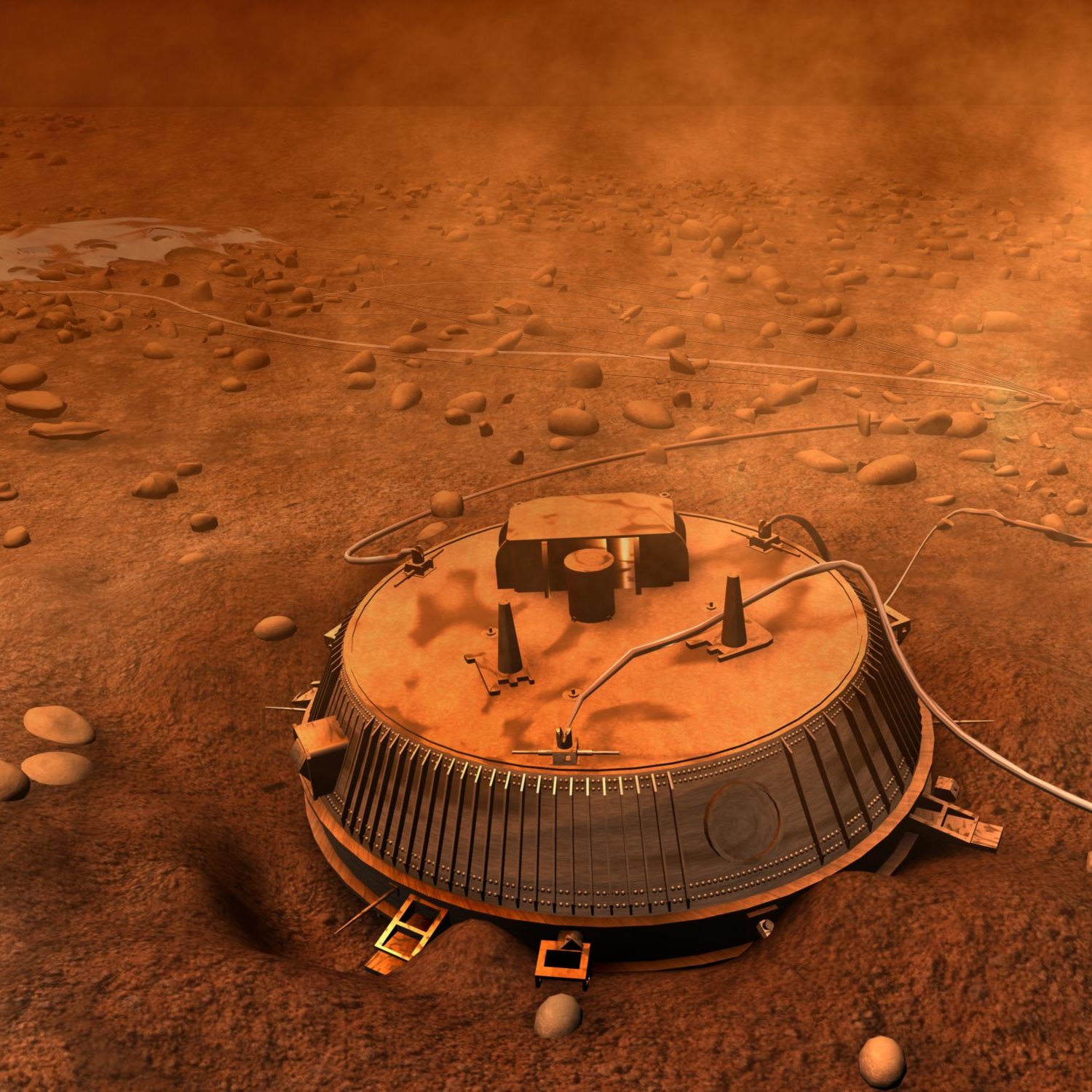
“January 14, 2005. This is an artist’s interpretation of the area surrounding the Huygens landing site, based on images and data returned.”
“After almost 20 years in space, NASA’s Cassini spacecraft begins the final chapter of its remarkable story of exploration: its Grand Finale. Between April and September 2017, Cassini will undertake a daring set of orbits that is, in many ways, like a whole new mission. Following a final close flyby of Saturn’s moon Titan, Cassini will leap over the planet’s icy rings and begin a series of 22 weekly dives between the planet and the rings.
No other mission has ever explored this unique region. What we learn from these final orbits will help to improve our understanding of how giant planets – and planetary systems everywhere – form and evolve.
On the final orbit, Cassini will plunge into Saturn’s atmosphere, sending back new and unique science to the very end. After losing contact with Earth, the spacecraft will burn up like a meteor, becoming part of the planet itself.
Cassini’s Grand Finale is about so much more than the spacecraft’s final dive into Saturn. That dramatic event is the capstone of six months of daring exploration and scientific discovery. (And those six months are the thrilling final chapter in a historic 20-year journey.)”
“Arctic sea ice extent ebbs and flows with the seasons. During the summer months, the ice melts and the edge recedes northward, usually reaching its annual minimum sometime in September. The ice extent is shaped by a variety of factors, including warmer temperatures, storms, and changes in the ocean, which makes it difficult to predict. Sea ice plays an important role in maintaining Earths temperature, so predicting how the ice extent might change helps us understand the warming climate. Scientists have developed a new model to predict the sea ice minimum extent, using historical measurements and real-time satellite data. The model can begin predictions up to six months before the predicted minimum and continue to improve each day.”
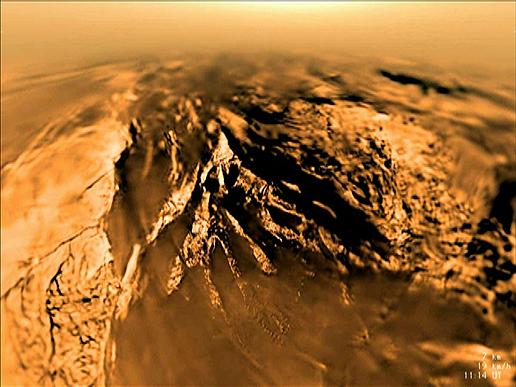
“January 14, 2005. Image collected during the 147-minute plunge through Titan’s thick orange-brown atmosphere to a soft sandy riverbed by the European Space Agency’s Huygens Descent Imager/Spectral Radiometer. In 4 minutes and 40 seconds, the movie shows what the probe ‘saw’ within the few hours of the descent and the landing. On approach, Titan appeared as just a little disk in the sky among the stars, but after landing, the probe’s camera resolved little grains of sand millions of times smaller than Titan.
At first, the Huygens camera just saw fog over the distant surface. The fog started to clear only at about 60 kilometers (37 miles) altitude, making it possible to resolve surface features as large as 100 meters (328 feet). Only after landing could the probe’s camera resolve the little grains of sand. The movie provides a glimpse of such a huge change of scale.”
“After almost 20 years in space, NASA’s Cassini spacecraft begins the final chapter of its remarkable story of exploration: its Grand Finale. Between April and September 2017, Cassini will undertake a daring set of orbits that is, in many ways, like a whole new mission. Following a final close flyby of Saturn’s moon Titan, Cassini will leap over the planet’s icy rings and begin a series of 22 weekly dives between the planet and the rings.
No other mission has ever explored this unique region. What we learn from these final orbits will help to improve our understanding of how giant planets – and planetary systems everywhere – form and evolve.
On the final orbit, Cassini will plunge into Saturn’s atmosphere, sending back new and unique science to the very end. After losing contact with Earth, the spacecraft will burn up like a meteor, becoming part of the planet itself.
Cassini’s Grand Finale is about so much more than the spacecraft’s final dive into Saturn. That dramatic event is the capstone of six months of daring exploration and scientific discovery. (And those six months are the thrilling final chapter in a historic 20-year journey.)”
“The Bigelow Expandable Activity Module (BEAM) is an experimental expandable space station module developed by Bigelow Aerospace, under contract to NASA, for testing as a temporary module on the International Space Station (ISS) from 2016 to 2018. It arrived at the ISS on April 10, 2016, was berthed to the station on April 16, and was expanded and pressurized on May 28, 2016.
NASA originally considered the idea of inflatable habitats in the 1960s, and developed the TransHab inflatable module concept in the late 1990s. The TransHab project was cancelled by Congress in 2000, and Bigelow Aerospace purchased the rights to the patents developed by NASA to pursue private space station designs. In 2006 and 2007, Bigelow launched two demonstration modules to Earth orbit, Genesis I and Genesis II.
NASA re-initiated analysis of expandable module technology for a variety of potential missions beginning in early 2010. Various options were considered, including procurement from commercial provider Bigelow Aerospace, for providing what in 2010 was proposed to be a torus-shaped storage module for the International Space Station. One application of the toroidal BEAM design was as a centrifuge demo preceding further developments of the NASA Nautilus-X multi-mission exploration concept vehicle. In January 2011, Bigelow projected that the BEAM module could be built and made flight-ready 24 months after a build contract was secured.
On December 20, 2012, NASA awarded Bigelow Aerospace a US$17.8 million contract to construct the Bigelow Expandable Activity Module under NASA’s Advanced Exploration Systems (AES) Program. Sierra Nevada Corporation built the $2 million Common Berthing Mechanism under a 16-month firm-fixed-price contract awarded in May 2013. NASA plans made public in mid-2013 called for a 2015 delivery of the module to the ISS. During a press event on March 12, 2015, at the Bigelow Aerospace facility in North Las Vegas, the completed ISS flight unit, compacted and with two Canadarm2 grapple fixtures attached, was displayed for the media.
The BEAM is an experimental program in an effort to test and validate expandable habitat technology. If BEAM performs favorably, it could lead to development of expandable habitation structures for future crews traveling in deep space. The two-year demonstration period will: demonstrate launch and deployment of a commercial inflatable module; implement folding and packaging techniques for inflatable shell; implement a venting system for inflatable shell during ascent to ISS; determine radiation protection capability of inflatable structures; demonstrate design performance of commercial inflatable structure like thermal, structural, mechanical durability, long term leak performance, etc.; demonstrate safe deployment and operation of an inflatable structure in a flight mission.
At the end of BEAM’s mission, the plan was to remove it from the ISS and burn up during reentry. On January 18, 2017, however, Bigelow and NASA announced they were discussing the possibility of extending the on-orbit life of BEAM and using it for other purposes.
BEAM is composed of two metal bulkheads, an aluminum structure, and multiple layers of soft fabric with spacing between layers, protecting an internal restraint and bladder system; it has neither windows nor internal power. The module was expanded about a month after being attached to the space station. It was inflated from its packed dimensions of 2.16 m (7.1 ft) long and 2.36 m (7.7 ft) in diameter to its pressurized dimensions of 4.01 m (13.2 ft) long and 3.23 m (10.6 ft) in diameter. The module has a mass of 1,413.0 kg (3,115.1 lb), and its interior pressure is 14.7 pounds per square inch (1 atm), the same as inside of the ISS.
BEAM’s internal dimensions provide 16 m3 (565 cu ft) of volume where a crew member will enter the module three to four times per year to collect sensor data, perform microbial surface sampling, conduct periodic change-out of the radiation area monitors, and inspect the general condition of the module. The hatch to the module will otherwise remain closed. Its interior is described as being “a large closet with padded white walls”, with various equipment and sensors attached to two central supports.”





 Subscribe to blog posts using RSS












