OrbitalHub

The place where space exploration, science, and engineering meet

Domain is for sale. $50,000,000.00 USD. Direct any inquiries to contact@orbitalhub.com.

Archive for 2017

May 28, 2017

Space Debris

Posted by


ESA dixit:

“Space debris – a journey to Earth takes the audience on a journey from the outer solar system back to our home planet. The objects encountered along the way are man made. Originally designed to explore the universe, these are now a challenge for modern space flight. An estimated number of 700,000 objects larger than 1 cm and 170 million objects larger than 1 mm are expected to reside in Earth orbits.

The video gives a closer look at the different regions used for space flight and explains how mitigation and removal measures could preserve future usage of these orbits.”

Video credit: ESA/ID&Sense/ONiRiXEL, CC BY-SA 3.0 IGO


  • Facebook
  • Google
  • Slashdot
  • Reddit
  • Live
  • TwitThis
May 24, 2017

Pan’s Shadow

Posted by


NASA dixit:

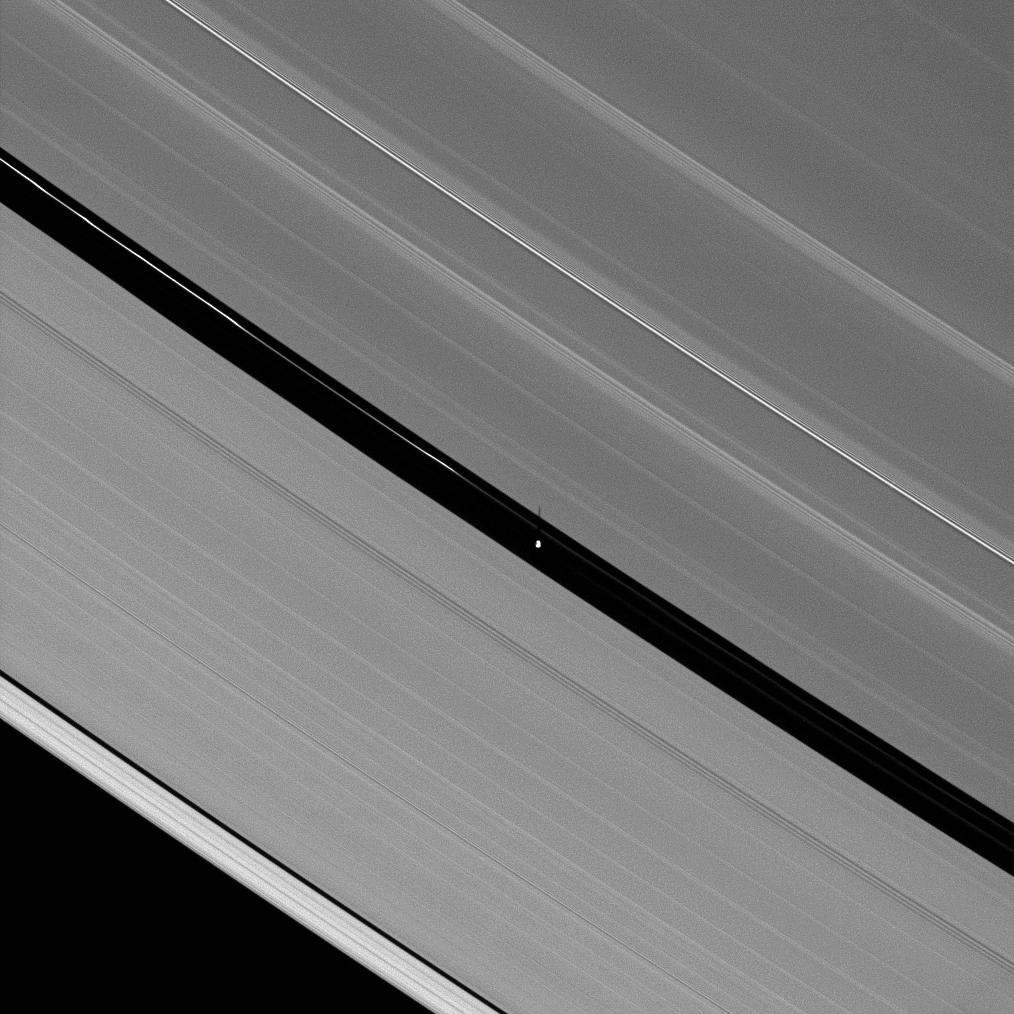
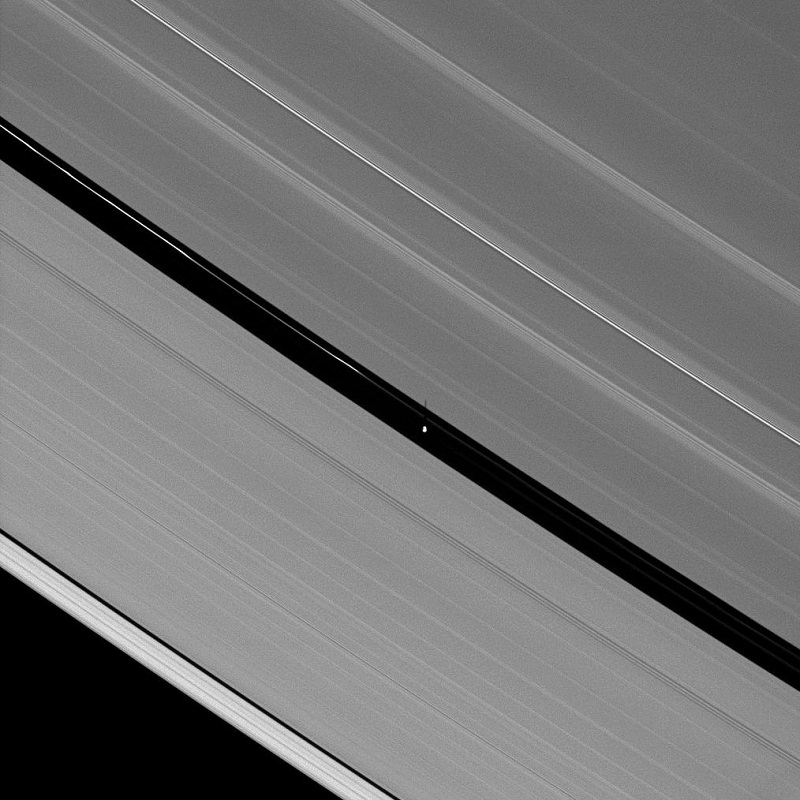
“February 12, 2009. Wendy Darling famously helped Peter Pan catch his shadow, and now Cassini captures the shadow of another Pan: Saturn’s 30-kilometer (19-mile) wide moon inhabiting the Encke Gap. In the center of this image, the shadow of Pan is a short streak thrown over the edge of the A ring where Pan travels its path through the Encke Gap.

One of the happy results of Saturn’s 29-year revolution around the sun is the changing elevation of the sun seen from the planet, and the changing elevation of the shadows of the rings and moons that the sun’s apparent motion brings. As Saturn approaches equinox, the angle at which the ringplane is inclined away from the sun will continue to decrease until August 2009, when equinox will bring about an alignment of the plane containing the rings with the rays of the sun. Only around the time of equinox is a moon’s shadow cast on the rings rather than the planet. Between now and equinox in August, the shadows cast by the moons on the rings will grow longer with time.

Cassini scientists planned a series of observations to chronicle these sights, knowing that the resulting images could hold valuable information about vertical displacements in the rings and the orbital inclinations of the shadow-casting moons. These planned images of course hold another reward: the simple but spectacular depiction of the path of sunlight across the solar system.

The image was taken in visible light with NASA’s Cassini spacecraft narrow-angle camera. This view looks toward the un-illuminated side of the rings from about 55 degrees above the ringplane. The view was obtained at a distance of approximately 997,000 kilometers (619,000 miles) from Pan and at a sun-Pan-spacecraft, or phase, angle of 112 degrees. Image scale is 6 kilometers (4 miles) per pixel.”

“After almost 20 years in space, NASA’s Cassini spacecraft begins the final chapter of its remarkable story of exploration: its Grand Finale. Between April and September 2017, Cassini will undertake a daring set of orbits that is, in many ways, like a whole new mission. Following a final close flyby of Saturn’s moon Titan, Cassini will leap over the planet’s icy rings and begin a series of 22 weekly dives between the planet and the rings.

No other mission has ever explored this unique region. What we learn from these final orbits will help to improve our understanding of how giant planets – and planetary systems everywhere – form and evolve.

On the final orbit, Cassini will plunge into Saturn’s atmosphere, sending back new and unique science to the very end. After losing contact with Earth, the spacecraft will burn up like a meteor, becoming part of the planet itself.

Cassini’s Grand Finale is about so much more than the spacecraft’s final dive into Saturn. That dramatic event is the capstone of six months of daring exploration and scientific discovery. And those six months are the thrilling final chapter in a historic 20-year journey.”

Image credit: NASA

 

  • Facebook
  • Google
  • Slashdot
  • Reddit
  • Live
  • TwitThis
May 24, 2017

Solar Eruption

Posted by


NASA Goddard dixit:

“From long, tapered jets to massive explosions of solar material and energy, eruptions on the sun come in many shapes and sizes. Since they erupt at such vastly different scales, jets and the massive clouds — called coronal mass ejections, or CMEs — were previously thought to be driven by different processes.

Scientists from Durham University in the United Kingdom and NASA now propose that a universal mechanism can explain the whole spectrum of solar eruptions. They used 3-D computer simulations to demonstrate that a variety of eruptions can theoretically be thought of as the same kind of event, only in different sizes and manifested in different ways.

The study was motivated by high-resolution observations of filaments from NASA’s Solar Dynamics Observatory, or SDO, and the joint Japan Aerospace Exploration Agency/NASA Hinode satellite. Filaments are dark, serpentine structures that are suspended above the sun’s surface and consist of dense, cold solar material. The onset of CME eruptions had long been known to be associated with filaments, but improved observations have recently shown that jets have similar filament-like structures before eruption too. So the scientists set out to see if they could get their computer simulations to link filaments to jet eruptions as well.

Solar scientists can use computer models like this to help round out their understanding of the observations they see through space telescopes. The models can be used to test different theories, essentially creating simulated experiments that cannot, of course, be performed on an actual star in real life.

The scientists call their proposed mechanism for how these filaments lead to eruptions the breakout model, for the way the stressed filament pushes relentlessly at — and ultimately breaks through — its magnetic restraints into space. They previously used this model to describe CMEs; in this study, the scientists adapted the model to smaller events and were able to reproduce jets in the computer simulations that match the SDO and Hinode observations. Such simulations provide additional confirmation to support the observations that first suggested coronal jets and CMEs are caused in the same way.”

Video credit: NASA’s Goddard Space Flight Center/Genna Duberstein


  • Facebook
  • Google
  • Slashdot
  • Reddit
  • Live
  • TwitThis
May 23, 2017

Nexø I

Posted by


Copenhagen Suborbitals dixit:

“In the summer of 2016, Copenhagen Suborbitals launched one of the most advanced liquid fueled rockets built by a team of volunteer amateurs. Follow the team close up during final preparations for the launch and during the launch of the Nexø I rocket. Enjoy.

Copenhagen Suborbitals is the world’s only manned, amateur space program, 100% crowdfunded and nonprofit. In the future, one of us will fly to space on a home built rocket.”

Video credit: Copenhagen Suborbitals


  • Facebook
  • Google
  • Slashdot
  • Reddit
  • Live
  • TwitThis
May 21, 2017

Crater View

Posted by


NASA dixit:

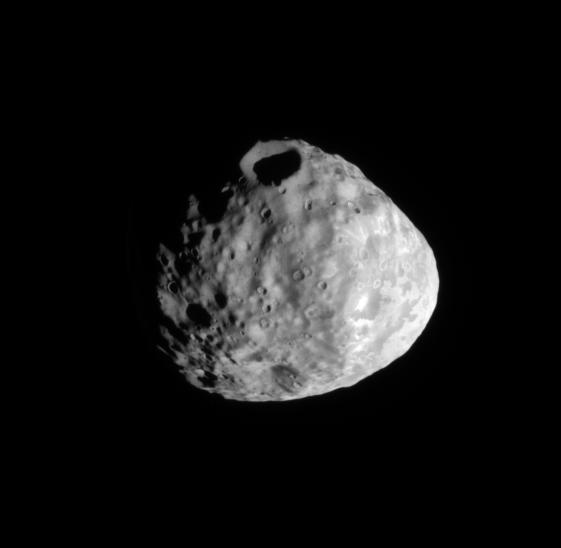
“July 26, 2009. The Cassini spacecraft eyes a prominent crater on the moon Janus. The south pole lies on the terminator at the bottom left of the image. This view is centered on terrain at 16 degrees south latitude, 64 degrees west longitude. This view looks toward the leading hemisphere of Janus (179 kilometers, or 111 miles across). North on Janus is up and rotated 31 degrees to the right. The image was taken in visible light with the Cassini spacecraft narrow-angle camera. The view was acquired at a distance of approximately 98,000 kilometers (61,000 miles) from Janus and at a Sun-Janus-spacecraft, or phase, angle of 58 degrees. Image scale is 586 meters (1,922 feet) per pixel.”

“After almost 20 years in space, NASA’s Cassini spacecraft begins the final chapter of its remarkable story of exploration: its Grand Finale. Between April and September 2017, Cassini will undertake a daring set of orbits that is, in many ways, like a whole new mission. Following a final close flyby of Saturn’s moon Titan, Cassini will leap over the planet’s icy rings and begin a series of 22 weekly dives between the planet and the rings.

No other mission has ever explored this unique region. What we learn from these final orbits will help to improve our understanding of how giant planets – and planetary systems everywhere – form and evolve.

On the final orbit, Cassini will plunge into Saturn’s atmosphere, sending back new and unique science to the very end. After losing contact with Earth, the spacecraft will burn up like a meteor, becoming part of the planet itself.

Cassini’s Grand Finale is about so much more than the spacecraft’s final dive into Saturn. That dramatic event is the capstone of six months of daring exploration and scientific discovery. And those six months are the thrilling final chapter in a historic 20-year journey.”

Image credit: NASA


  • Facebook
  • Google
  • Slashdot
  • Reddit
  • Live
  • TwitThis
May 21, 2017

ExoMars Rover

Posted by


ESA dixit:

“The ExoMars Rover, developed by ESA, provides key mission capabilities: surface mobility, subsurface drilling and automatic sample collection, processing, and distribution to instruments. It hosts a suite of analytical instruments dedicated to exobiology and geochemistry research: this is the Pasteur payload.

The Rover uses solar panels to generate the required electrical power, and is designed to survive the cold Martian nights with the help of novel batteries and heater units. Due to the infrequent communication opportunities, only 1 or 2 short sessions per sol (Martian day), the ExoMars Rover is highly autonomous. Scientists on Earth will designate target destinations on the basis of compressed stereo images acquired by the cameras mounted on the Rover mast.

The Rover must then calculate navigation solutions and safely travel approximately 100 m per sol. To achieve this, it creates digital maps from navigation stereo cameras and computes a suitable trajectory. Close-up collision avoidance cameras are used to ensure safety.

The locomotion is achieved through six wheels. Each wheel pair is suspended on an independently pivoted bogie (the articulated assembly holding the wheel drives), and each wheel can be independently steered and driven. All wheels can be individually pivoted to adjust the Rover height and angle with respect to the local surface, and to create a sort of walking ability, particularly useful in soft, non-cohesive soils like dunes. In addition, inclinometers and gyroscopes are used to enhance the motion control robustness. Finally, Sun sensors are utilised to determine the Rover’s absolute attitude on the Martian surface and the direction to Earth.

The camera system’s images, combined with ground penetrating radar data collected while travelling, will allow scientists on-ground to define suitable drilling locations.The Rover subsurface sampling device will then autonomously drill to the required depth (maximum 2 m) while investigating the borehole wall mineralogy, and collect a small sample. This sample will be delivered to the analytical laboratory in the heart of the vehicle. The laboratory hosts four different instruments and several support mechanisms. The sample will be crushed into a fine powder. By means of a dosing station the powder will then be presented to other instruments for performing a detailed chemistry, physical, and spectral analyses.”

Video credit: ESA


  • Facebook
  • Google
  • Slashdot
  • Reddit
  • Live
  • TwitThis