OrbitalHub

The place where space exploration, science, and engineering meet

Domain is for sale. $50,000,000.00 USD. Direct any inquiries to contact@orbitalhub.com.

Archive for 2017

June 8, 2017

Dragon Arrives at the Space Station

Posted by


NASA dixit:

“The SpaceX/Dragon cargo ship arrived at the International Space Station after a two-day journey to deliver about 7,600 pounds of supplies and science experiments to the Expedition 52 crew. Following its launch atop the SpaceX Falcon 9 rocket June 3 from the Kennedy Space Center, Florida, Dragon was captured by Expedition 52 Flight Engineer Jack Fischer of NASA using the station’s Canadian-built robotic arm. Ground controllers then took control of the robotic arm, maneuvering Dragon to the Earth-facing port of the Harmony module, where it was installed and bolted into place. Dragon is scheduled to remain at the station for a month before it is unberthed and deorbited for a parachute-assisted splashdown in the Pacific Ocean.”

Video credit: NASA


  • Facebook
  • Google
  • Slashdot
  • Reddit
  • Live
  • TwitThis
June 4, 2017

SpaceX CRS-11 Launch

Posted by


NASA dixit:

“The SpaceX Falcon 9 rocket lifted off on June 3 from Launch Pad 39A at the Kennedy Space Center, Florida, carrying the uncrewed Dragon cargo ship to orbit for the start of a delivery run to the residents of the International Space Station. Loaded with about 6,000 pounds of supplies and science experiments, Dragon is scheduled to arrive at the station on June 5, where it will be captured by Expedition 52 Flight Engineer Jack Fischer of NASA using the station’s Canadian-built robotic arm. Dragon is scheduled to remain at the station for a month before it is unberthed and deorbited for a parachute-assisted splashdown in the Pacific Ocean.”

Video credit: NASA


  • Facebook
  • Google
  • Slashdot
  • Reddit
  • Live
  • TwitThis
June 2, 2017

Giant Propeller in A Ring

Posted by


NASA dixit:

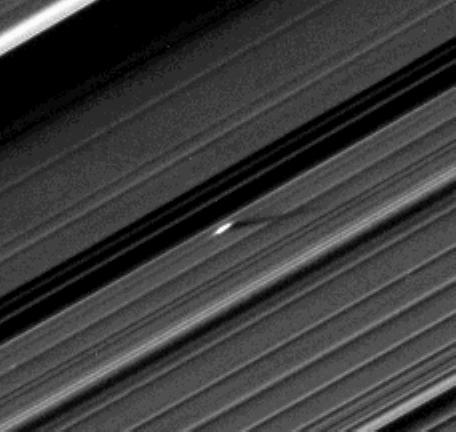
“August 13, 2009. An unusually large propeller feature is detected just beyond the Encke Gap in this Cassini image of Saturn’s outer A ring taken a couple days after the planet’s August 2009 equinox.

The unique geometry of equinox has thrown into relief small moonlets within the rings and the structures they create around them. Propeller-like features, a few kilometers long, centered on and created by the action of small embedded moonlets only about 100 meters across, were discovered early in the mission. These previous findings constituted the first recognition of the presence in Saturn’s rings of bodies bigger than the largest ring particles (about 10 meters, or 30 feet, across) but smaller than the 8-kilometer-wide (5-mile-wide) ring moon, Daphnis, in the outer A ring.

From the 350-kilometer (220-mile) length of the shadow cast by this 130-kilometer-long (80-mile-long) propeller, the heights of these features above the ring plane have been measured to reach about 200 meters (650 feet), indicating the moonlet responsible for the propeller in this image is likely to be 400 meters (1,300 feet) across.

Cassini scientists have tracked several individual propeller moons embedded in Saturn’s A ring over several years. The A ring is the outermost of Saturn’s main rings. Imaging scientists nicknamed the propeller shown here “Earhart” after the American aviatrix Amelia Earhart.

It has since become a growing realization resulting from Cassini’s exploration of Saturn that the objects forming Saturn’s rings very likely span the full spectrum of sizes, from the smallest dust-sized ring particles to the ring-moons like Daphnis and 29-kilometer-wide (18-mile-wide) Pan — a significant advance in divining the origin of Saturn’s rings.

The novel illumination geometry that accompanies equinox lowers the sun’s angle to the ring plane, significantly darkens the rings, and causes out-of-plane structures to cast long shadows across the rings. (The rings have been brightened in this image to enhance visibility.) These scenes are possible only during the few months before and after Saturn’s equinox which occurs only once in about 15 Earth years.

This view looks toward the northern side of the rings from about 20 degrees above the ring plane. The image was taken in visible light with the Cassini spacecraft narrow-angle camera. The view was acquired at a distance of approximately 1.2 million kilometers (746,000 miles) from Saturn and at a sun-Saturn-spacecraft, or phase, angle of 87 degrees. Image scale is 7 kilometers (4 miles) per pixel.”

“After almost 20 years in space, NASA’s Cassini spacecraft begins the final chapter of its remarkable story of exploration: its Grand Finale. Between April and September 2017, Cassini will undertake a daring set of orbits that is, in many ways, like a whole new mission. Following a final close flyby of Saturn’s moon Titan, Cassini will leap over the planet’s icy rings and begin a series of 22 weekly dives between the planet and the rings.

No other mission has ever explored this unique region. What we learn from these final orbits will help to improve our understanding of how giant planets – and planetary systems everywhere – form and evolve.

On the final orbit, Cassini will plunge into Saturn’s atmosphere, sending back new and unique science to the very end. After losing contact with Earth, the spacecraft will burn up like a meteor, becoming part of the planet itself.

Cassini’s Grand Finale is about so much more than the spacecraft’s final dive into Saturn. That dramatic event is the capstone of six months of daring exploration and scientific discovery. And those six months are the thrilling final chapter in a historic 20-year journey.”

Image credit: NASA

 

  • Facebook
  • Google
  • Slashdot
  • Reddit
  • Live
  • TwitThis


NASA dixit:

“Expedition 51 Flight Engineer and Soyuz Commander Oleg Novitskiy of the Russian Federal Space Agency (Roscosmos) and Flight Engineer Thomas Pesquet of ESA (European Space Agency) landed safely near the town of Dzhezkazgan, Kazakhstan June 2 after bidding farewell to their colleagues on the International Space Station and undocking their Soyuz MS-03 spacecraft from the Rassvet Module on the Russian segment of the complex. The two crew members spent 196 days in space overall and 194 days on the station conducting research and operational work.”

Video credit: NASA / Roscosmos


  • Facebook
  • Google
  • Slashdot
  • Reddit
  • Live
  • TwitThis
May 31, 2017

Dust Devils on Mars

Posted by


NASA dixit:

“On Mars, wind rules. Wind has been shaping the Red Planet’s landscapes for billions of years and continues to do so today. Studies using both a NASA orbiter and a rover reveal its effects on scales grand to tiny on the strangely structured landscapes within Gale Crater.

NASA’s Curiosity Mars rover, on the lower slope of Mount Sharp — a layered mountain inside the crater — has begun a second campaign of investigating active sand dunes on the mountain’s northwestern flank. The rover also has been observing whirlwinds carrying dust and checking how far the wind moves grains of sand in a single day’s time.

Gale Crater observations by NASA’s Mars Reconnaissance Orbiter have confirmed long-term patterns and rates of wind erosion that help explain the oddity of having a layered mountain in the middle of an impact crater.

“The orbiter perspective gives us the bigger picture — on all sides of Mount Sharp and the regional context for Gale Crater. We combine that with the local detail and ground-truth we get from the rover,” said Mackenzie Day of the University of Texas, Austin, lead author of a research report in the journal Icarus about wind’s dominant role at Gale.

The combined observations show that wind patterns in the crater today differ from when winds from the north removed the material that once filled the space between Mount Sharp and the crater rim. Now, Mount Sharp itself has become a major factor in determining local wind directions. Wind shaped the mountain; now the mountain shapes the wind.

The Martian atmosphere is about a hundred times thinner than Earth’s, so winds on Mars exert much less force than winds on Earth. Time is the factor that makes Martian winds so dominant in shaping the landscape. Most forces that shape Earth’s landscapes — water that erodes and moves sediments, tectonic activity that builds mountains and recycles the planet’s crust, active volcanism — haven’t influenced Mars much for billions of years. Sand transported by wind, even if infrequent, can whittle away Martian landscapes over that much time.”

Video credit: NASA Jet Propulsion Laboratory


  • Facebook
  • Google
  • Slashdot
  • Reddit
  • Live
  • TwitThis
May 28, 2017

Pan’s Lengthening Shadow

Posted by


NASA dixit:

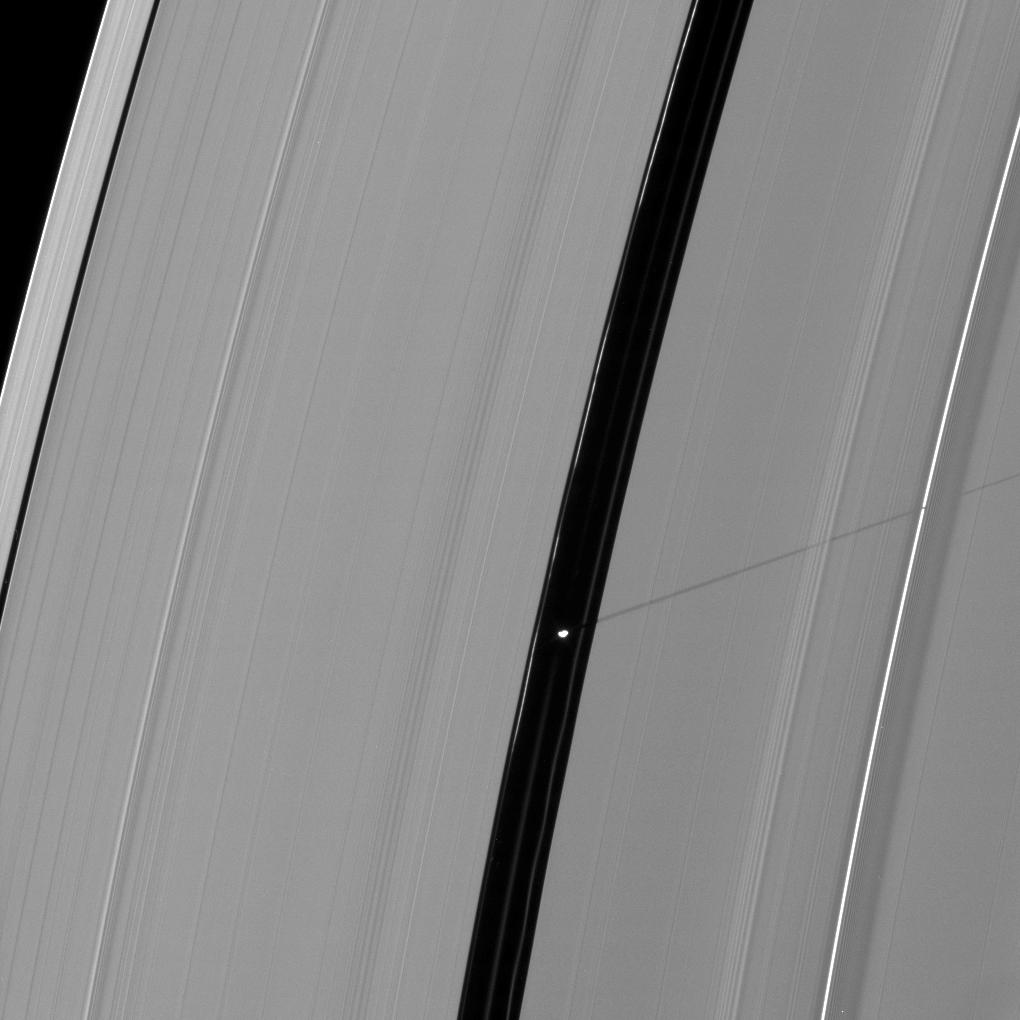
“July 27, 2009. The novel illumination geometry created around the time of Saturn’s August 2009 equinox allows moons orbiting in or near the plane of Saturn’s equatorial rings to cast shadows onto the rings. These scenes are possible only during the few months before and after Saturn’s equinox, which occurs only once in about 15 Earth years.

Pan (28 kilometers, or 17 miles across) orbits in the Encke Gap. This view looks toward the unilluminated side of the rings from about 34 degrees above the ring plane. The image was taken in visible light with the Cassini spacecraft narrow-angle camera. The view was acquired at a distance of approximately 839,000 kilometers (521,000 miles) from Pan and at a Sun-Pan-spacecraft, or phase, angle of 74 degrees. Image scale is 5 kilometers (3 miles) per pixel.”

“After almost 20 years in space, NASA’s Cassini spacecraft begins the final chapter of its remarkable story of exploration: its Grand Finale. Between April and September 2017, Cassini will undertake a daring set of orbits that is, in many ways, like a whole new mission. Following a final close flyby of Saturn’s moon Titan, Cassini will leap over the planet’s icy rings and begin a series of 22 weekly dives between the planet and the rings.

No other mission has ever explored this unique region. What we learn from these final orbits will help to improve our understanding of how giant planets – and planetary systems everywhere – form and evolve.

On the final orbit, Cassini will plunge into Saturn’s atmosphere, sending back new and unique science to the very end. After losing contact with Earth, the spacecraft will burn up like a meteor, becoming part of the planet itself.

Cassini’s Grand Finale is about so much more than the spacecraft’s final dive into Saturn. That dramatic event is the capstone of six months of daring exploration and scientific discovery. And those six months are the thrilling final chapter in a historic 20-year journey.”

Image credit: NASA


  • Facebook
  • Google
  • Slashdot
  • Reddit
  • Live
  • TwitThis