OrbitalHub

The place where space exploration, science, and engineering meet

Domain is for sale. $50,000,000.00 USD. Direct any inquiries to contact@orbitalhub.com.

Archive for 2017

June 14, 2017

Progress MS-06 Rollout and Launch

Posted by


NASA dixit:

“The unpiloted Russian ISS Progress 67 cargo ship launched atop a Soyuz booster June 14 from the Baikonur Cosmodrome in Kazakhstan on a two-day journey to the International Space Station. The new Progress, which is carrying three tons of food, fuel and supplies for the residents of the orbital complex, is scheduled to automatically dock to the rear port of the station’s Zvezda Service Module on June 16. It will remain attached to the station through December.”

Video credit: NASA/Roscosmos


  • Facebook
  • Google
  • Slashdot
  • Reddit
  • Live
  • TwitThis
June 13, 2017

Lithospheric Magnetic Field

Posted by


ESA dixit:

“ESA’s Swarm satellites are seeing fine details in one of the most difficult layers of Earth’s magnetic field to unpick – as well as our planet’s magnetic history imprinted on Earth’s crust. Earth’s magnetic field can be thought of as a huge cocoon, protecting us from cosmic radiation and charged particles that bombard our planet in solar wind. Without it, life as we know it would not exist. Most of the field is generated at depths greater than 3000 km by the movement of molten iron in the outer core. The remaining 6% is partly due to electrical currents in space surrounding Earth, and partly due to magnetised rocks in the upper lithosphere – the rigid outer part of Earth, consisting of the crust and upper mantle.

Although this ‘lithospheric magnetic field’ is very weak and therefore difficult to detect from space, the Swarm trio is able to map its magnetic signals. After three years of collecting data, the highest resolution map of this field from space to date has been released.

“By combining Swarm measurements with historical data from the German CHAMP satellite, and using a new modelling technique, it was possible to extract the tiny magnetic signals of crustal magnetisation,†explained Nils Olsen from the Technical University of Denmark, one of the scientists behind the new map. ESA’s Swarm mission manager, Rune Floberghagen, added: “Understanding the crust of our home planet is no easy feat. We can’t simply drill through it to measure its structure, composition and history. “Measurements from space have great value as they offer a sharp global view on the magnetic structure of our planet’s rigid outer shell.â€

The magnetic field is in a permanent state of flux. Magnetic north wanders, and every few hundred thousand years the polarity flips so that a compass would point south instead of north. When new crust is generated through volcanic activity, mainly along the ocean floor, iron-rich minerals in the solidifying magma are oriented towards magnetic north, thus capturing a ‘snapshot’ of the magnetic field in the state it was in when the rocks cooled. Since magnetic poles flip back and forth over time, the solidified minerals form ‘stripes’ on the seafloor and provide a record of Earth’s magnetic history.”

Video credit: ESA


  • Facebook
  • Google
  • Slashdot
  • Reddit
  • Live
  • TwitThis
June 11, 2017

Epimetheus, Rings and Spokes

Posted by


NASA dixit:

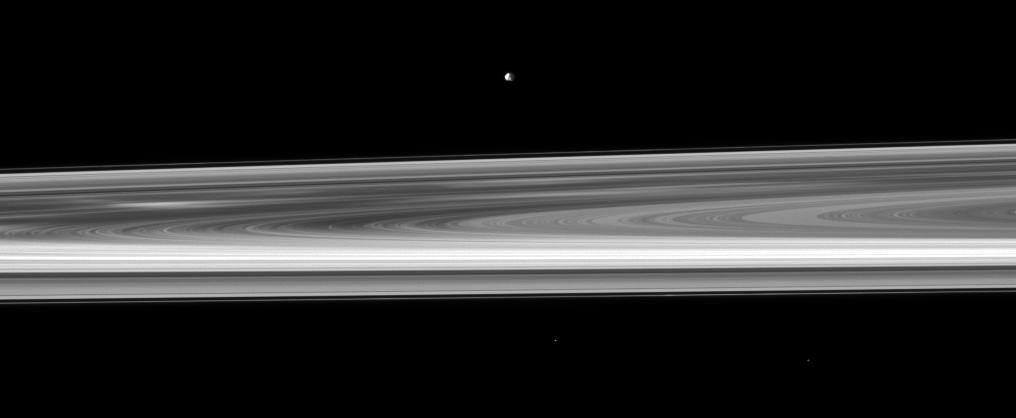
“October 18, 2009. Orbiting near the plane of Saturn’s rings, the Cassini spacecraft looks across the span of the rings to spy the small moon Epimetheus. The brightest spoke is visible on the left of the image, but others can be seen near the middle of the image and elsewhere on the B ring.

This view looks toward the northern, sunlit side of the rings from about 1 degree above the ringplane. Cassini is closer to the rings than to Epimetheus (113 kilometers, or 70 miles across). Two background stars are visible. The image was taken in visible light with the Cassini spacecraft narrow-angle camera. The view was acquired at a distance of approximately 2.2 million kilometers (1.4 million miles) from Epimetheus. Image scale is 13 kilometers (8 miles) per pixel.”

“After almost 20 years in space, NASA’s Cassini spacecraft begins the final chapter of its remarkable story of exploration: its Grand Finale. Between April and September 2017, Cassini will undertake a daring set of orbits that is, in many ways, like a whole new mission. Following a final close flyby of Saturn’s moon Titan, Cassini will leap over the planet’s icy rings and begin a series of 22 weekly dives between the planet and the rings.

No other mission has ever explored this unique region. What we learn from these final orbits will help to improve our understanding of how giant planets – and planetary systems everywhere – form and evolve.

On the final orbit, Cassini will plunge into Saturn’s atmosphere, sending back new and unique science to the very end. After losing contact with Earth, the spacecraft will burn up like a meteor, becoming part of the planet itself.

Cassini’s Grand Finale is about so much more than the spacecraft’s final dive into Saturn. That dramatic event is the capstone of six months of daring exploration and scientific discovery. And those six months are the thrilling final chapter in a historic 20-year journey.”

Image credit: NASA

 

  • Facebook
  • Google
  • Slashdot
  • Reddit
  • Live
  • TwitThis
June 11, 2017

Proton-M Launch with EchoStar 21

Posted by


Wikipedia dixit:

“EchoStar was originally formed in 1980 as a distributor of C band TV systems. In 1987, it applied for a direct broadcast satellite (DBS) license with the Federal Communications Commission and was granted access to orbital slot 119° west longitude in 1992. On December 28, 1995, the firm successfully launched its first satellite, EchoStar I. On March 4, 1996, it established the Dish Network brand name to market its home satellite TV system.

In 1998, EchoStar purchased the broadcasting assets of a satellite broadcasting joint venture of News Corporation’s ASkyB and MCI Worldcom. With this purchase the firm obtained 28 of the 32 transponder licenses in the 110° W orbital slot, more than doubling existing CONUS broadcasting capacity at a value of $682.5 million. The acquisition inspired the company to introduce a multi-satellite system called DISH 500, theoretically capable of receiving more than 500 channels on one dish.
“Legacy” represent the 950 to 1450 MHz frequencies used to deliver the signal throughout the home; the signal is broadcast to the home on the Ku band from satellite (12.2-12.7 GHz). Ku frequencies will not work on home wiring, the signal is downconverted to the intermediate frequency (IF) of 950-1450 MHz at the dish antenna. Newer technology (DishPro) also uses 1650-2150 MHz in addition to 950-1450.

Also in 1998, the firm, in association with Bell Canada, launched Bell TV. On September 25, 2007, the firm announced it had agreed to acquire Sling Media, Inc.
On January 2, 2008, the Dish Network business was demerged from the technology and infrastructure side of the business. A split in the shares created two companies, DISH Network Corporation which consists mainly of the DISH Network business, and EchoStar Corporation which retains ownership of the technology side including the satellites, Sling Media, and the set-top box development arm. DISH Network completed its distribution to Echostar of its digital set-top box business, certain infrastructure, and other assets and related liabilities, including certain of their satellites, uplink and satellite transmission assets, and real estate (the “Spin-off”). Since the Spin-off, EchoStar and DISH Network have operated as separate publicly-traded companies. However, as a result of the Satellite and Tracking Stock Transaction, DISH Network owns shares of EchoStar and their subsidiary’s preferred tracking stock representing an aggregate 80.0% economic interest in the residential retail satellite broadband business of their Hughes segment.

EchoStar 21 will provide mobile broadband services over Europe with an S-band payload for EchoStar Mobile Ltd (formerly known as TerreStar 2).”

Video credit: Roscosmos


  • Facebook
  • Google
  • Slashdot
  • Reddit
  • Live
  • TwitThis
June 10, 2017

CRS-11 First Stage Landing

Posted by


Wikipedia dixit:

“SpaceX CRS-11, also known as SpX-11, is a current cargo resupply mission to the International Space Station, launched successfully on 3 June 2017. The mission was contracted by NASA and is being flown by SpaceX. The mission utilized a Falcon 9 launch rocket and reuses a Dragon v1 cargo vessel that was previously flown on the CRS-4 mission. CRS-11 is the penultimate of the first twelve missions awarded to SpaceX under the CRS contract to resupply the International Space Station.

This was the first time that a Dragon spacecraft is reused, helping SpaceX to scale back its production line and shift focus to Dragon 2. CRS-11 launched aboard a Falcon 9 rocket on 3 June 2017 at 21:07 UTC from Kennedy Space Center’s Launch Complex 39A. The spacecraft rendezvoused with the station on 5 June and conducted a series of orbit adjustment burns to match speed, altitude, and orientation with the ISS. After arriving at the capture point at 13:37 UTC, the vehicle was snared at 13:52 UTC by Canadarm2, operated by Peggy Whitson and Jack Fischer. It was berthed to the Harmony module at 16:07 UTC, where it will reside until 2 July 2017.

The first stage landed successfully on Landing Zone 1, making it the fifth successful touch down on land and the 11th overall.”

Video credit: SpaceX


  • Facebook
  • Google
  • Slashdot
  • Reddit
  • Live
  • TwitThis
June 8, 2017

A Small Find Near Equinox

Posted by


NASA dixit:

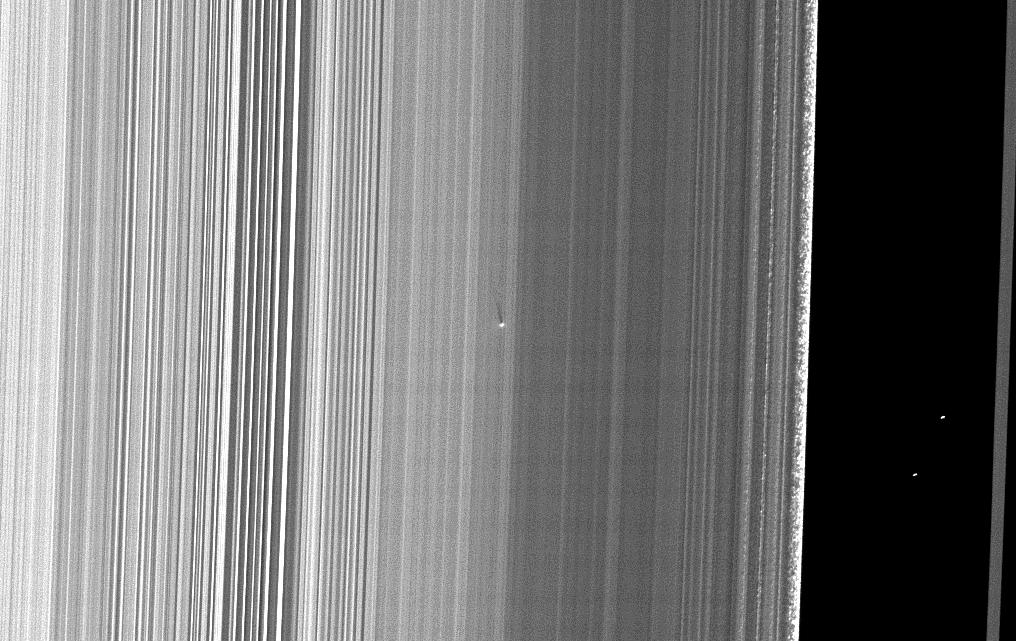
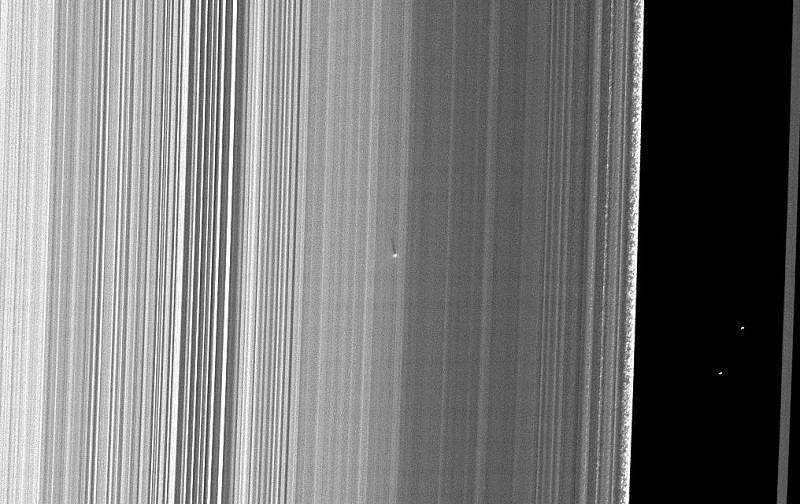
“July 26, 2009. The Cassini spacecraft captured this image of a small object in the outer portion of Saturn’s B ring casting a shadow on the rings as Saturn approaches its August 2009 equinox. This new moonlet, situated about 300 miles (480 kilometers), inward from the outer edge of the B ring, was found by detection of its shadow which stretches 25 miles, or 41 kilometers, across the rings. The shadow length implies the moonlet is protruding about 660 feet, or 200 meters, above the ring plane. If the moonlet is orbiting in the same plane as the ring material surrounding it, which is likely, it must be about 1,300 feet, or 400 meters, across.

This object is not attended by a propeller feature, unlike the band of moonlets discovered in Saturn’s A ring earlier by Cassini. The A ring moonlets, which have not been directly imaged, were found because of the propeller-like narrow gaps on either side of them that they create as they orbit within the rings. The lack of a propeller feature surrounding the new moonlet is likely because the B ring is dense, and the ring material in a dense ring would be expected to fill in any gaps around the moonlet more quickly than in a less dense region like the mid-A ring. Also, it may simply be harder in the first place for a moonlet to create propeller-like gaps in a dense ring.

This image and others like it are only possible around the time of Saturn’s equinox which occurs every half-Saturn-year (equivalent to about 15 Earth years). The illumination geometry that accompanies equinox lowers the sun’s angle to the ring plane and causes out-of-plane structures to cast long shadows across the rings. This view looks toward the sunlit side of the rings from about 42 degrees below the ring plane. Background stars are visible on the right of the image. They appear elongated by the camera’s exposure time.

The image was taken in visible light with the Cassini spacecraft narrow-angle camera. The view was obtained at a distance of approximately 296,000 kilometers (184,000 miles) from Saturn and at a Sun-Saturn-spacecraft, or phase, angle of 120 degrees. Image scale is 1 kilometer (4,680 feet) per pixel.”

“After almost 20 years in space, NASA’s Cassini spacecraft begins the final chapter of its remarkable story of exploration: its Grand Finale. Between April and September 2017, Cassini will undertake a daring set of orbits that is, in many ways, like a whole new mission. Following a final close flyby of Saturn’s moon Titan, Cassini will leap over the planet’s icy rings and begin a series of 22 weekly dives between the planet and the rings.

No other mission has ever explored this unique region. What we learn from these final orbits will help to improve our understanding of how giant planets – and planetary systems everywhere – form and evolve.

On the final orbit, Cassini will plunge into Saturn’s atmosphere, sending back new and unique science to the very end. After losing contact with Earth, the spacecraft will burn up like a meteor, becoming part of the planet itself.

Cassini’s Grand Finale is about so much more than the spacecraft’s final dive into Saturn. That dramatic event is the capstone of six months of daring exploration and scientific discovery. And those six months are the thrilling final chapter in a historic 20-year journey.”

Image credit: NASA


  • Facebook
  • Google
  • Slashdot
  • Reddit
  • Live
  • TwitThis