OrbitalHub

The place where space exploration, science, and engineering meet

Domain is for sale. $50,000,000.00 USD. Direct any inquiries to contact@orbitalhub.com.

Archive for 2017

July 1, 2017

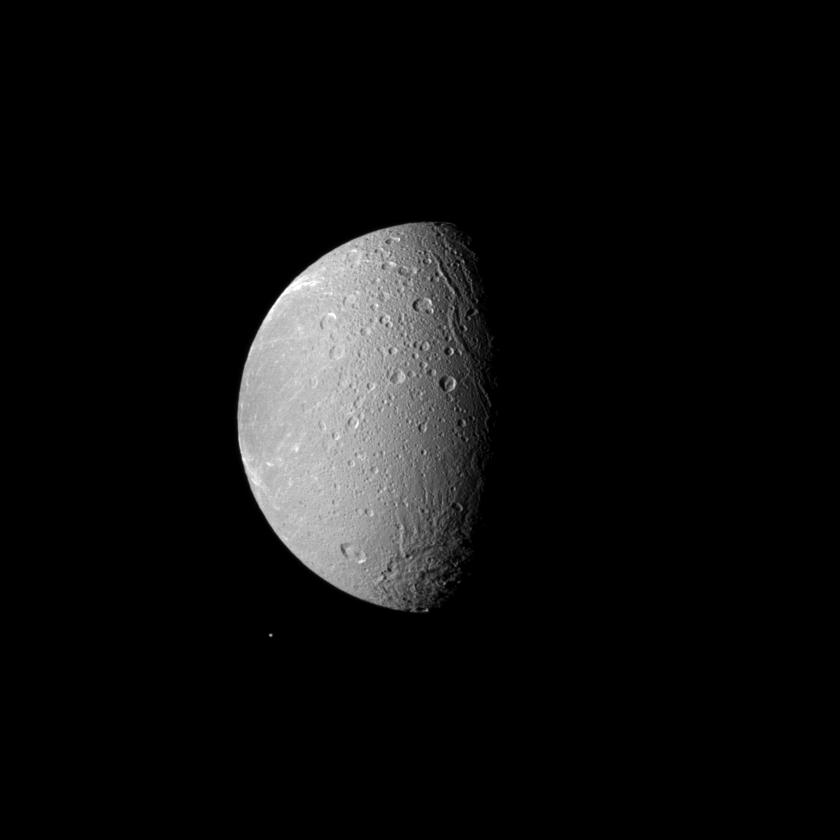
Dione and Telesto

Posted by


NASA dixit:

“March 4, 2010. Saturn’s moon Dione dwarfs the moon Telesto in this Cassini spacecraft image. Dione (1123 kilometers, 698 miles across) is the fourth largest of Saturn’s moons, and it dominates this view. Tiny Telesto (25 kilometers, or 16 miles across) can be seen below and to the left of Dione. This view looks toward the anti-Saturn side of Dione. North on Dione is up. The image was taken in visible light with the Cassini spacecraft narrow-angle camera. The view was acquired at a distance of approximately 477,000 kilometers (296,000 miles) from Dione and at a Sun-Dione-spacecraft, or phase, angle of 72 degrees. Scale on Dione is 3 kilometers (2 miles) per pixel.”

“After almost 20 years in space, NASA’s Cassini spacecraft begins the final chapter of its remarkable story of exploration: its Grand Finale. Between April and September 2017, Cassini will undertake a daring set of orbits that is, in many ways, like a whole new mission. Following a final close flyby of Saturn’s moon Titan, Cassini will leap over the planet’s icy rings and begin a series of 22 weekly dives between the planet and the rings.

No other mission has ever explored this unique region. What we learn from these final orbits will help to improve our understanding of how giant planets – and planetary systems everywhere – form and evolve.

On the final orbit, Cassini will plunge into Saturn’s atmosphere, sending back new and unique science to the very end. After losing contact with Earth, the spacecraft will burn up like a meteor, becoming part of the planet itself.

Cassini’s Grand Finale is about so much more than the spacecraft’s final dive into Saturn. That dramatic event is the capstone of six months of daring exploration and scientific discovery. And those six months are the thrilling final chapter in a historic 20-year journey.”

Image credit: NASA


  • Facebook
  • Google
  • Slashdot
  • Reddit
  • Live
  • TwitThis
July 1, 2017

Parker Solar Probe

Posted by


Wikipedia dixit:

“Parker Solar Probe is a planned NASA robotic spacecraft to probe the outer corona of the Sun. It will approach to within 8.5 solar radii (5.9 million kilometers or 3.67 million miles) to the ‘surface’ (photosphere) of the Sun. The project was announced as a new mission start in the fiscal 2009 budget year. On May 1, 2008 Johns Hopkins University Applied Physics Laboratory announced it will design and build the spacecraft, on a schedule to launch it in 2015. The launch date has since been pushed back to 2018, with the Delta IV Heavy as the launch vehicle. On May 31, 2017 the probe was renamed after solar astrophysicist Eugene Parker. According to NASA, this was the first time in history a space vessel was named after a living person.

The Parker Solar Probe mission design uses repeated gravity assists at Venus to incrementally decrease the orbital perihelion to achieve multiple passes of the Sun at approximately 8.5 solar radii, or about 6 million km (3.7 million mi; 0.040 AU). The mission is designed to survive the harsh environment near the Sun, where the incident solar intensity is approximately 520 times the intensity at Earth orbit, by the use of a solar shadow-shield. The solar shield, at the front of the spacecraft, is made of reinforced carbon-carbon composite. The spacecraft systems and scientific instruments are located in the shadow umbra of the shield, where direct light from the sun is fully blocked. The primary power for the mission will be by use of a dual system of photovoltaic arrays. A primary photovoltaic array, used for the portion of the mission outside 0.25 AU, is retracted behind the shadow shield during the close approach to the Sun, and a much smaller secondary array powers the spacecraft through closest approach. This secondary array uses pumped-fluid cooling to maintain operating temperature. As the probe passes around the Sun, it will achieve a velocity of up to 200 km/s (120 mi/s) making it by any measure, the fastest manmade object ever, almost three times faster than the current record holder, Helios 2.”

Video credit: NASA


  • Facebook
  • Google
  • Slashdot
  • Reddit
  • Live
  • TwitThis
June 29, 2017

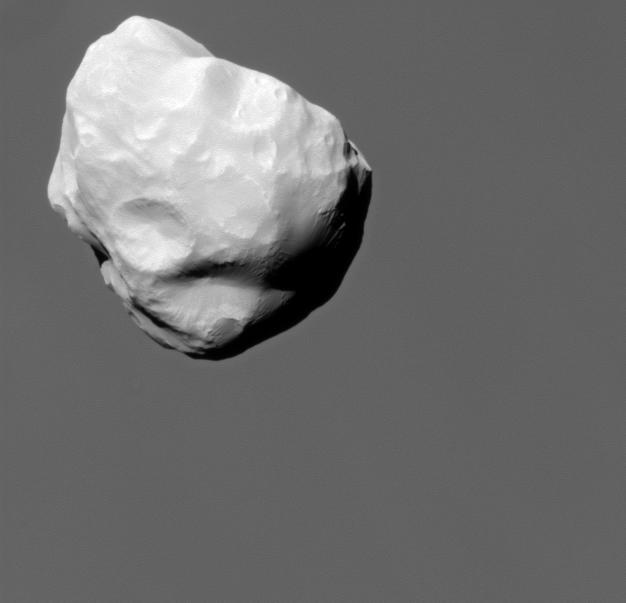
Closest View of Helene

Posted by


NASA dixit:

“March 3, 2010. The Cassini spacecraft snapped this image during the spacecraft’s closest flyby of Saturn’s moon Helene (33 kilometers, or 21 miles across). The small moon leads the much larger Dione by 60 degrees in the moons’ shared orbit. Helene is a “Trojan” moon of Dione, named for the Trojan asteroids that orbit 60 degrees ahead of and behind Jupiter as the giant planet circles the Sun.

Lit terrain seen here is on the anti-Saturn side of Helene. The south pole of the moon is in the lower right of the image. The image was taken in visible light with the Cassini spacecraft wide-angle camera. The view was obtained at a distance of approximately 1,900 kilometers (1,200 miles) from Helene and at a Sun-Helene-spacecraft, or phase, angle of 90 degrees. Scale in the original image was 235 meters (771 feet) per pixel. The image has been magnified by a factor of two and contrast-enhanced to aid visibility.”

“After almost 20 years in space, NASA’s Cassini spacecraft begins the final chapter of its remarkable story of exploration: its Grand Finale. Between April and September 2017, Cassini will undertake a daring set of orbits that is, in many ways, like a whole new mission. Following a final close flyby of Saturn’s moon Titan, Cassini will leap over the planet’s icy rings and begin a series of 22 weekly dives between the planet and the rings.

No other mission has ever explored this unique region. What we learn from these final orbits will help to improve our understanding of how giant planets – and planetary systems everywhere – form and evolve.

On the final orbit, Cassini will plunge into Saturn’s atmosphere, sending back new and unique science to the very end. After losing contact with Earth, the spacecraft will burn up like a meteor, becoming part of the planet itself.

Cassini’s Grand Finale is about so much more than the spacecraft’s final dive into Saturn. That dramatic event is the capstone of six months of daring exploration and scientific discovery. And those six months are the thrilling final chapter in a historic 20-year journey.”

Image credit: NASA


  • Facebook
  • Google
  • Slashdot
  • Reddit
  • Live
  • TwitThis
June 29, 2017

The Future of the Orion Constellation

Posted by


ESA dixit:

“Video, based on measurements by ESA’s Gaia and Hipparcos satellites, shows how our view of the Orion constellation will evolve over the next 450 000 years. Stars are not motionless in the sky: their positions change continuously as they move through our Galaxy, the Milky Way. These motions, too slow to be appreciated with the naked eye over a human lifetime, can be captured by high-precision observations like those performed by ESA’s billion-star surveyor, Gaia. By measuring their current movements, we can reconstruct the past trajectories of stars through the Milky Way to study the origins of our Galaxy, and even estimate stellar paths millions of years into the future. This video provides us with a glimpse over the coming 450 000 years, showing the expected evolution of a familiar patch of the sky, featuring the constellation of Orion, the Hunter.

The portion of the sky depicted in the video measures 40 x 20º – as a comparison, the diameter of the full Moon in the sky is about half a degree. Amid a myriad of drifting stars, the shape of Orion as defined by its brightest stars is slowly rearranged into a new pattern as time goes by, revealing how constellations are ephemeral. The red supergiant star Betelgeuse is visible at the centre towards the top of the frame at the beginning of the video (represented in a yellow–orange hue). According to its current motion, the star will move out of this field of view in about 100 000 years. The Universe has a much harsher fate in store for Betelgeuse, which is expected to explode as a supernova within the next million of years.

More of the stars shown in this view will have exploded as supernovas before the end of the video, while others might be still evolving towards that end, like Orion’s blue supergiant, Rigel, visible as the bright star in the lower left, or the red giant Aldebaran, which is part of the constellation Taurus, and can be seen crossing the lower part of the frame from right to left. Many new stars will also have been born from the Orion molecular cloud, a mixture of gas and dust that is not directly seen by Gaia – it can be identified as dark patches against the backdrop of stars – but shines brightly at infrared wavelengths. The birth and demise of stars are not shown in the video. The Hyades cluster, a group of stars that are physically bound together and are also part of the Taurus constellation, slowly makes its way from the lower right corner to the upper left.

The new video is based on data from the Tycho–Gaia Astrometric Solution, a resource that lists distances and motions for two million stars in common between Gaia’s first data release and the Tycho-2 Catalogue from the Hipparcos mission. Additional information from ground-based observations were included, as well as data from the Hipparcos catalogue for the brightest stars in the view.”

Video credit: ESA


  • Facebook
  • Google
  • Slashdot
  • Reddit
  • Live
  • TwitThis
June 25, 2017

20 Years of 24/7 Mars Exploration

Posted by


NASA dixit:

“No one under 20 has experienced a day without NASA at Mars. The Pathfinder mission, carrying the Sojourner rover, landed on Mars on July 4, 1997. In the 20 years since Pathfinder’s touchdown, eight other NASA landers and orbiters have arrived successfully, and not a day has passed without the United States having at least one active robot on Mars or in orbit around Mars.”

Mars Pathfinder

Mars Global Surveyor

2001 Mars Odyssey

Mars Exploration Rover

Mars Reconnaissance Orbiter

Phoenix

Curiosity

MAVEN

Video credit: NASA


  • Facebook
  • Google
  • Slashdot
  • Reddit
  • Live
  • TwitThis
June 22, 2017

Catching Helene

Posted by


NASA dixit:

“March 3, 2010. Although traveling at great speed, the Cassini spacecraft managed to capture this close view of Saturn’s small moon Helene during a flyby. Saturn’s atmosphere makes up the background of this composition. This view looks toward the anti-Saturn side of Helene (33 kilometers, or 21 miles across). North on Helene is up and rotated 44 degrees to the right.

The image was taken in visible light with the Cassini spacecraft narrow-angle camera. The view was obtained at a distance of approximately 19,000 kilometers (12,000 miles) from Helene and at a sun-Helene-spacecraft, or phase, angle of 25 degrees. Image scale is 113 meters (371 feet) per pixel.”

“After almost 20 years in space, NASA’s Cassini spacecraft begins the final chapter of its remarkable story of exploration: its Grand Finale. Between April and September 2017, Cassini will undertake a daring set of orbits that is, in many ways, like a whole new mission. Following a final close flyby of Saturn’s moon Titan, Cassini will leap over the planet’s icy rings and begin a series of 22 weekly dives between the planet and the rings.

No other mission has ever explored this unique region. What we learn from these final orbits will help to improve our understanding of how giant planets – and planetary systems everywhere – form and evolve.

On the final orbit, Cassini will plunge into Saturn’s atmosphere, sending back new and unique science to the very end. After losing contact with Earth, the spacecraft will burn up like a meteor, becoming part of the planet itself.

Cassini’s Grand Finale is about so much more than the spacecraft’s final dive into Saturn. That dramatic event is the capstone of six months of daring exploration and scientific discovery. And those six months are the thrilling final chapter in a historic 20-year journey.”

Image credit: NASA


  • Facebook
  • Google
  • Slashdot
  • Reddit
  • Live
  • TwitThis