“Bricks have been 3D printed out of simulated moondust using concentrated sunlight. This ESA project took place at the DLR German Aerospace Center facility in Cologne, with a 3D printer table attached to a solar furnace, baking successive 0.1 mm layers of moondust at a temperature of 1000°C. A 20 x 10 x 3 cm brick for building can be completed in around five hours. DLR Cologne’s solar furnace has two working setups: as a baseline, it uses 147 curved mirror facets to focus either actual sunlight into a high temperature beam, employed to melt together the grains of regolith. But this mode is weather dependent, so a solar simulator was subsequently employed as well – based on an array of xenon lamps more typically found in cinema projectors.”
“Gale is a crater, and probable dry lake, on Mars near the northwestern part of the Aeolis quadrangle at 5.4°S 137.8°E. It is 154 km (96 mi) in diameter and estimated to be about 3.5-3.8 billion years old. The crater was named after Walter Frederick Gale, an amateur astronomer from Sydney, Australia, who observed Mars in the late 19th century. Aeolis Mons is a mountain in the center of Gale and rises 5.5 km (18,000 ft) high. Aeolis Palus is the plain between the northern wall of Gale and the northern foothills of Aeolis Mons. Peace Vallis, a nearby outflow channel, ‘flows’ down from the Gale crater hills to the Aeolis Palus below and seems to have been carved by flowing water. The NASA Mars rover, Curiosity, of the Mars Science Laboratory (MSL) mission, landed in “Yellowknife” Quad 51 of Aeolis Palus in Gale at 05:32 UTC August 6, 2012. NASA named the landing location Bradbury Landing on August 22, 2012. Curiosity is exploring Aeolis Mons and surrounding areas.
Gale crater, named for Walter F. Gale (1865-1945), an amateur astronomer from Australia, spans 154 km (96 mi) in diameter and holds a mountain, Aeolis Mons (informally named “Mount Sharp” to pay tribute to geologist Robert P. Sharp) rising 18,000 ft (5,500 m) from the crater floor, higher than Mount Rainier rises above Seattle. Gale is roughly the size of Connecticut and Rhode Island.
The crater formed when a meteor hit Mars in its early history, about 3.5 to 3.8 billion years ago. The meteor impact punched a hole in the terrain, and the subsequent explosion ejected rocks and soil that landed around the crater. Layering in the central mound (Aeolis Mons) suggests it is the surviving remnant of an extensive sequence of deposits. Some scientists believe the crater filled in with sediments and, over time, the relentless Martian winds carved Aeolis Mons, which today rises about 5.5 km (3.4 mi) above the floor of Gale—three times higher than the Grand Canyon is deep.
At 10:32 p.m. PDT on Aug. 5, 2012 (1:32 a.m. EDT on Aug. 6, 2012), the Mars Science Laboratory rover, Curiosity, landed on Mars at 4.5°S 137.4°E, at the foot of the layered mountain inside Gale crater. Curiosity landed within a landing ellipse approximately 7 km (4.3 mi) by 20 km (12 mi). The landing ellipse is about 4,400 m (14,400 ft) below Martian “sea level” (defined as the average elevation around the equator). The expected near-surface atmospheric temperatures at the landing site during Curiosity’s primary mission (1 Martian year or 687 Earth days) are from −90 °C (−130 °F) to 0 °C (32 °F).
Scientists chose Gale as the landing site for Curiosity because it has many signs that water was present over its history. The crater’s geology is notable for containing both clays and sulfate minerals, which form in water under different conditions and may also preserve signs of past life. The history of water at Gale, as recorded in its rocks, is giving Curiosity lots of clues to study as it pieces together whether Mars ever could have been a habitat for microbes. Gale Crater contains a number of fans and deltas that provide information about lake levels in the past, including: Pancake Delta, Western Delta, Farah Vallis delta and the Peace Vallis Fan.”
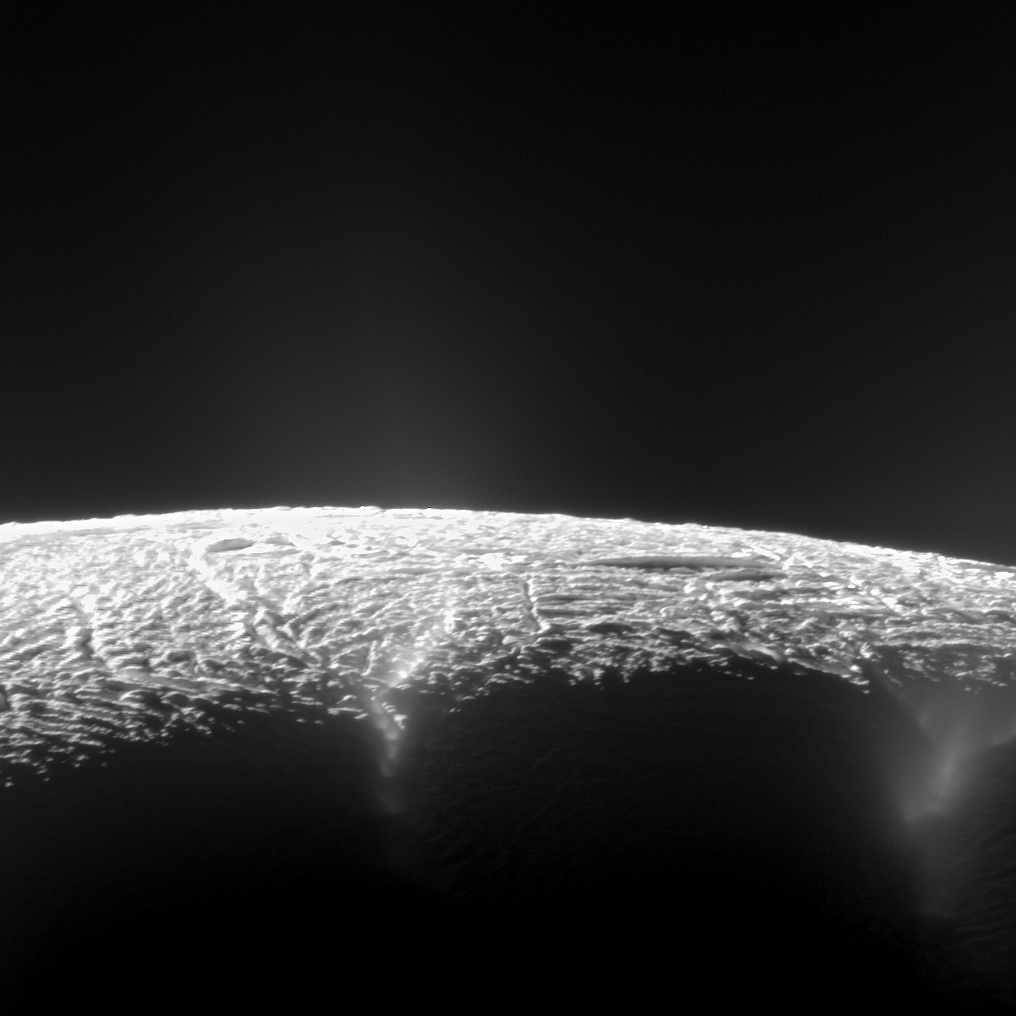
“August 13, 2010. This dramatic view looks across the region of Enceladus’ geyser basin and down on the ends of the Baghdad and Damascus fractures that face Saturn. The image, which looks approximately in the direction of Saturn, was taken from a more elevated viewpoint than other Cassini survey images of this area of the moon’s south pole. The geysering segments of the fractures seen here are among the most active and warmest in the whole region. As seen from the spacecraft from an elevation angle of 25 degrees south, the jets are projected against the bright surface as opposed to black sky. Consequently, despite the pronounced activity, the jets appear fuzzy, or indistinct, in this image and their tilts are consequently not measurable. Though their source locations are clearly seen, this image was not used in the process of triangulation, but instead it was used to confirm source locations determined from triangulation using other images.
The image was taken with Cassini’s narrow-angle camera through the clear filter, with an image scale about 230 feet (70 meters) per pixel and a sun-Enceladus-spacecraft, or phase, angle of about 151 degrees.”
“After almost 20 years in space, NASA’s Cassini spacecraft begins the final chapter of its remarkable story of exploration: its Grand Finale. Between April and September 2017, Cassini will undertake a daring set of orbits that is, in many ways, like a whole new mission. Following a final close flyby of Saturn’s moon Titan, Cassini will leap over the planet’s icy rings and begin a series of 22 weekly dives between the planet and the rings.
No other mission has ever explored this unique region. What we learn from these final orbits will help to improve our understanding of how giant planets – and planetary systems everywhere – form and evolve.
On the final orbit, Cassini will plunge into Saturn’s atmosphere, sending back new and unique science to the very end. After losing contact with Earth, the spacecraft will burn up like a meteor, becoming part of the planet itself.
Cassini’s Grand Finale is about so much more than the spacecraft’s final dive into Saturn. That dramatic event is the capstone of six months of daring exploration and scientific discovery. And those six months are the thrilling final chapter in a historic 20-year journey.”
“Sunspots are temporary phenomena on the Sun’s photosphere that appear as spots darker than the surrounding areas. They are regions of reduced surface temperature caused by concentrations of magnetic field flux that inhibit convection. Sunspots usually appear in pairs of opposite magnetic polarity. Their number varies according to the approximately 11-year solar cycle. Individual sunspots may last anywhere from a few days to a few months, but eventually decay. Sunspots expand and contract as they move across the surface of the Sun, with diameters ranging from 16 km (10 mi) to 160,000 km (100,000 mi). The larger variety are visible from Earth without the aid of a telescope. They may travel at relative speeds, or proper motions, of a few hundred meters per second when they first emerge.
Indicating intense magnetic activity, sunspots accompany secondary phenomena such as coronal loops, prominences, and reconnection events. Most solar flares and coronal mass ejections originate in magnetically active regions around visible sunspot groupings. Similar phenomena indirectly observed on stars other than the Sun are commonly called starspots, and both light and dark spots have been measured.
Although they are at temperatures of roughly 3,000–4,500 K (2,700–4,200 °C), the contrast with the surrounding material at about 5,780 K (5,500 °C) leaves sunspots clearly visible as dark spots. This is because the luminance (which is essentially “brightness” in visible light) of a heated black body (closely approximated by the photosphere) at these temperatures varies extremely with temperature—considerably more so than the (temperature to the fourth power) variation in the total black-body radiation at all wavelengths (see Stefan–Boltzmann law). Isolated from the surrounding photosphere a sunspot would be brighter than the Moon.
Sunspots have two parts: the central umbra, which is the darkest part, where the magnetic field is approximately vertical (normal to the Sun’s surface) and the surrounding penumbra, which is lighter, where the magnetic field is more inclined.
Although the details of sunspot generation are still a matter of research, it appears that sunspots are the visible counterparts of magnetic flux tubes in the Sun’s convective zone that get “wound up” by differential rotation. If the stress on the tubes reaches a certain limit, they curl up and puncture the Sun’s surface. Convection is inhibited at the puncture points; the energy flux from the Sun’s interior decreases; and with it surface temperature.
The Wilson effect implies that sunspots are depressions on the Sun’s surface. Observations using the Zeeman effect show that prototypical sunspots come in pairs with opposite magnetic polarity. From cycle to cycle, the polarities of leading and trailing (with respect to the solar rotation) sunspots change from north/south to south/north and back. Sunspots usually appear in groups.
Magnetic pressure should tend to remove field concentrations, causing the sunspots to disperse, but sunspot lifetimes are measured in days to weeks. In 2001, observations from the Solar and Heliospheric Observatory (SOHO) using sound waves traveling below the photosphere (local helioseismology) were used to develop a three-dimensional image of the internal structure below sunspots; these observations show that a powerful downdraft underneath each sunspot, forms a rotating vortex that sustains the concentrated magnetic field.”
“Curiosity comprised 23 percent of the mass of the 3,893 kg (8,583 lb) Mars Science Laboratory (MSL) spacecraft, which had the sole mission of delivering the rover safely across space from Earth to a soft landing on the surface of Mars. The remaining mass of the MSL craft was discarded in the process of carrying out this task. Curiosity has a mass of 899 kg (1,982 lb) including 80 kg (180 lb) of scientific instruments. The rover is 2.9 m (9.5 ft) long by 2.7 m (8.9 ft) wide by 2.2 m (7.2 ft) in height.
Curiosity is powered by a radioisotope thermoelectric generator (RTG), like the successful Viking 1 and Viking 2 Mars landers in 1976. Radioisotope power systems (RPSs) are generators that produce electricity from the decay of radioactive isotopes, such as plutonium-238, which is a non-fissile isotope of plutonium. Heat given off by the decay of this isotope is converted into electric voltage by thermocouples, providing constant power during all seasons and through the day and night. Waste heat can be used via pipes to warm systems, freeing electrical power for the operation of the vehicle and instruments. Curiosity’s RTG is fueled by 4.8 kg (11 lb) of plutonium-238 dioxide supplied by the U.S. Department of Energy.
Curiosity is powered by a Multi-Mission Radioisotope Thermoelectric Generator (MMRTG), designed and built by Rocketdyne and Teledyne Energy Systems under contract to the U.S. Department of Energy, and assembled and tested by the Idaho National Laboratory. Based on legacy RTG technology, it represents a more flexible and compact development step, and is designed to produce 125 watts of electrical power from about 2,000 watts of thermal power at the start of the mission. The MMRTG produces less power over time as its plutonium fuel decays: at its minimum lifetime of 14 years, electrical power output is down to 100 watts. The power source will generate 9 MJ (2.5 kWh) each day, much more than the solar panels of the Mars Exploration Rovers, which can generate about 2.1 MJ (0.58 kWh) each day. The electrical output from the MMRTG charges two rechargeable lithium-ion batteries. This enables the power subsystem to meet peak power demands of rover activities when the demand temporarily exceeds the generator’s steady output level. Each battery has a capacity of about 42 ampere-hours.
The temperatures at the landing site can vary from −127 to 40 °C (−197 to 104 °F); therefore, the thermal system will warm the rover for most of the Martian year. The thermal system will do so in several ways: passively, through the dissipation to internal components; by electrical heaters strategically placed on key components; and by using the rover heat rejection system (HRS). It uses fluid pumped through 60 m (200 ft) of tubing in the rover body so that sensitive components are kept at optimal temperatures. The fluid loop serves the additional purpose of rejecting heat when the rover has become too warm, and it can also gather waste heat from the power source by pumping fluid through two heat exchangers that are mounted alongside the RTG. The HRS also has the ability to cool components if necessary.
The two identical on-board rover computers, called Rover Computer Element (RCE) contain radiation hardened memory to tolerate the extreme radiation from space and to safeguard against power-off cycles. The computers run the VxWorks real-time operating system (RTOS). Each computer’s memory includes 256 kB of EEPROM, 256 MB of DRAM, and 2 GB of flash memory. For comparison, the Mars Exploration Rovers used 3 MB of EEPROM, 128 MB of DRAM, and 256 MB of flash memory.
The RCE computers use the RAD750 CPU, which is a successor to the RAD6000 CPU of the Mars Exploration Rovers. The RAD750 CPU, a radiation-hardened version of the PowerPC 750, can execute up to 400 MIPS, while the RAD6000 CPU is capable of up to only 35 MIPS. Of the two on-board computers, one is configured as backup and will take over in the event of problems with the main computer. On February 28, 2013, NASA was forced to switch to the backup computer due to an issue with the then active computer’s flash memory, which resulted in the computer continuously rebooting in a loop. The backup computer was turned on in safe mode and subsequently returned to active status on March 4. The same issue happened in late March, resuming full operations on March 25, 2013.
The rover has an Inertial Measurement Unit (IMU) that provides 3-axis information on its position, which is used in rover navigation. The rover’s computers are constantly self-monitoring to keep the rover operational, such as by regulating the rover’s temperature. Activities such as taking pictures, driving, and operating the instruments are performed in a command sequence that is sent from the flight team to the rover. The rover installed its full surface operations software after the landing because its computers did not have sufficient main memory available during flight. The new software essentially replaced the flight software.
Curiosity is equipped with significant telecommunication redundancy by several means – an X band transmitter and receiver that can communicate directly with Earth, and a UHF Electra-Lite software-defined radio for communicating with Mars orbiters. Communication with orbiters is expected to be the main path for data return to Earth, since the orbiters have both more power and larger antennas than the lander allowing for faster transmission speeds. Telecommunication includes a small deep space transponder on the descent stage and a solid-state power amplifier on the rover for X band. The rover also has two UHF radios, the signals of which the 2001 Mars Odyssey satellite is capable of relaying back to Earth. An average of 14 minutes, 6 seconds will be required for signals to travel between Earth and Mars. Curiosity can communicate with Earth directly at speeds up to 32 kbit/s, but the bulk of the data transfer should be relayed through the Mars Reconnaissance Orbiter and Odyssey orbiter. Data transfer speeds between Curiosity and each orbiter may reach 2000 kbit/s and 256 kbit/s, respectively, but each orbiter is able to communicate with Curiosity for only about eight minutes per day (0.56% of the time). Communication from and to Curiosity relies on internationally agreed space data communications protocols as defined by the Consultative Committee for Space Data Systems.
JPL is the central data distribution hub where selected data products are provided to remote science operations sites as needed. JPL is also the central hub for the uplink process, though participants are distributed at their respective home institutions. At landing, telemetry was monitored by three orbiters, depending on their dynamic location: the 2001 Mars Odyssey, Mars Reconnaissance Orbiter and ESA’s Mars Express satellite.
Curiosity is equipped with six 50 cm (20 in) diameter wheels in a rocker-bogie suspension. The suspension system also served as landing gear for the vehicle, unlike its smaller predecessors. Each wheel has cleats and is independently actuated and geared, providing for climbing in soft sand and scrambling over rocks. Each front and rear wheel can be independently steered, allowing the vehicle to turn in place as well as execute arcing turns. Each wheel has a pattern that helps it maintain traction but also leaves patterned tracks in the sandy surface of Mars. That pattern is used by on-board cameras to estimate the distance traveled. The pattern itself is Morse code for “JPL” (·— ·–· ·-··). The rover is capable of climbing sand dunes with slopes up to 12.5°. Based on the center of mass, the vehicle can withstand a tilt of at least 50° in any direction without overturning, but automatic sensors will limit the rover from exceeding 30° tilts. After two years of use, the wheels are visibly worn with punctures and tears.
Curiosity can roll over obstacles approaching 65 cm (26 in) in height, and it has a ground clearance of 60 cm (24 in). Based on variables including power levels, terrain difficulty, slippage and visibility, the maximum terrain-traverse speed is estimated to be 200 m (660 ft) per day by automatic navigation. The rover landed about 10 km (6.2 mi) from the base of Mount Sharp, (officially named Aeolis Mons) and it is expected to traverse a minimum of 19 km (12 mi) during its primary two-year mission. It can travel up to 90 metres (300 ft) per hour but average speed is about 30 metres (98 ft) per hour.”
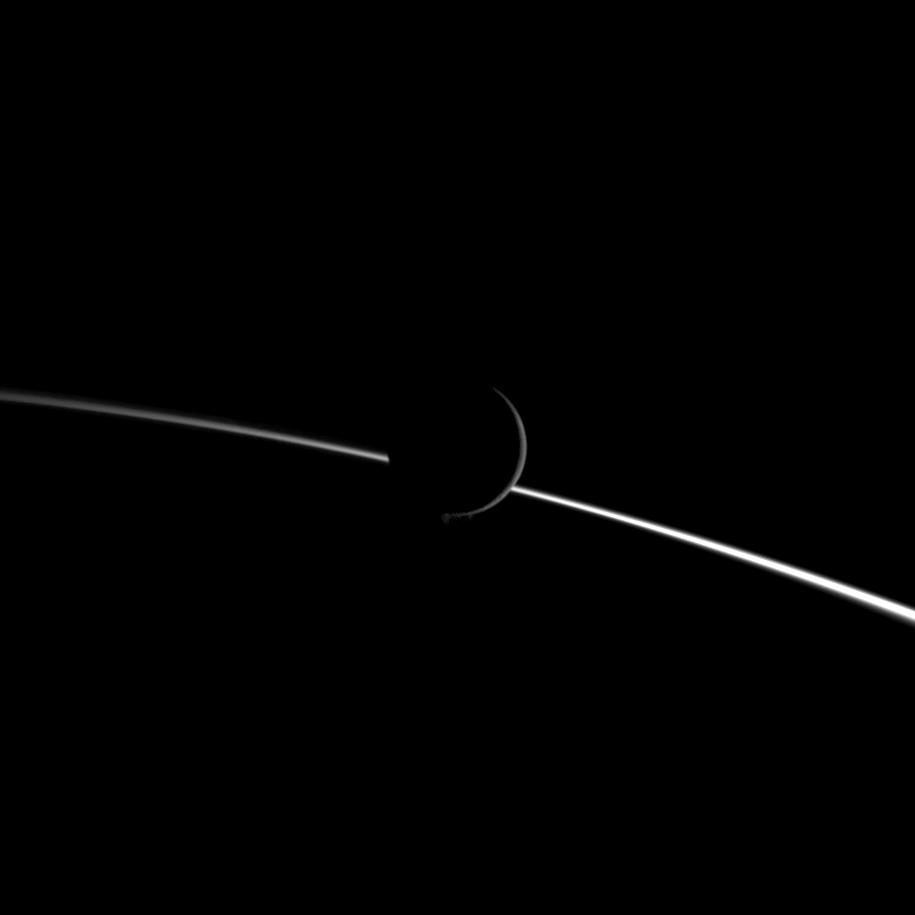
“August 13, 2010. Jets of water ice particles spew from Saturn’s moon Enceladus in this image obtained by NASA’s Cassini spacecraft. A crescent of the moon appears dimly illuminated in front of the bright limb of Saturn. This view looks toward the night side of Saturn, which occupies the lower half of the image. Enceladus, in the center of the image, is closer to the spacecraft than the planet is in this view. Sunlight scatters through the planet’s atmosphere and forms the bright diagonal line running from the left to right of the image. Lit terrain seen on Enceladus (504 kilometers, 313 miles across) is on the leading hemisphere of the moon. North on Enceladus is up. The jets erupting from the south polar region appear faint here, but can be seen at the bottom of the crescent of the moon.
The image was taken in visible light with the Cassini spacecraft wide-angle camera. The view was acquired at a distance of approximately 61,000 kilometers (38,000 miles) from Enceladus and at a sun-Enceladus-spacecraft, or phase, angle of 155 degrees. Image scale is 4 kilometers (2 miles) per pixel.”
“After almost 20 years in space, NASA’s Cassini spacecraft begins the final chapter of its remarkable story of exploration: its Grand Finale. Between April and September 2017, Cassini will undertake a daring set of orbits that is, in many ways, like a whole new mission. Following a final close flyby of Saturn’s moon Titan, Cassini will leap over the planet’s icy rings and begin a series of 22 weekly dives between the planet and the rings.
No other mission has ever explored this unique region. What we learn from these final orbits will help to improve our understanding of how giant planets – and planetary systems everywhere – form and evolve.
On the final orbit, Cassini will plunge into Saturn’s atmosphere, sending back new and unique science to the very end. After losing contact with Earth, the spacecraft will burn up like a meteor, becoming part of the planet itself.
Cassini’s Grand Finale is about so much more than the spacecraft’s final dive into Saturn. That dramatic event is the capstone of six months of daring exploration and scientific discovery. And those six months are the thrilling final chapter in a historic 20-year journey.”



 Subscribe to blog posts using RSS












