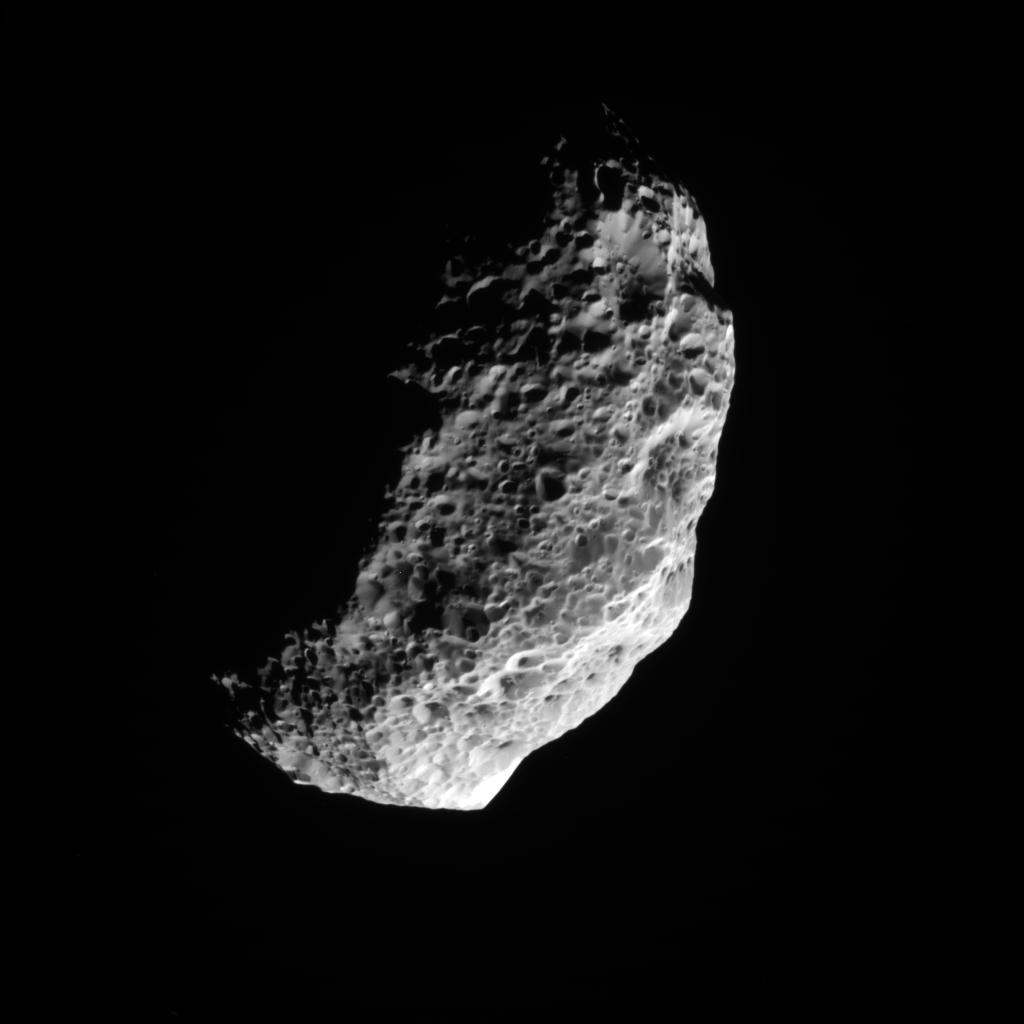
“November 28, 2010. NASA’s Cassini spacecraft obtained this raw image of the Saturnian moon Hyperion when the spacecraft was about 73,000 kilometers (45,000 miles) away from the moon’s surface.”
“After almost 20 years in space, NASA’s Cassini spacecraft begins the final chapter of its remarkable story of exploration: its Grand Finale. Between April and September 2017, Cassini will undertake a daring set of orbits that is, in many ways, like a whole new mission. Following a final close flyby of Saturn’s moon Titan, Cassini will leap over the planet’s icy rings and begin a series of 22 weekly dives between the planet and the rings.
No other mission has ever explored this unique region. What we learn from these final orbits will help to improve our understanding of how giant planets – and planetary systems everywhere – form and evolve.
On the final orbit, Cassini will plunge into Saturn’s atmosphere, sending back new and unique science to the very end. After losing contact with Earth, the spacecraft will burn up like a meteor, becoming part of the planet itself.
Cassini’s Grand Finale is about so much more than the spacecraft’s final dive into Saturn. That dramatic event is the capstone of six months of daring exploration and scientific discovery. And those six months are the thrilling final chapter in a historic 20-year journey.”
“A solar flare is a sudden flash of brightness observed near the Sun’s surface. It involves a very broad spectrum of emissions, an energy release of typically 1 × 10²⁰ joules of energy for a well-observed event. A major event can emit up to 1 × 1025 joules (the latter is roughly the equivalent of 1 billion megatons of TNT, or over 400 times more energy than released from the impact of Comet Shoemaker–Levy 9 with Jupiter). Flares are often, but not always, accompanied by a coronal mass ejection. The flare ejects clouds of electrons, ions, and atoms through the corona of the sun into space. These clouds typically reach Earth a day or two after the event. The term is also used to refer to similar phenomena in other stars, where the term stellar flare applies.
Solar flares affect all layers of the solar atmosphere (photosphere, chromosphere, and corona), when the plasma medium is heated to tens of millions kelvins, while the cosmic-ray-like electrons, protons, and heavier ions are accelerated to near the speed of light. They produce radiation across the electromagnetic spectrum at all wavelengths, from radio waves to gamma rays, although most of the energy is spread over frequencies outside the visual range and for this reason the majority of the flares are not visible to the naked eye and must be observed with special instruments. Flares occur in active regions around sunspots, where intense magnetic fields penetrate the photosphere to link the corona to the solar interior. Flares are powered by the sudden (timescales of minutes to tens of minutes) release of magnetic energy stored in the corona. The same energy releases may produce coronal mass ejections (CME), although the relation between CMEs and flares is still not well established.
X-rays and UV radiation emitted by solar flares can affect Earth’s ionosphere and disrupt long-range radio communications. Direct radio emission at decimetric wavelengths may disturb the operation of radars and other devices that use those frequencies.
Solar flares were first observed on the Sun by Richard Christopher Carrington and independently by Richard Hodgson in 1859 as localized visible brightenings of small areas within a sunspot group. Stellar flares can be inferred by looking at the lightcurves produced from the telescope or satellite data of variety of other stars.
The frequency of occurrence of solar flares varies, from several per day when the Sun is particularly “active” to less than one every week when the Sun is “quiet”, following the 11-year cycle (the solar cycle). Large flares are less frequent than smaller ones. On July 23, 2012, a massive, and potentially damaging, solar superstorm (solar flare, coronal mass ejection, solar EMP) barely missed Earth, according to NASA. According to NASA, there may be as much as a 12% chance of a similar event occurring between 2012 and 2022, although because this particular figure was based on an extreme extrapolation of the calculated frequency of future storms, the actual probability of this is quite uncertain.”
Video credit: NASA’s Goddard Space Flight Center/Genna Duberstein
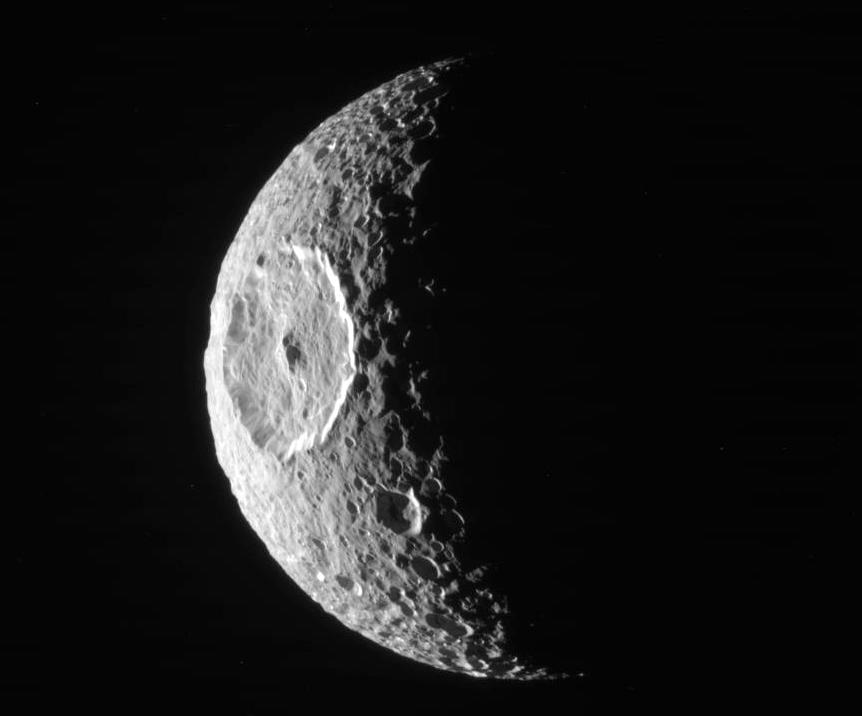
“October 16, 2010. NASA’s Cassini spacecraft obtained this raw image of the moon Mimas just before Mimas went into shadow behind Saturn. The camera was approximately 101,552 kilometers (63,1010 miles) away.”
“After almost 20 years in space, NASA’s Cassini spacecraft begins the final chapter of its remarkable story of exploration: its Grand Finale. Between April and September 2017, Cassini will undertake a daring set of orbits that is, in many ways, like a whole new mission. Following a final close flyby of Saturn’s moon Titan, Cassini will leap over the planet’s icy rings and begin a series of 22 weekly dives between the planet and the rings.
No other mission has ever explored this unique region. What we learn from these final orbits will help to improve our understanding of how giant planets – and planetary systems everywhere – form and evolve.
On the final orbit, Cassini will plunge into Saturn’s atmosphere, sending back new and unique science to the very end. After losing contact with Earth, the spacecraft will burn up like a meteor, becoming part of the planet itself.
Cassini’s Grand Finale is about so much more than the spacecraft’s final dive into Saturn. That dramatic event is the capstone of six months of daring exploration and scientific discovery. And those six months are the thrilling final chapter in a historic 20-year journey.”
“The 8.5-minute test conducted at NASA’s Stennis Space Center is part of a series of tests designed to put the upgraded former space shuttle engines through the rigorous temperature and pressure conditions they will experience during a launch. The tests also support the development of a new controller, or “brain,” for the engine, which monitors engine status and communicates between the rocket and the engine, relaying commands to the engine and transmitting data back to the rocket.”
“A neutron star is the collapsed core of a large (10–29 solar masses) star. Neutron stars are the smallest and densest stars known to exist. Though neutron stars typically have a radius on the order of 10 kilometres (6.2 mi), they can have masses of about twice that of the Sun. They result from the supernova explosion of a massive star, combined with gravitational collapse, that compresses the core past the white dwarf star density to that of atomic nuclei. Most of the basic models for these objects imply that neutron stars are composed almost entirely of neutrons, which are subatomic particles with no net electrical charge and with slightly larger mass than protons. They are supported against further collapse by neutron degeneracy pressure, a phenomenon described by the Pauli exclusion principle. If the remnant has too great a density, something which occurs in excess of an upper limit of the size of neutron stars at 2–3 solar masses, it will continue collapsing to form a black hole.
Neutron stars that can be observed are very hot and typically have a surface temperature around 600000 K. They are so dense that a normal-sized matchbox containing neutron-star material would have a mass of approximately 3 billion tonnes, or a 0.5 cubic kilometre chunk of the Earth (a cube with edges of about 800 metres). Their magnetic fields are between 108 and 1015 times as strong as that of the Earth. The gravitational field at the neutron star’s surface is about 2×10¹¹ times that of the Earth.
As the star’s core collapses, its rotation rate increases as a result of conservation of angular momentum, hence newly formed neutron stars rotate at up to several hundred times per second. Some neutron stars emit beams of electromagnetic radiation that make them detectable as pulsars. Indeed, the discovery of pulsars in 1967 was the first observational suggestion that neutron stars exist. The radiation from pulsars is thought to be primarily emitted from regions near their magnetic poles. If the magnetic poles do not coincide with the rotational axis of the neutron star, the emission beam will sweep the sky, and when seen from a distance, if the observer is somewhere in the path of the beam, it will appear as pulses of radiation coming from a fixed point in space (the so-called “lighthouse effect”). The fastest-spinning neutron star known is PSR J1748-2446ad, rotating at a rate of 716 times a second or 43,000 revolutions per minute, giving a linear speed at the surface on the order of 0.24 c (i.e. nearly a quarter the speed of light).
There are thought to be around 100 million neutron stars in the Milky Way, a figure obtained by estimating the number of stars that have undergone supernova explosions. However, most are old and cold, and neutron stars can only be easily detected in certain instances, such as if they are a pulsar or part of a binary system. Slow-rotating and non-accreting neutron stars are virtually undetectable; however, since the Hubble Space Telescope detection of RX J185635-3754, a few nearby neutron stars that appear to emit only thermal radiation have been detected. Soft gamma repeaters are conjectured to be a type of neutron star with very strong magnetic fields, known as magnetars, or alternatively, neutron stars with fossil disks around them.
Neutron stars in binary systems can undergo accretion which typically makes the system bright in x-rays while the material falling onto the neutron star can form hotspots that rotate in and out of view in identified X-ray pulsar systems. Additionally, such accretion can “recycle” old pulsars and potentially cause them to gain mass and spin-up to very fast rotation rates, forming the so-called millisecond pulsars. These binary systems will continue to evolve, and eventually the companions can become compact objects such as white dwarfs or neutron stars themselves, though other possibilities include a complete destruction of the companion through ablation or merger. The merger of binary neutron stars may be the source of short-duration gamma-ray bursts and are likely strong sources of gravitational waves. Though as of 2016 no direct detection of the gravitational waves from such an event has been made, gravitational waves have been indirectly detected in a system where two neutron stars orbit each other.”
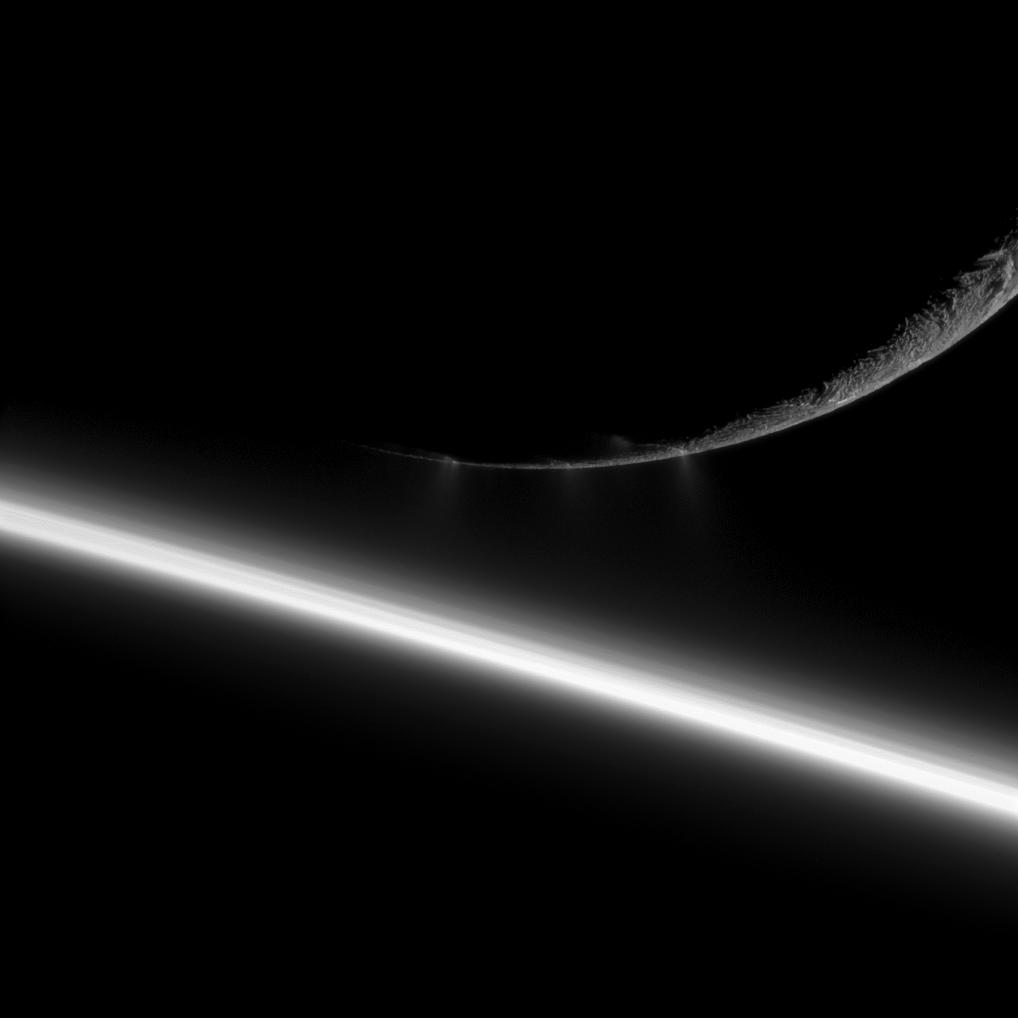
“August 13, 2010. Small water ice particles fly from fissures in the south polar region of Saturn’s moon Enceladus in this image taken during the flyby of the moon by NASA’s Cassini spacecraft. This view looks toward the night side of Saturn, which is in the lower left of the image. Enceladus, in the top right, is closer to the spacecraft than the planet is in this view. Sunlight scatters through the planet’s atmosphere and forms the bright diagonal line running from the left to bottom right of the image. The atmosphere appears layered here. Scientists think the different layers on the limb are real and not an artifact of the camera’s exposure.
The famous jets, imaged by Cassini’s cameras for the first time in 2005, are faintly seen here erupting from the fractures that cross the south polar region of the moon. Illuminated terrain seen on Enceladus is on the leading hemisphere of the moon, or the side facing forward in the moon’s orbit around Saturn. North on Enceladus (504 kilometers, 313 miles across) is up. The jets appear faint here, but can be seen near the center of the image.
The image was taken in visible light with the Cassini spacecraft narrow-angle camera. The view was obtained at a distance of approximately 59,000 kilometers (37,000 miles) from Enceladus and at a sun-Enceladus-spacecraft, or phase, angle of 155 degrees. Image scale on Enceladus is 353 meters (1,157 feet) per pixel.”
“After almost 20 years in space, NASA’s Cassini spacecraft begins the final chapter of its remarkable story of exploration: its Grand Finale. Between April and September 2017, Cassini will undertake a daring set of orbits that is, in many ways, like a whole new mission. Following a final close flyby of Saturn’s moon Titan, Cassini will leap over the planet’s icy rings and begin a series of 22 weekly dives between the planet and the rings.
No other mission has ever explored this unique region. What we learn from these final orbits will help to improve our understanding of how giant planets – and planetary systems everywhere – form and evolve.
On the final orbit, Cassini will plunge into Saturn’s atmosphere, sending back new and unique science to the very end. After losing contact with Earth, the spacecraft will burn up like a meteor, becoming part of the planet itself.
Cassini’s Grand Finale is about so much more than the spacecraft’s final dive into Saturn. That dramatic event is the capstone of six months of daring exploration and scientific discovery. And those six months are the thrilling final chapter in a historic 20-year journey.”





 Subscribe to blog posts using RSS












