OrbitalHub

The place where space exploration, science, and engineering meet

Domain is for sale. $50,000,000.00 USD. Direct any inquiries to contact@orbitalhub.com.

Archive for 2017

September 14, 2017

Three Years of NEOWISE Data

Posted by


NASA dixit:

“NASA’s Near-Earth Object Wide-field Infrared Survey Explorer (NEOWISE) mission has released its third year of survey data, with the spacecraft discovering 97 previously unknown celestial objects in the last year. Of those, 28 were near-Earth objects, 64 were main belt asteroids and five were comets. The spacecraft has now characterized a total of 693 near-Earth objects since the mission was re-started in December 2013. Of these, 114 are new. The NEOWISE team has released an animation depicting this solar system survey’s discoveries and characterizations for its third year of operations.

“NEOWISE is not only discovering previously uncharted asteroids and comets, but it is providing excellent data on many of those already in our catalog,” said Amy Mainzer, NEOWISE principal investigator from NASA’s Jet Propulsion Laboratory in Pasadena, California. “It is also proving to be an invaluable tool in in the refining and perfecting of techniques for near-Earth object discovery and characterization by a space-based infrared observatory.”

Near-Earth objects (NEOs) are comets and asteroids that have been nudged by the gravitational attraction of the planets in our solar system into orbits that allow them to enter Earth’s neighborhood. Ten of the objects discovered by NEOWISE in the past year have been classified as potentially hazardous asteroids, based on their size and their orbits. More than 2.6 million infrared images of the sky were collected in the third year of operations by NEOWISE. These data are combined with the Year 1 and 2 NEOWISE data into a single archive that contains approximately 7.7 million sets of images and a database of more than 57.7 billion source detections extracted from those images. The NEOWISE images also contain glimpses of rare objects, like comet C/2010 L5 WISE. A new technique of modeling comet behavior called tail-fitting showed that this particular comet experienced a brief outburst as it swept through the inner-solar system.

“Comets that have abrupt outbursts are not commonly found, but this may be due more to the sudden nature of the activity rather than their inherent rarity,” said Emily Kramer, a NASA Postdoctoral Program Fellow at JPL and lead author of paper on the NEOWISE study. “It is great for astronomers to view and collect cometary data when they find an outburst, but since the activity is so short-lived, we may simply miss them most of the time.”

The tail-fitting technique identifies the size and quantity of dust particles in the vicinity of the comet, and when they were ejected from the comet’s nucleus, revealing the history of the comet’s activity. With tail-fitting, future all-sky surveys may be able to find and collect data on more cometary outburst activity when it happens. A paper detailing the tail-fitting technique and other results of the study was published in the March 20 volume of the Astrophysical Journal.

Originally called the Wide-field Infrared Survey Explorer (WISE), the spacecraft was launched in December 2009. It was placed in hibernation in 2011 after its primary astrophysics mission was completed. In September 2013, it was reactivated, renamed NEOWISE and assigned a new mission: to assist NASA’s efforts to identify the population of potentially hazardous near-Earth objects. NEOWISE also is characterizing more distant populations of asteroids and comets to provide information about their sizes and compositions.

NASA’s Jet Propulsion Laboratory in Pasadena, California, manages the NEOWISE mission for NASA’s Planetary Defense Coordination Office within the Science Mission Directorate in Washington. The Space Dynamics Laboratory in Logan, Utah, built the science instrument. Ball Aerospace & Technologies Corp. of Boulder, Colorado, built the spacecraft. Science operations and data processing take place at the Infrared Processing and Analysis Center at Caltech in Pasadena. Caltech manages JPL for NASA.”

Video credit: NASA Jet Propulsion Laboratory


  • Facebook
  • Google
  • Slashdot
  • Reddit
  • Live
  • TwitThis
September 13, 2017

Melanthius at Dusk

Posted by


NASA dixit:

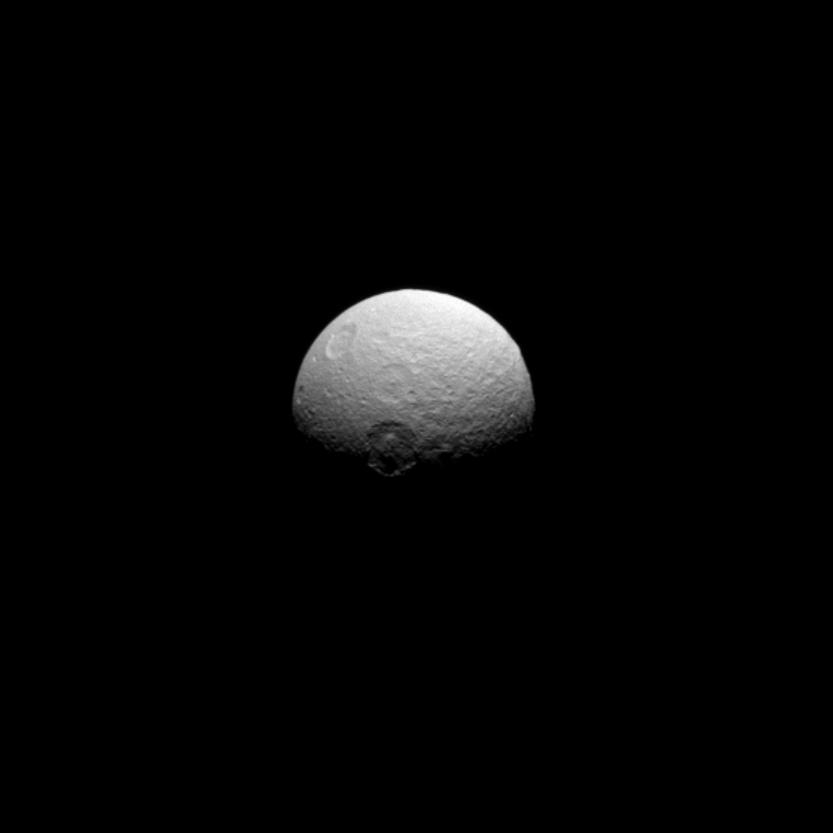
“May 16, 2013. The craters of Tethys tell the story of a violent history marked by impacts. The names of the craters also tell oft-violent stories: in this case, the Iliad and the Odyssey. Here, we see the craters Melanthius (near the center, at the day/night terminator), Dolius (above Melanthius), and Penelope (upper left almost over the limb). Penelope was the faithful and wise wife of the Greek hero Odysseus, Dolius was their loyal gardener, and Melanthius was Dolius’ son.

This view looks toward the leading side of Tethys. North on Tethys is up and rotated 32 degrees to the right. The image was taken in visible light with the Cassini spacecraft narrow-angle camera. The view was obtained at a distance of approximately 684,000 miles (1.1 million kilometers) from Tethys and at a Sun-Tethys-spacecraft, or phase, angle of 63 degrees. Image scale is 4 miles (7 kilometers) per pixel. The image has been zoomed in by a factor of 1.5.”

“After almost 20 years in space, NASA’s Cassini spacecraft begins the final chapter of its remarkable story of exploration: its Grand Finale. Between April and September 2017, Cassini will undertake a daring set of orbits that is, in many ways, like a whole new mission. Following a final close flyby of Saturn’s moon Titan, Cassini will leap over the planet’s icy rings and begin a series of 22 weekly dives between the planet and the rings.

No other mission has ever explored this unique region. What we learn from these final orbits will help to improve our understanding of how giant planets – and planetary systems everywhere – form and evolve.

On the final orbit, Cassini will plunge into Saturn’s atmosphere, sending back new and unique science to the very end. After losing contact with Earth, the spacecraft will burn up like a meteor, becoming part of the planet itself.

Cassini’s Grand Finale is about so much more than the spacecraft’s final dive into Saturn. That dramatic event is the capstone of six months of daring exploration and scientific discovery. And those six months are the thrilling final chapter in a historic 20-year journey.”

Image credit: NASA


  • Facebook
  • Google
  • Slashdot
  • Reddit
  • Live
  • TwitThis
September 13, 2017

The Moon May Have Frost

Posted by


NASA dixit:

“Scientists using data from NASA’s Lunar Reconnaissance Orbiter, or LRO, have identified bright areas in craters near the moon’s south pole that are cold enough to have frost present on the surface. The new evidence comes from an analysis that combined surface temperatures with information about how much light is reflected off the moon’s surface.

“We found that the coldest places near the moon’s south pole are also the brightest places—brighter than we would expect from soil alone—and that might indicate the presence of surface frost,” said Elizabeth Fisher, the lead author of the study, published in Icarus. Fisher carried out the data analysis while doing research at the University of Hawai‘i at Manoa after earning her undergraduate degree. She is now a graduate student at Brown University.

The icy deposits appear to be patchy and thin, and it’s possible that they are mixed in with the surface layer of soil, dust and small rocks called the regolith. The researchers say they are not seeing expanses of ice similar to a frozen pond or skating rink. Instead, they are seeing signs of surface frost. The frost was found in cold traps close to the moon’s south pole. Cold traps are permanently dark areas—located either on the floor of a deep crater or along a section of crater wall that doesn’t receive direct sunlight—where temperatures remain below minus 260 degrees Fahrenheit (minus 163 degrees Celsius). Under these conditions, water ice can persist for millions or billions of years.

More than a half-century ago, scientists suggested that lunar cold traps could store water ice, but confirming that hypothesis turned out to be challenging. Observations made by NASA’s Lunar Prospector orbiter in the late 1990s identified hydrogen-rich areas near the moon’s poles but could not determine whether that hydrogen was bound up in water or was present in some other form. Understanding the nature of these deposits has been one of the driving goals of LRO, which has been orbiting the moon since 2009.

Fisher and her colleagues found evidence of lunar frost by comparing temperature readings from LRO’s Diviner instrument with brightness measurements from the spacecraft’s Lunar Orbiter Laser Altimeter, or LOLA. In these comparisons, the coldest areas near the south pole also were very bright, indicating the presence of ice or other highly reflective materials. The researchers looked at the peak surface temperatures, because water ice won’t last if the temperature creeps above the crucial threshold.”

Video credit: NASA Goddard


  • Facebook
  • Google
  • Slashdot
  • Reddit
  • Live
  • TwitThis
September 12, 2017

Goodbye to Rhea

Posted by


NASA dixit:

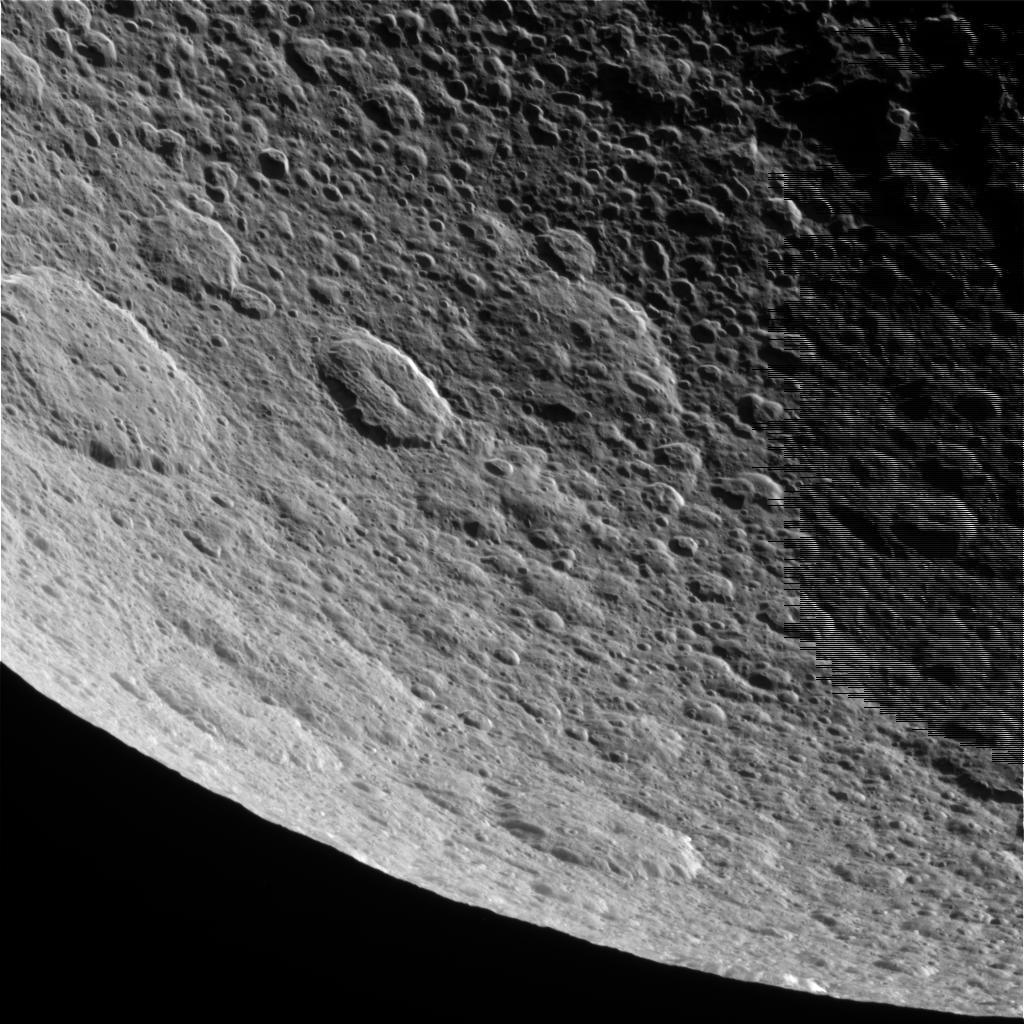
“March 9, 2013. On its fourth and final targeted flyby of Rhea, the Cassini spacecraft provided this stunning view of the ancient and heavily cratered surface. Billions of years of impacts have sculpted Rhea’s surface into the form we see today. With a diameter of 949 miles (1,528 kilometers) Rhea is Saturn’s second-largest moon.

This view is centered on terrain at 33 degrees north latitude, 358 degrees west longitude. The image was taken in visible light with the Cassini spacecraft narrow-angle camera. The view was acquired at a distance of approximately 2,280 miles (3,670 kilometers) from Rhea and at a Sun-Rhea-spacecraft, or phase, angle of 92 degrees. Image scale is 72 feet (22 meters) per pixel.”

“After almost 20 years in space, NASA’s Cassini spacecraft begins the final chapter of its remarkable story of exploration: its Grand Finale. Between April and September 2017, Cassini will undertake a daring set of orbits that is, in many ways, like a whole new mission. Following a final close flyby of Saturn’s moon Titan, Cassini will leap over the planet’s icy rings and begin a series of 22 weekly dives between the planet and the rings.

No other mission has ever explored this unique region. What we learn from these final orbits will help to improve our understanding of how giant planets – and planetary systems everywhere – form and evolve.

On the final orbit, Cassini will plunge into Saturn’s atmosphere, sending back new and unique science to the very end. After losing contact with Earth, the spacecraft will burn up like a meteor, becoming part of the planet itself.

Cassini’s Grand Finale is about so much more than the spacecraft’s final dive into Saturn. That dramatic event is the capstone of six months of daring exploration and scientific discovery. And those six months are the thrilling final chapter in a historic 20-year journey.”

Image credit: NASA


  • Facebook
  • Google
  • Slashdot
  • Reddit
  • Live
  • TwitThis
September 12, 2017

Human Activity Impacted Space Weather

Posted by


NASA dixit:

“Our Cold War history is now offering scientists a chance to better understand the complex space system that surrounds us. Space weather — which can include changes in Earth’s magnetic environment — are usually triggered by the sun’s activity, but recently declassified data on high-altitude nuclear explosion tests have provided a new look at the mechanisms that set off perturbations in that magnetic system. Such information can help support NASA’s efforts to protect satellites and astronauts from the natural radiation inherent in space.”

Video credit: NASA Goddard


  • Facebook
  • Google
  • Slashdot
  • Reddit
  • Live
  • TwitThis
September 11, 2017

Battered Icy Moon

Posted by


NASA dixit:

“This image was taken on March 09, 2013, and received on Earth March 10, 2013, by NASA’s Cassini spacecraft. The camera was pointing toward Rhea at approximately 39,072 miles (62,880 kilometers) away, and the image was taken using the CL1 and CL2 filters.”

“After almost 20 years in space, NASA’s Cassini spacecraft begins the final chapter of its remarkable story of exploration: its Grand Finale. Between April and September 2017, Cassini will undertake a daring set of orbits that is, in many ways, like a whole new mission. Following a final close flyby of Saturn’s moon Titan, Cassini will leap over the planet’s icy rings and begin a series of 22 weekly dives between the planet and the rings.

No other mission has ever explored this unique region. What we learn from these final orbits will help to improve our understanding of how giant planets – and planetary systems everywhere – form and evolve.

On the final orbit, Cassini will plunge into Saturn’s atmosphere, sending back new and unique science to the very end. After losing contact with Earth, the spacecraft will burn up like a meteor, becoming part of the planet itself.

Cassini’s Grand Finale is about so much more than the spacecraft’s final dive into Saturn. That dramatic event is the capstone of six months of daring exploration and scientific discovery. And those six months are the thrilling final chapter in a historic 20-year journey.”

Image credit: NASA


  • Facebook
  • Google
  • Slashdot
  • Reddit
  • Live
  • TwitThis