“Asia Satellite Telecommunications Holdings Limited known as its brand name AsiaSat is a commercial operator of communication spacecraft. AsiaSat is based in Hong Kong but incorporated in Bermuda. It is a red chip company, as it was (jointly) controlled by Chinese state-owned CITIC Group indirectly. It had a market capitalization of HK$3.251 billion on 30 June 2017.
In December 2013, AsiaSat commissioned AsiaSat 9 to be built by Space Systems/Loral, originally intending it to be launched in Q2 2017 in order to replace AsiaSat 4 at 122 degrees east. In early 2015, AsiaSat reported a nine percent revenue drop, and a 27 percent drop in contracts, pointing to a regional oversupply of satellite communication services in the Asian regions it serves. At that time, AsiaSat had four commsats in operation and had recently launched two more, AsiaSat 6 and AsiaSat 8, which had added 22 percent additional bandwidth capacity into the shrinking market. Although revenues were down just nine percent—to HK$1365 billion—2014 profits declined by 25 percent over 2013, to HK$559 million.”
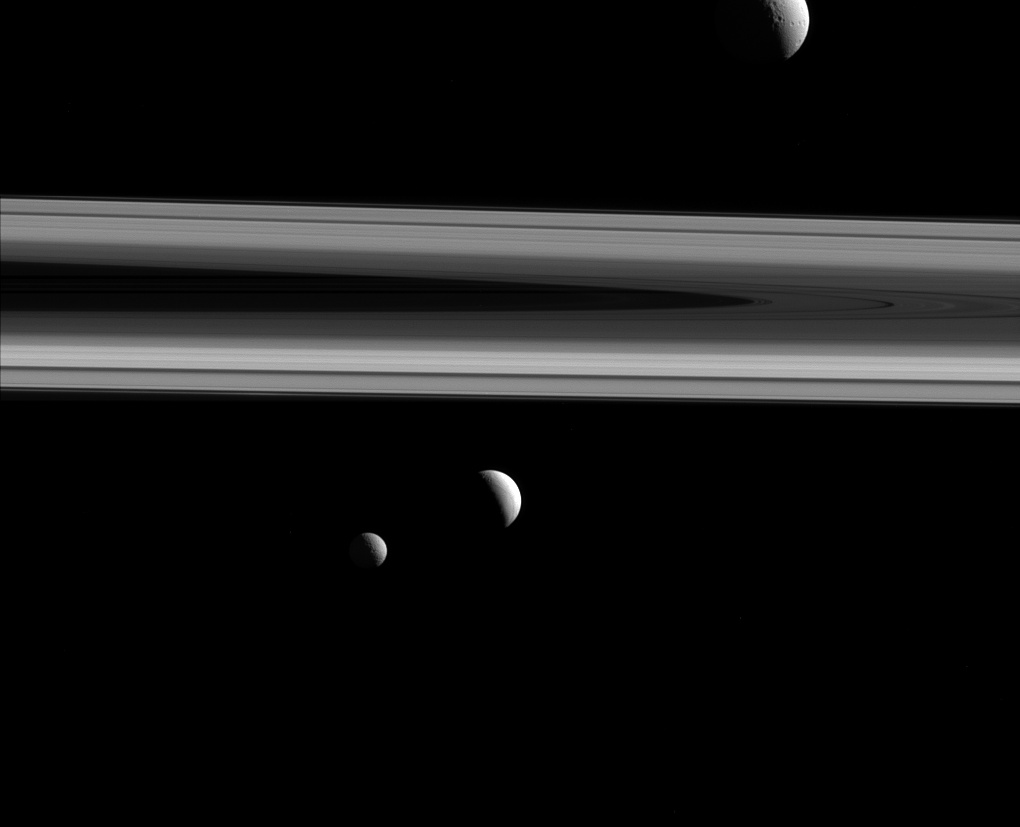
“December 3, 2015. Three of Saturn’s moons, Tethys, Enceladus, and Mimas, are captured in this group photo from NASA’s Cassini spacecraft. Tethys (660 miles or 1062 kilometers across) appears above the rings, while Enceladus (313 miles or 504 kilometers across) sits just below center. Mimas (246 miles or 396 kilometers across) hangs below and to the left of Enceladus.
This view looks toward the sunlit side of the rings from about 0.4 degrees above the ring plane. The image was taken in visible light with the Cassini spacecraft narrow-angle camera. The view was acquired at a distance of approximately 837,000 miles (1.35 million kilometers) from Enceladus, with an image scale of 5 miles (8 kilometers) per pixel. Tethys was approximately 1.2 million miles (1.9 million kilometers) away with an image scale of 7 miles (11 kilometers) per pixel. Mimas was approximately 1.1 million miles (1.7 million kilometers) away with an image scale of 6 miles (10 kilometers) per pixel.”
Image credit: NASA/JPL-Caltech/Space Science Institute
“The BFR, which is variously said to stand for either Big Falcon Rocket or Big F@#$%^& Rocket, announced in September 2017, is SpaceX’s privately-funded launch vehicle, spacecraft and space and ground infrastructure system of spaceflight technology—including reusable launch vehicles and spacecraft. The system includes Earth infrastructure for rapid launch and relaunch; low Earth orbit, and zero-gravity propellant transfer technology. The new vehicle, while much smaller than an earlier version of SpaceX composite material vehicle design, is much larger than the existing SpaceX operational vehicles which it is intended to replace.
The new launch vehicle is planned to replace both Falcon 9 and Falcon Heavy launch vehicles and the Dragon spacecraft, in the operational SpaceX fleet in the early 2020s, initially aiming at the Earth-orbit market, but explicitly adding substantial capability to the spacecraft vehicles to support long-duration spaceflight in the cislunar and Mars mission environment as well. SpaceX intends this approach to bring significant cost savings which will help the company justify the development expense of designing and building the new launch vehicle design. BFR is a 9 meters (30 ft)-diameter launch vehicle.
An earlier larger design for the first non-Falcon launch vehicle from SpaceX was known as the ITS launch vehicle in 2016–2017. The design for all of the ITS vehicles were 12 meters (39 ft) diameter. While the earlier SpaceX designs had been aimed at Mars transit and other interplanetary uses, SpaceX pivoted in 2017 to a plan that would replace all SpaceX launch-service-provider capacity—Earth orbit, the Lunar-orbit region, and interplanetary space transport—with a single 9 m (30 ft)-diameter class of launch vehicles and spacecraft.
Development work began on the Raptor rocket engines to be used for both stages of the BFR launch vehicle in 2012, and engine testing began in 2016. New rocket engine designs are typically considered one of the longest of the development subprocesses for new launch vehicles and spacecraft. Tooling for the main tanks has been ordered and a facility to build the vehicles is under construction; construction will start on the first ship in 2Q2018. The company publicly stated an aspirational goal for initial Mars-bound cargo flights of BFR launching as early as 2022, followed by the first BFR flight with passengers one synodic period later, in 2024.”
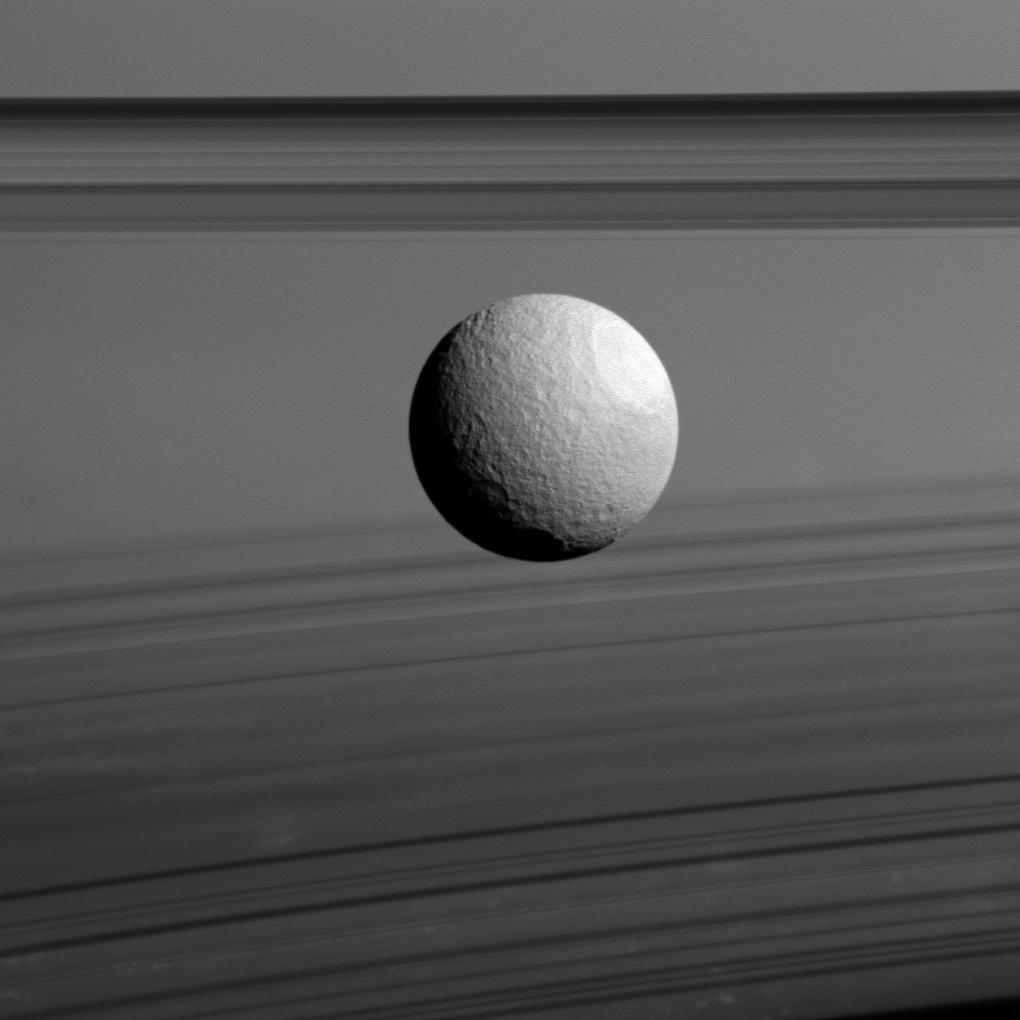
“November 23, 2015. Saturn’s moon Tethys appears to float between two sets of rings in this view from NASA’s Cassini spacecraft, but it’s just a trick of geometry. The rings, which are seen nearly edge-on, are the dark bands above Tethys, while their curving shadows paint the planet at the bottom of the image. Tethys (660 miles or 1,062 kilometers across) has a surface composed mostly of water ice, much like Saturn’s rings. Water ice dominates the icy surfaces in the the far reaches of our solar system, but ammonia and methane ices also can be found.
The image was taken in visible light with the Cassini spacecraft wide-angle camera. North on Tethys is up. The view was obtained at a distance of approximately 40,000 miles (65,000 kilometers) from Tethys. Image scale is 2.4 miles (4 kilometers) per pixel.”
Image credit: NASA/JPL-Caltech/Space Science Institute
“The video shows the motions of two million stars about 1.1–1.5 million years in the future. It displays a map of the full sky as seen from the Sun. The star initially circled is Gliese 710; its trajectory is then indicated with the extending line. Gliese 710 will have a close encounter with our Sun in about 1.3 million years, coming within the Oort Cloud reservoir of comets that resides in the outskirts of our Solar System. The star is predicted to pass within about 2.3 trillion kilometres, the equivalent of about 16 000 Earth–Sun distances. The stars are plotted in galactic coordinates and the plane of the Milky Way stands out as the horizontal band with greater density of stars.”
“October 27, 2015. Janus and Tethys demonstrate the main difference between small moons and large ones. It’s all about the moon’s shape. Moons like Tethys (660 miles or 1,062 kilometers across) are large enough that their own gravity is sufficient to overcome the material strength of the substances they are made of (mostly ice in the case of Tethys) and mold them into spherical shapes. But small moons like Janus (111 miles or 179 kilometers across) are not massive enough for their gravity to form them into a sphere. Janus and its like are left as irregularly shaped bodies.
Saturn’s narrow F ring and the outer edge of its A ring slice across the scene. This view looks toward the unilluminated side of the rings from about 0.23 degrees below the ring plane. The image was taken in visible green light with the Cassini spacecraft narrow-angle camera. The view was obtained at a distance of approximately 593,000 miles (955,000 kilometers) from Janus. Image scale at Janus is 3.7 miles (6 kilometers) per pixel. Tethys was at a distance of 810,000 miles (1.3 million kilometers) for an image scale of 5 miles (8 kilometers) per pixel.”
Image credit: NASA/JPL-Caltech/Space Science Institute




 Subscribe to blog posts using RSS












