Soyuz TMA-20 undocked from the International Space Station. Soyuz is carrying Dmitry Kondratyev, Cady Coleman, and Paolo Nespoli.
Read more about the International Space Station…



Soyuz TMA-20 undocked from the International Space Station. Soyuz is carrying Dmitry Kondratyev, Cady Coleman, and Paolo Nespoli.
Read more about the International Space Station…


The Soyuz TMA-20 hatch closes behind Commander Dmitry Kondratyev, anf Flight Engineers Cady Coleman and Paolo Nespoli.
Read more about the International Space Station…
 |
| Credits: Orbital Sciences Corporation |
We can identify two categories of risks associated with mitigation methods: operational risks and risks associated with re-entry.
Operational risks are linked to three major factors. The first is the limited amount of information that satellite operators are willing to share, in some cases for national security reasons. Obviously, a balance must be found between the need for operators to protect sensitive information and the need to share information in order to ensure the safety of space missions.
The second is that satellites can trespass into the operating space of other satellites. This can happen during launch, when relocating to a new orbit, or during the decommissioning phase. Information related to these operations must be shared among satellite operators. If not, collisions are very likely to occur.
Finally, decreased reliability due to implementation of mitigation measures can cause partial or complete loss of control of satellites, which drift from designated orbits. Events like these must be announced as they can lead to collisions as well.
Risks associated with re-entry are due to the fact that in most cases the re-entry happens at random, with no control over the parameters of the impact. For large objects, it is expected that 20% to 40% of the mass survives the ablation and reaches the ground. Even if there is a residual risk to the ground population, to air traffic, and to maritime traffic, re-entry, as a post-mission disposal method, is a viable option in order to preserve a safe level for space operations.
The most important economic implication caused by the adoption of space debris mitigation methods is the increased costs of spacecraft and launch vehicles as well as their operations. In general, modifying the designs of spacecraft and launch vehicles adds to the development costs. However, including mitigation measures early in the design and striving to achieve simpler designs, may lead to simpler and more cost-effective solutions. Launch performance and mass penalty must also be taken into account. Mission profiles that require upper stages of launch vehicles to have a short orbital lifetime will affect launch performances. In the same way, additional mass added to meet mitigation objectives will lower the payload capacity. Mission lifetime can also be affected by post-mission disposal methods. Many satellite operators have accepted the time penalty because it allows them to preserve their orbital regimes.
Reliability is also of great concern, as embedding debris mitigation measures into the spacecraft can affect the overall reliability of the system.
An important observation to make is that as long as mitigation methods are not imposed to hardware manufacturers, the early adopters will have a slight disadvantage. Slogans like ‘True, more expensive, but we are green!’ might not do the trick in this case.
The Alpha Magnetic Spectrometer (AMS) is installed outside the International Space Station. AMS is a high-energy particle detector. AMS will detect electrons, positrons, protons, antiprotons, and nuclei in cosmic radiation.
Read more about the Alpha Magnetic Spectrometer…
Space Shuttle Endeavour performs a Rendezvous Pitch Maneuver (RPM) allowing the station crew to inspect the shuttle for any damage.
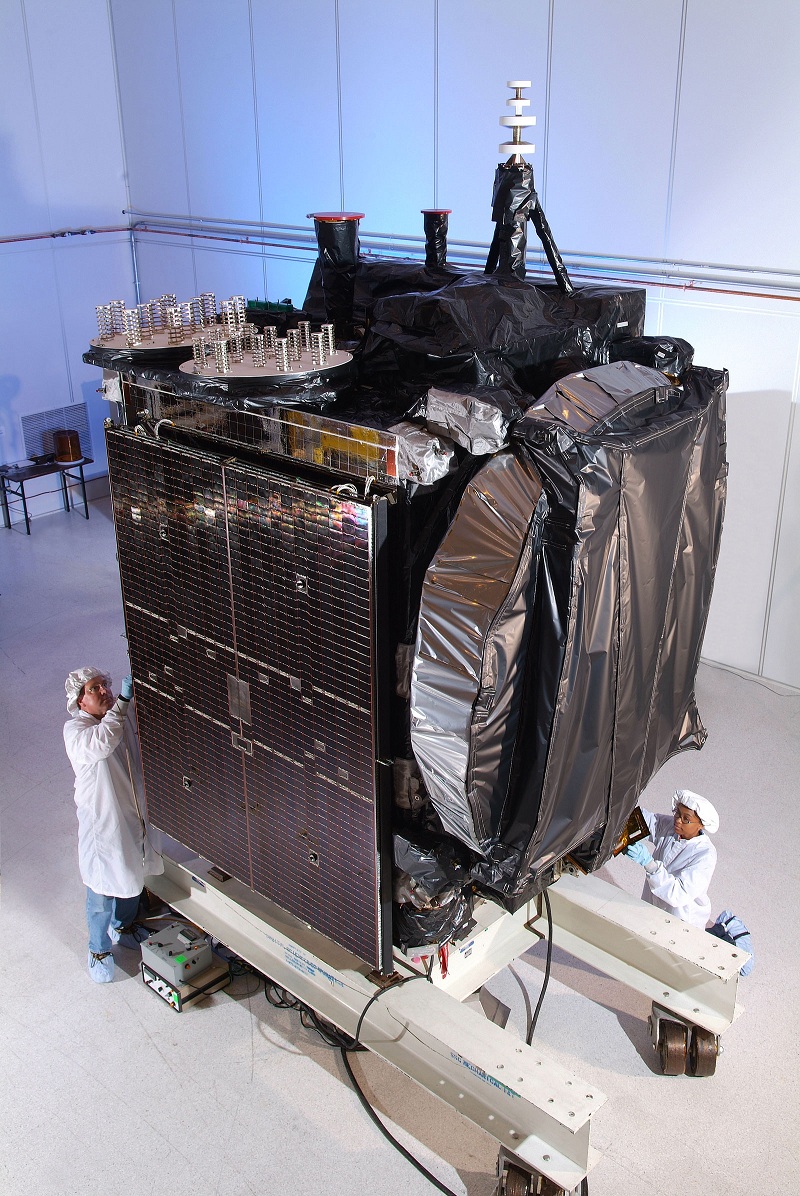
On May 17, 2011, a Proton-M/Breeze-M launch vehicle rolled out to the launch pad at the Baikonur cosmodrome. Proton-M will place into orbit an American satellite, Telstar 14P.
Read more about Proton-M launch vehicle and Breeze-M upper stage…













 Subscribe to blog posts using RSS