Columbus is an integral part of the International Space Station (ISS), and it is the first European laboratory dedicated to long-term experimentation in zero-g conditions. The projected lifetime of the laboratory is ten years. The Columbus laboratory is named after the famous Italian navigator and explorer Christoforo Columbus, who discovered the Americas in 1492.
Columbus is the smallest ISS laboratory, but it has the same scientific, power, and data handling capacity as the other laboratories owned by Russia, USA, and Japan.
ESA plans to design and build an autonomous lifting and aerodynamically controlled re-entry system. Critical technologies are being tested: instrumentation for aerodynamics and aerothermodynamics, thermal protection and hot-structure solutions, guidance, navigation, and flight control using a combination of jets and aerodynamic flaps. The Intermediate Experimental Vehicle (IXV) will be the European platform for in-flight testing of re-entry technologies.
The mission is planned to launch from the European spaceport at Kourou, French Guiana. In 2012, a new launch vehicle, Vega, will inject IXV into a low Earth orbit. The small spacecraft will perform a controlled re-entry, its descent slowed by a parachute, and will land in the Pacific Ocean.
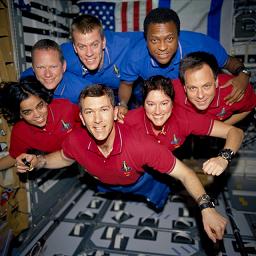
The STS-107 crew members in the SPACEHAB Research Double Module (RDM) aboard the Space Shuttle Columbia. From the left (bottom row): Kalpana Chawla (mission specialist), Rick D. Husband (mission commander), Laurel B. Clark (mission specialist), and Ilan Ramon (payload specialist). From the left (top row): David M. Brown (mission specialist), William C. McCool (pilot), and Michael P. Anderson (payload commander).
The picture was recovered from a roll of unprocessed film found among the debris.
On January 28, 1986, the Space Shuttle Challenger broke apart seventy-three seconds into its flight. The disintegration of the space shuttle occurred after an O-ring seal in one of its solid rocket boosters (SRB) failed. The O-ring failure caused a breach in the SRB, and a flare from within the solid rocket motor reached outside. This led to the separation of the SRB aft attachment and the structural failure of the external tank.
The Space Shuttle program was halted for 32 months. A special commission was appointed by President Ronald Reagan to investigate the accident. The commission offered NASA nine recommendations that were to be implemented as a condition to have the space shuttle flights resumed.
The crew of Space Shuttle Challenger was composed of Francis R. Scobee, Michael J. Smith, Judith A. Resnik, Ellison S. Onizuka, Ronald E. McNair, Gregory B. Jarvis, and Sharon Christa McAuliffe.
The area where M.E.R. Opportunity landed in the Meridiani Planum on Mars is called Challenger Memorial Station, in memory of the last crew of the Space Shuttle Challenger.
On January 27, 1967, during a test and training exercise at Launch Complex 34, Cape Canaveral, the command module of the Apollo/Saturn 204 mission was destroyed by fire.
The crew training at that time was composed of the astronauts selected for the first manned Apollo Program mission: Command Pilot Virgil I. Gus Grissom, Senior Pilot Ed White, and Pilot Roger B. Chaffee. All three astronauts died in the fire.
The typical ATV mission starts in French Guiana, at the Kourou launch site. An Ariane 5 rocket deploys the ATV spacecraft on a circular Low Earth Orbit (LEO) at an altitude of 260 km. ATV then activates its navigation systems and fires its thrusters to reach the transfer orbit to the ISS.
After two or three days, and raising its orbit to 400 km, ATV will be in sight of ISS. It will start the approaching phase of the mission from about 30 km behind and 5 km below the station. Even if the approach and the docking procedures are fully automatic, the flight controllers can at any time call on the spacecraft and back away from the station. The ISS crew can also reject the spacecraft in case any anomalies are noticed.
Once the spacecraft is safely docked to the ISS, the station\’s crew can access the pressurized cargo section and remove the payload. After the payload is removed, the crew fills the cargo section with used hardware and waste materials. At intervals of 10 to 14 days, the main thrusters of the ATV will be used to boost the station\’s altitude. At the end of the mission, the ATV separates from the ISS, and performs a controlled and safe destructive re-entry somewhere above the Pacific Ocean.



 Subscribe to blog posts using RSS












