
Credits: NASA
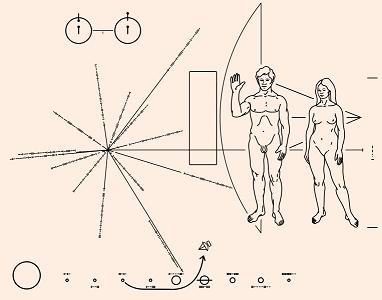
Pioneer 10 is heading in the direction of Aldebaran, the orange giant star which is the Bull\’s Eye in the Taurus Constellation. The last contact with the probe was established in 2003.

Pioneer 10 is heading in the direction of Aldebaran, the orange giant star which is the Bull\’s Eye in the Taurus Constellation. The last contact with the probe was established in 2003.
Three GLONASS satellites were blasted into space onboard a Proton launch vehicle from Baikonur Cosmodrome, in Kazakhstan, on March 1, 2010. GLONASS, or GLObal\’naya NAvigatsionnaya Sputnikovaya Sistema, is a satellite navigation system operated for the Russian government by the Russian Space Forces.
After a fifteen-day successful mission, Space Shuttle Endeavour touched down at the Shuttle Landing Facility at Kennedy Space Center, on February 21, 2010. During three EVAs, the mission specialists Nicholas Patrick and Robert L. Behnken berthed the Tranquility Module, and relocated and attached the Cupola.
Read more about the International Space Station…
The Shuttle-Derived Heavy Launch Vehicle (HLV) was presented on June 17, 2009, by NASA\’s Shuttle Program manager to the Augustine Commission. HLV is a proposed alternative to the NASA Constellation Program. The new design reuses the external fuel tank (ET) and the four-segment solid rocket boosters (SRBs).
The video presents the STS-130 mission highlights. Endeavour delivers Node 3 / Tranquility connecting module and a seven-windowed cupola. The cupola will serve as a control room for robotics.
Read more about the International Space Station…
The Solar Dynamics Observatory (SDO) lifted off aboard an Atlas V launch vehicle on Thursday, February 11, 2010, from Cape Canaveral Air Force Station\’s Launch Complex 41. SDO is a NASA mission that will operate on a geosynchronous orbit, which will allow continuous observations of the Sun.
Read more about the Solar Dynamics Observatory…





