OrbitalHub

The place where space exploration, science, and engineering meet

Domain is for sale. $50,000,000.00 USD. Direct any inquiries to contact@orbitalhub.com.

Archive for the Astronomy category

October 13, 2015

Jupiter HD

Posted by


NASA dixit:

“New imagery from NASA’s Hubble Space Telescope is revealing details never before seen on Jupiter. High-resolution maps and spinning globes (rendered in the 4k Ultra HD format) are the first products to come from a program to study the solar system’s outer planets each year using Hubble. The observations are designed to capture a broad range of features, including winds, clouds, storms and atmospheric chemistry. These annual studies will help current and future scientists see how such giant worlds change over time.”

Video credit: NASA Goddard


  • Facebook
  • Google
  • Slashdot
  • Reddit
  • Live
  • TwitThis
September 23, 2015

SOHO and Comets

Posted by


NASA dixit:

“In this video, Karl Battams of the Naval Research Lab talks us through a visualization of the comets that SOHO has witnessed. Since its launch nearly 20 years ago, NASA and the European Space Agency’s Solar and Heliospheric Observatory has spotted 3000 comets. The mission’s The Large Angle and Spectrometric Coronagraph (LASCO) instrument blocks out the bright solar disk, making it easier to see the corona of plasma and dust around the Sun, normally only visible during solar eclipses. This instrument also provides a very large field of view of the region around the Sun.

This visualization utilizes SOHO data from 1998 – 2010 and shows over 2000 comets. Comets that were first observed by SOHO carry no labels, and comets witnessed but not discovered by the spacecraft are represented with their labels. Trails on the comets are color coded based on family: yellow – unaffiliated comets, red – Kreutz group, green – Meyer group, blue – Marsden, cyan – Kracht, and magenta – Kracht 2.”

Video credit: NASA


  • Facebook
  • Google
  • Slashdot
  • Reddit
  • Live
  • TwitThis
August 15, 2015

1999 JD6 a.k.a. 85989

Posted by


Wikipedia dixit:

“(85989) 1999 JD6 is an Aten asteroid, near-Earth object, and potentially hazardous object in the inner Solar System that makes frequent close approaches to Earth and Venus. […] Although 1999 JD6 in its current orbit never passes closer than 0.047 AU to Earth, it is listed as a potentially hazardous object because it is large and might pose a threat in the future. The asteroid is well-observed, having been observed over 1,500 times over a length of over 25 years, and was assigned a numeric designation in August 2004.”

NASA JPL:

“Radar data of asteroid 1999 JD6 revealed the object is a contact binary consisting of two lobes. The data was collected over seven and a half hours on July 25, 2015, when the asteroid was about 4.5 million miles (7.2 million kilometers) from Earth.”

Video credit: NASA JPL


  • Facebook
  • Google
  • Slashdot
  • Reddit
  • Live
  • TwitThis
August 12, 2015

Ceres 3D Tour

Posted by


Wikipedia dixit:

“Ceres is the largest object in the asteroid belt, which lies between the orbits of Mars and Jupiter. Its diameter is approximately 945 kilometers (587 miles), making it the largest of the minor planets within the orbit of Neptune. The thirty-third largest known body in the Solar System, it is the only one within the orbit of Neptune that is designated a dwarf planet by the International Astronomical Union (IAU). Composed of rock and ice, Ceres is estimated to comprise approximately one third of the mass of the entire asteroid belt. Ceres is the only object in the asteroid belt known to be unambiguously rounded by its own gravity. From Earth, the apparent magnitude of Ceres ranges from 6.7 to 9.3, and hence even at its brightest, it is too dim to be seen with the naked eye, except under extremely dark skies.

Ceres was the first asteroid discovered, by Giuseppe Piazzi at Palermo on 1 January 1801. It was originally considered a planet, but was reclassified as an asteroid in the 1850s when many other objects in similar orbits were discovered.

Ceres appears to be differentiated into a rocky core and icy mantle, and may harbor a remnant internal ocean of liquid water under the layer of ice. The surface is probably a mixture of water ice and various hydrated minerals such as carbonates and clay. In January 2014, emissions of water vapor were detected from several regions of Ceres. This was unexpected, because large bodies in the asteroid belt do not typically emit vapor, a hallmark of comets.

The robotic NASA spacecraft Dawn entered orbit around Ceres on 6 March 2015. Pictures with a resolution previously unattained were taken during imaging sessions starting in January 2015 as Dawn approached Ceres, showing a cratered surface. Two distinct bright spots (or high-albedo features) inside a crater, incorrectly reported as observed in earlier Hubble images, were seen in a 19 February 2015 image, leading to speculation about a possible cryovolcanic origin or outgassing. On 3 March 2015, a NASA spokesperson said the spots are consistent with highly reflective materials containing ice or salts, but that cryovolcanism is unlikely. On 11 May 2015, NASA released a higher resolution image showing that, instead of one or two spots, there are actually several.”

Video credit: NASA JPL


  • Facebook
  • Google
  • Slashdot
  • Reddit
  • Live
  • TwitThis
August 22, 2011

Underground Astronomy

Posted by


Credits: ASPERA


When Einstein was awarded the Nobel Prize in Physics in 1921, he did not receive it for his contributions to the understanding of gravity through his theory of relativity… actually he received it for a paper he wrote in annus mirabilis 1905 on the law of the photoelectric effect.


At that time, relativity and the new perspective on gravity offered by Einstein’s theory was so controversial that the Nobel Prize Committee members chose to protect their reputations and felt that it would be appropriate to award Einstein the Nobel Prize for “his services to theoretical Physics, and especially for his discovery of the law of the photoelectric effect”. One hundred years later, the theory of relativity is part of second-year University curriculum and reputations are safe.


Classical astronomy relies on the fact that cosmic events generate electromagnetic radiation in different regions of the electromagnetic spectrum (radio waves, microwaves, infrared radiation, visible light, ultraviolet radiation, X-rays, and gamma rays). This electromagnetic radiation is recorded with telescopes or other instruments and the details of the astronomic events are revealed to observers. The limitations of the early ground astronomical observatories are quite obvious: the eyes of the astronomers were used as sensors and they were able to receive only the electromagnetic radiation passing through the atmospheric window. Many secrets have been revealed to us only after the telescope sensors were able to record data across all regions of the spectrum and when the astronomic observatories have been moved in orbit around Earth.


But the strength of our space telescopes is also their weakness… there are astronomical events that do not generate electromagnetic radiation, or to be more exact, they keep it for themselves. And the example is just beyond the event horizon: a black hole. This is where Einstein’s theory of relativity comes to the rescue. Even if the electromagnetic radiation cannot escape the gravitational grip of a black hole, gravitational waves can. A black hole cannibalizing another black hole will generate gravitational waves that cause distortions in the space-time.


The question is how to detect the gravitational waves. The first generation of gravitational wave detectors is already deployed, and the second generation is currently being designed by scientists. They are based on interferometers and the principle on which they rely is very simple: they detect tiny variations in the relative positions of sensors located far away from each other. The Advanced Laser Interferometer Gravitational Wave Observatory (LIGO), which is a first-generation instrument, consists in two perpendicular four-kilometer tubes in which LASER light enters through a splitter. Each tube has mirrors located at their ends so the light can bounce back and forth between the end points of the tubes many times. The two beams of light eventually return to the splitter and if the two tubes have different lengths (they are designed and built identical) the splitter will not be able to reconstruct the initial LASER beam.


Gravitational waves passing through the gravitational wave observatory would affect the two tubes in different ways so a photodetector exposed to the reconstructed LASER beam would record the variations. In order to validate such observations and rule out false signals caused by earthquakes, tides, and even human activity, LIGO consists of three interferometers.


A third-generation observatory, ten times more sensitive than the second-generation instruments, was proposed by a team of European scientists. This third-generation observatory is called the Einstein Telescope. Similar to LIGO, the Einstein Telescope will consist of three interferometers. An improvement of the new instrument is the ten-kilometer arms, and a cryogenic system that will cool the elements of the instrument so that the noise caused by molecular motion will not affect the measurements. In addition, the interferometers are located 150 meters underground and away from coast lines.


The project is supported by the European Commission and there are eight research institutions involved in the study and the conceptual design of the telescope. The design study project is organized in four working groups: WP1 (Site Identification), WP2 (Suspension Requirements), WP3 (Topology Identification), and WP4 (Astrophysics Issues).


We are witnessing the emergence of a new field of astronomy — Gravitational Wave Astronomy. You can find more details about Gravitational Wave Astronomy and the Einstein Telescope on the telescope home website.



  • Facebook
  • Google
  • Slashdot
  • Reddit
  • Live
  • TwitThis
December 20, 2010

How Easy is it to Measure the Universe?

Posted by


Credits: NASA/ESA/A.Zezas/JPL/Caltech/GALEX Team/J.Huchra et al.


One thing that I find fascinating about astronomy is the ingenious ways astronomers have come up with to solve the puzzles laid out in the skies. You cannot travel to distant stars and galaxies to study them… so what do you do? Well, you use all of the knowledge that mathematics and physics give you and find out anything you want to know (or pretty much everything) about them.


Eratosthenes (276-194 BC) was the chief librarian of the Library of Alexandria (the same library that Julius Caesar burned to the ground in 48 BC). He knew that every year on June 21 at noon the Sun was 7.2 degrees off the vertical in Alexandria, while in Syene the Sun stood directly overhead. Knowing the distance between the two locations and using basic geometry, he was able to determine the circumference of the Earth to be around 40,000 km. Pretty amazing for that time, don’t you think?


Closer to our time, the astronomer Edwin Hubble (1889-1953) has devised methods for finding distances to other galaxies. Hubble was also able to measure the radial velocities of galaxies using the redshift in their spectral lines. His findings proved not just that the Universe is expanding, but also determined that it all began about 13.7 billion years ago.


Have you ever been able to visualize in terms of relative size or scale the planets and the moons of our solar system? How big do you think the Earth is compared to Mercury or Mars? Which one do you think is a bigger moon, the Earth’s Moon or Saturn’s Titan? How many times do you think the Grand Canyon would fit inside the Valles Marineris on Mars? How big is, let us say, the asteroid Itokawa compared to the International Space Station? Is our own Milky Way galaxy bigger than Andromeda?


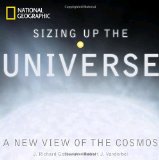
I found many other interesting stories and had the above questions answered in a new book, Sizing Up The Universe. I would say that the unifying theme of the book is size comparison. Numerous charts capture a fresh vision of the Universe, introducing an original way of comparing objects in the heavens.


Browsing through Sizing Up The Universe, I could not help thinking about my high school astronomy textbook. The author of the textbook was definitely not into visual arts, as the pages were flooded with math formulas and only a few sketches were present here and there. I did not mind it at that time, but I realize now that stunning images of planets, stars, and galaxies, such as those found in Sizing Up The Universe, would make the learning process much more enjoyable. Moreover, the real stories behind groundbreaking discoveries in astronomy that are sprinkled throughout the text make it captivating and easy to read.


The authors of Sizing Up The Universe are J. Richard Gott III and Robert J. Vanderbei. J. Richard Gott III is professor of astrophysics at Princeton University. He has written articles for Time, Scientific American, and New Scientist. He is also the author of Time Travel in Einstein’s Universe. Robert J. Vanderbei is professor and chair of the Department of Operations Research and Financial Engineering at Princeton University. He is an amateur astronomer and has taken from his own backyard many images of astronomical objects, some of which can be found in the book.


  • Facebook
  • Google
  • Slashdot
  • Reddit
  • Live
  • TwitThis