OrbitalHub

The place where space exploration, science, and engineering meet

Domain is for sale. $50,000,000.00 USD. Direct any inquiries to contact@orbitalhub.com.

Archive for the Astronomy category

October 7, 2017

Moonrise from the Space Station

Posted by


ESA dixit:

“On 18 September 2017, ESA astronaut Paolo Nespoli shot this beautiful time-lapse showing the Moon rising above the Earth’s horizon together with Mercury, Mars, the star Regulus, and Venus. ESA astronaut Paolo Nespoli is currently working and living on board the International Space Station as part of his long duration Vita mission.”

Video credit: ESA


  • Facebook
  • Google
  • Slashdot
  • Reddit
  • Live
  • TwitThis
October 6, 2017

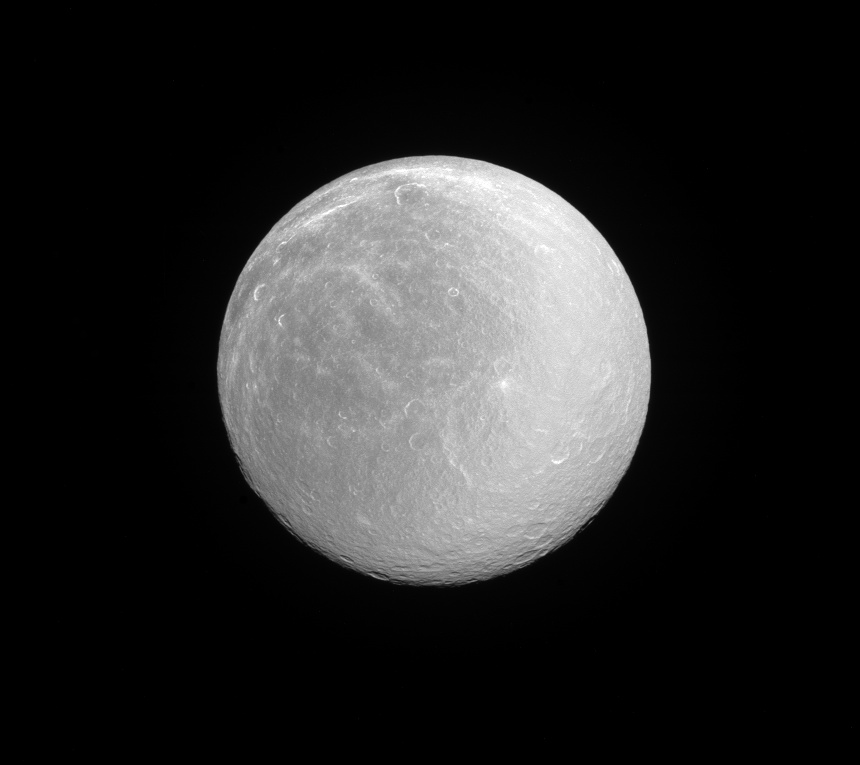
Regarding Rhea

Posted by


NASA dixit:

“June 3, 2016. Rhea, like many moons in the outer solar system, appears dazzlingly bright in full sunlight. This is the signature of the water ice that forms most of the moon’s surface. Rhea (949 miles or 1,527 kilometers across) is Saturn’s second largest moon after Titan. Its ancient surface is one of the most heavily cratered of all of Saturn’s moons. Subtle albedo variations across the disk of Rhea hint at past geologic activity.

This view looks toward the anti-Saturn hemisphere of Rhea. North on Rhea is up and rotated 36 degrees to the right. The image was taken with the Cassini spacecraft narrow-angle camera using a spectral filter which preferentially admits wavelengths of ultraviolet light centered at 338 nanometers. The view was acquired at a distance of approximately 365,000 miles (587,000 kilometers) from Rhea and at a Sun-Rhea-spacecraft, or phase, angle of 9 degrees. Image scale is 2.4 miles (3.9 kilometers) per pixel.”

Image credit: NASA/JPL-Caltech/Space Science Institute


  • Facebook
  • Google
  • Slashdot
  • Reddit
  • Live
  • TwitThis
October 5, 2017

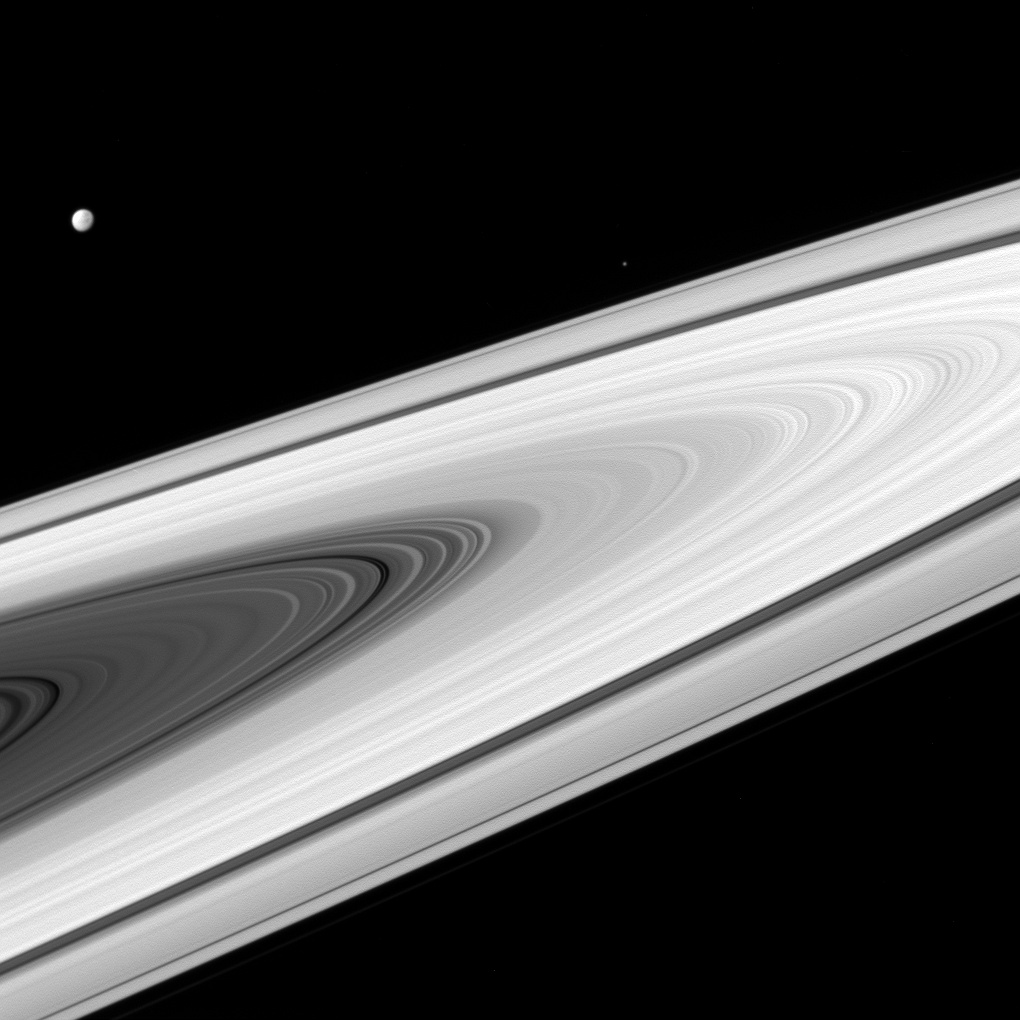
Not Really Starless at Saturn

Posted by


NASA dixit:

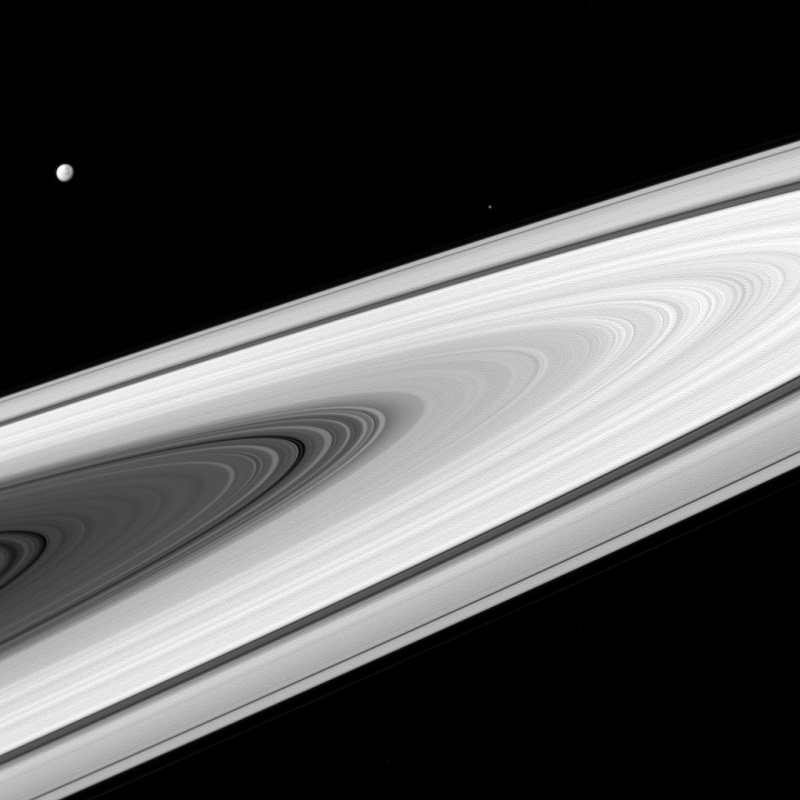
“April 2, 2016. Saturn’s main rings, along with its and moons, are much brighter than most stars. As a result, much shorter exposure times (10 milliseconds, in this case) are required to produce an image and not saturate the detectors of the imaging cameras on NASA’s Cassini spacecraft. A longer exposure would be required to capture the stars as well. Cassini has captured stars on many occasions, especially when a target moon is in eclipse, and thus darker than normal. Dione (698 miles, 1123 kilometers across) and Epimetheus (70 miles, 113 kilometers across) are seen in this view, above the rings at left and right respectively.

This image looks toward the sunlit side of the rings from about 3 degrees above the ring plane. The image was taken in visible light with the Cassini spacecraft wide-angle camera. The view was obtained at a distance of approximately 257,000 miles (413,000 kilometers) from Saturn and at a Sun-Saturn-spacecraft, or phase, angle of 34 degrees. Image scale is 15 miles (25 kilometers) per pixel.”

Image credit: NASA/JPL-Caltech/Space Science Institute

 

  • Facebook
  • Google
  • Slashdot
  • Reddit
  • Live
  • TwitThis
October 4, 2017

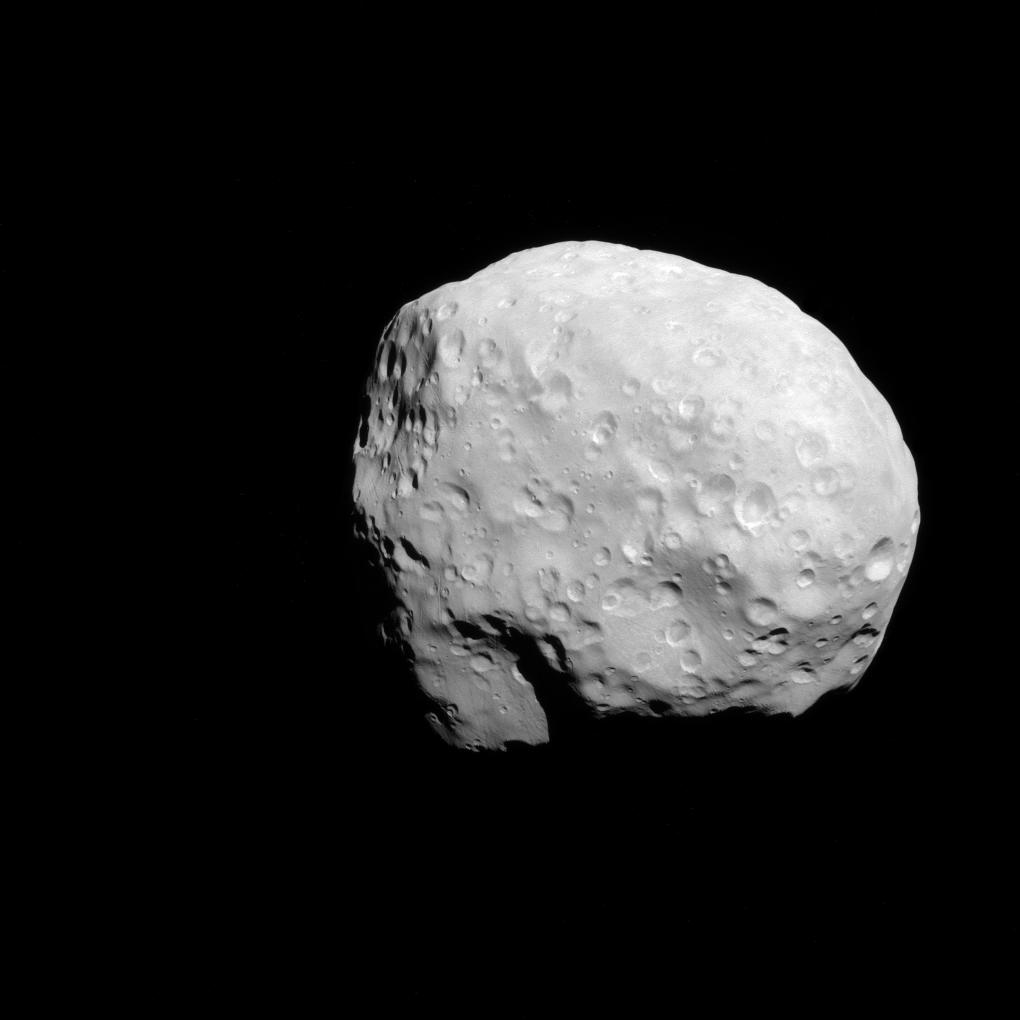
Examining Epimetheus

Posted by


NASA dixit:

“December 6, 2015. NASA’s Cassini spacecraft captured this view of Saturn’s moon Epimetheus (116 kilometers, or 72 miles across) during a moderately close flyby. This is one of Cassini’s highest resolution views of the small moon. This view looks toward the Saturn facing side of Epimetheus. North on Epimetheus is up. The image was taken in green polarized light with the Cassini spacecraft narrow-angle camera.

The view was acquired at a distance of approximately 22,000 miles (35,000 kilometers) from Epimetheus and at a Sun-Epimetheus-spacecraft, or phase, angle of 28 degrees. Image scale is 697 feet (212 meters) per pixel.”

Image credit: NASA/JPL-Caltech/Space Science Institute


  • Facebook
  • Google
  • Slashdot
  • Reddit
  • Live
  • TwitThis
October 3, 2017

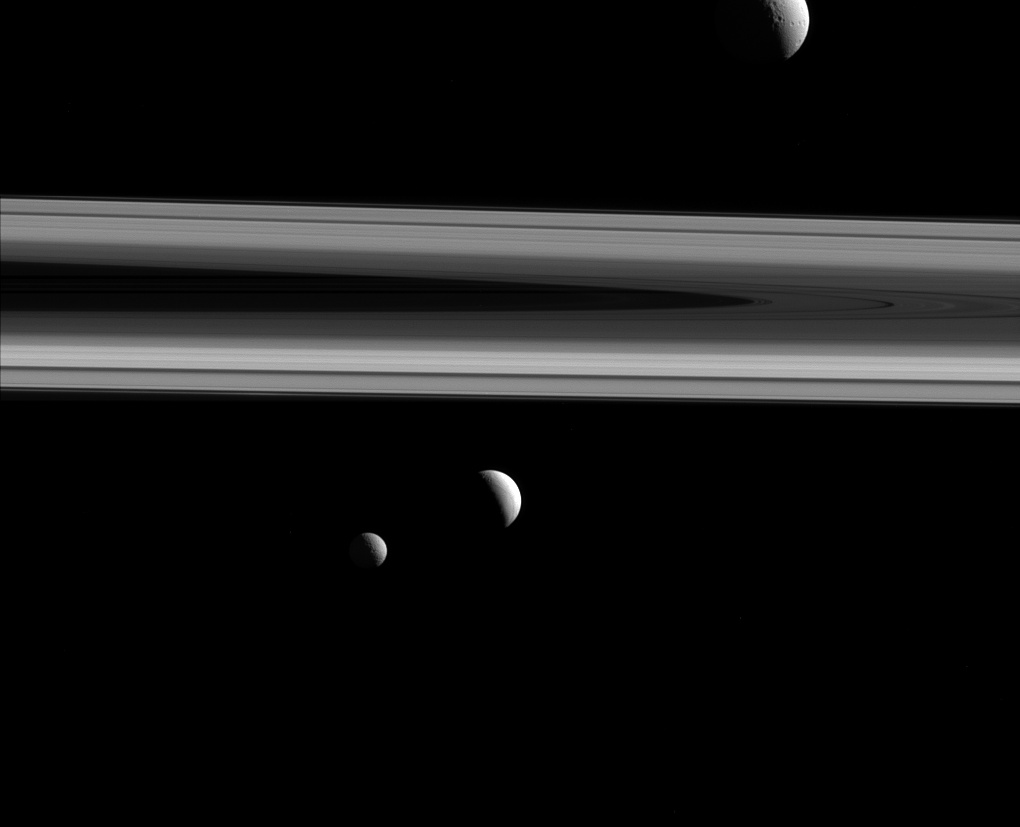
Three Times the Fun

Posted by


NASA dixit:

“December 3, 2015. Three of Saturn’s moons, Tethys, Enceladus, and Mimas, are captured in this group photo from NASA’s Cassini spacecraft. Tethys (660 miles or 1062 kilometers across) appears above the rings, while Enceladus (313 miles or 504 kilometers across) sits just below center. Mimas (246 miles or 396 kilometers across) hangs below and to the left of Enceladus.

This view looks toward the sunlit side of the rings from about 0.4 degrees above the ring plane. The image was taken in visible light with the Cassini spacecraft narrow-angle camera. The view was acquired at a distance of approximately 837,000 miles (1.35 million kilometers) from Enceladus, with an image scale of 5 miles (8 kilometers) per pixel. Tethys was approximately 1.2 million miles (1.9 million kilometers) away with an image scale of 7 miles (11 kilometers) per pixel. Mimas was approximately 1.1 million miles (1.7 million kilometers) away with an image scale of 6 miles (10 kilometers) per pixel.”

Image credit: NASA/JPL-Caltech/Space Science Institute


  • Facebook
  • Google
  • Slashdot
  • Reddit
  • Live
  • TwitThis
October 2, 2017

Ices and Shadows

Posted by


NASA dixit:

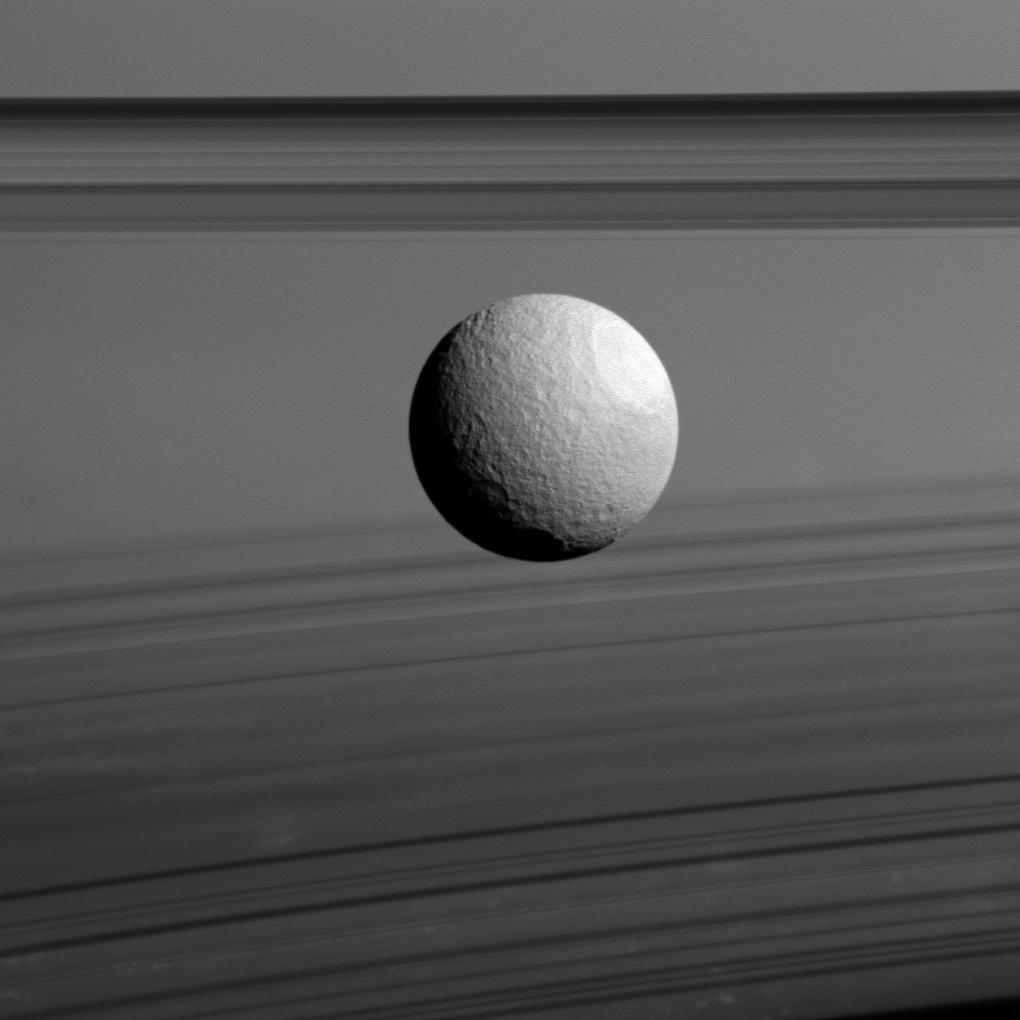
“November 23, 2015. Saturn’s moon Tethys appears to float between two sets of rings in this view from NASA’s Cassini spacecraft, but it’s just a trick of geometry. The rings, which are seen nearly edge-on, are the dark bands above Tethys, while their curving shadows paint the planet at the bottom of the image. Tethys (660 miles or 1,062 kilometers across) has a surface composed mostly of water ice, much like Saturn’s rings. Water ice dominates the icy surfaces in the the far reaches of our solar system, but ammonia and methane ices also can be found.

The image was taken in visible light with the Cassini spacecraft wide-angle camera. North on Tethys is up. The view was obtained at a distance of approximately 40,000 miles (65,000 kilometers) from Tethys. Image scale is 2.4 miles (4 kilometers) per pixel.”

Image credit: NASA/JPL-Caltech/Space Science Institute


  • Facebook
  • Google
  • Slashdot
  • Reddit
  • Live
  • TwitThis