OrbitalHub

The place where space exploration, science, and engineering meet

Domain is for sale. $50,000,000.00 USD. Direct any inquiries to contact@orbitalhub.com.

Archive for the Space Telescopes category

October 29, 2008

Herschel, Planck’s Big Brother

Posted by


Credits: ESA/AOES Medialab


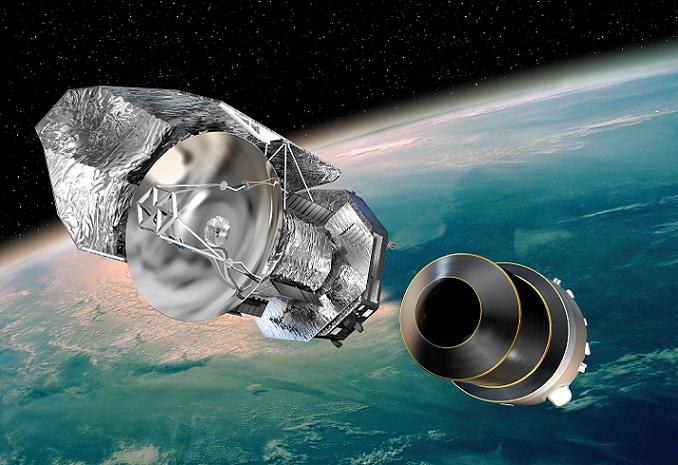
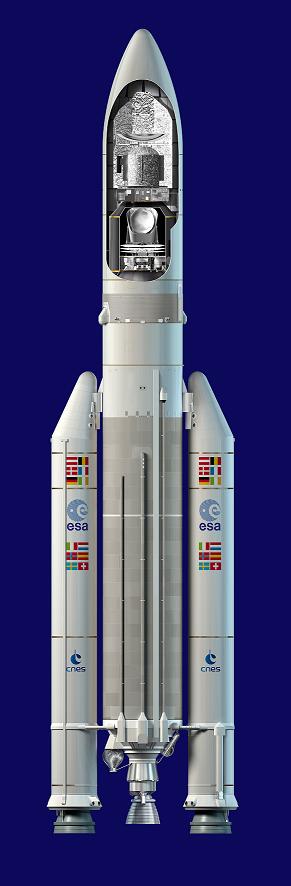
In a previous post, we presented the Planck spacecraft. We would like to dedicate this post to Planck’s big brother, Herschel. Why b(r)other? Because Planck and Herschel will be launched into space by the same Ariane 5 launcher and they will share the fairing section during the launch phase of the mission. Why big? Well, because Herschel is a larger spacecraft than Planck… actually Herschel is the largest space telescope ever built.


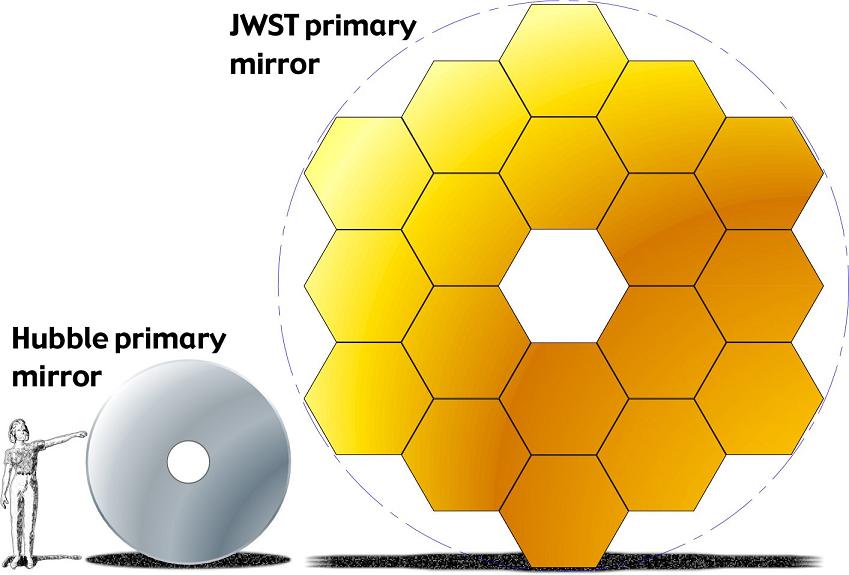
Just to have an idea about the size of the infrared telescope onboard the Herschel spacecraft, the primary mirror has a diameter of 3.5 m and a mass of only 350 kg. In comparison, the mirror of the Hubble space telescope has a diameter of 2.4 m and a mass of 1.5 tons. Obviously, a great deal of effort has been put into minimizing the mass of the telescope, an advance made possible by present-day technology.


The infrared telescope will become operational four months after its launch and will have a nominal mission lifetime of three years. The objectives that ESA set for the Herschel Space Observatory are ambitious: the study of the galaxies in the early universe, the investigation of the creation of stars, the observation of the chemical composition of the atmosphere and surfaces of comets, planets and satellites, as well as examining the molecular chemistry of the universe.


Like Planck, Herschel will observe the sky from the second Lagrangean Point (L2) of the Sun-Earth system. The instruments onboard Herschel will collect long-wavelength infrared radiation. Herschel will be the only space observatory to cover the spectral range from the far infrared to sub-millimeter, which is the reason why the initial name of the space observatory was Far Infrared and Sub-millimeter Telescope (FIRST).


Credits: ESA


The Herschel spacecraft will have 3.3 tons at launch, with a length of 7.5 m and a cross section of 4×4 m. The spacecraft comprises of two modules: the service module and the payload module. While the service module contains the systems for power conditioning, attitude control, data handling and communications, and the warm parts of the scientific instruments, the payload module contains the telescope, the optical bench, the cold parts of the scientific instruments and the cooling system. A sunshield protects the telescope and the cryostat from solar radiation. The sunshield also carries solar cells for power generation.


In order to make accurate observations of the infrared spectrum, parts of the scientific instruments onboard have to be cooled to temperatures close to absolute zero. Two thousand liters of liquid helium will be used for primary cooling during the mission. In addition, each detector onboard is equipped with additional cooling systems.


Credits: ESA/Guarniero


Herschel will not be the first infrared telescope launched into space. There are three predecessors that we would like to mention here: IRAS, the US-Dutch-British satellite launched in 1983, ISO – launched by ESA in 1995, and the NASA’s Spitzer Space Telescope – launched in 2003. However, these three infrared space telescopes were operated on Earth orbits. As we mentioned, Herschel will operate in the L2 point, away from any interference that would affect the scientific instruments onboard. Operating in the L2 point will also help with regard to thermal stability because the spacecraft will not move in and out of eclipse regions.


The launch date is set for early 2009. The journey to the final operational position will take around four months. The European Space Operations Control Center (ESOC) in Darmstadt will coordinate the mission.


  • Facebook
  • Google
  • Slashdot
  • Reddit
  • Live
  • TwitThis
October 25, 2008

Starquakes Detected By COROT

Posted by


Credits: CNES / D. Ducros


Stellar seismology is a relatively new field of study. Since 1995, the ESA/NASA mission SOHO (SOlar Heliospheric Observatory) has pioneered the study of stellar seismology through observations of our own star, the Sun. Despite its name, stellar seismology is the study of stellar pressure waves and not stellar seismic activity (There is no such thing as seismic activity inside a star).


The COROT mission uses a similar approach to study other stars. Three stars similar to the Sun – known as HD499933, HD181420, and HD181906 – have been probed and starquakes have been detected.


Credits: CNES


Starquakes, or oscillations of distant stars, can be detected through variation in the light emitted by the star as sound waves hit the star’s surface.


This method reveals the internal structure of the star, and the patterns that the energy follows when transported from the core to the surface. These observations also allow astronomers to calculate the star’s mass, age, and chemical composition.


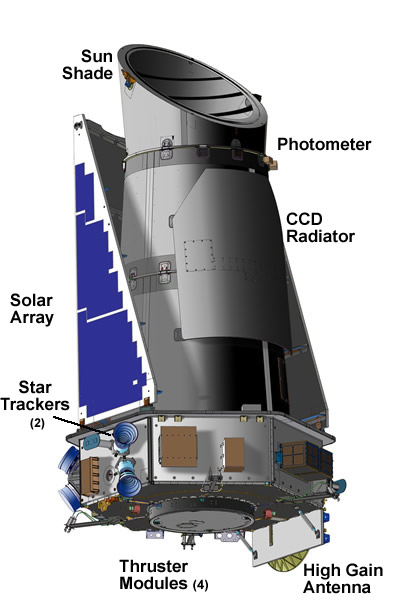
The COROT satellite, carrying a 27 cm diameter telescope, was launched in December 2006 by a Soyuz rocket from the Baikonur Cosmodrome. COROT is a 360 kg satellite and operates on a polar orbit at an altitude of 896 km. COROT is a mission lead by the French Space Agency (CNES); ESA, Austria, Belgium, Germany, Spain, and Brazil also contributed to the mission. The main objectives of the mission are to search for exoplanets and to study stellar interiors.


Credits: CNES


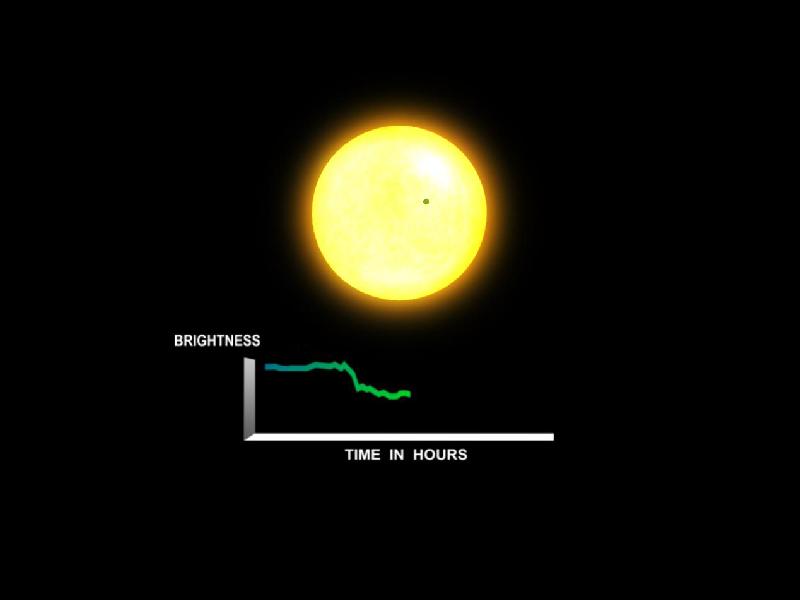
The telescope onboard COROT cannot see exoplanets directly. The method employed by COROT to discover exoplanets is to measure variations in the luminosity of stars. Planets cause such variations as they pass in front of their parent stars. These celestial alignments are called planetary transits. Obviously, the smaller the planet, the higher the telescope’s sensitivity must be in order to detect it.


Ground telescopes have detected more than 200 exoplanets to date (all of them gas giants). COROT continues the search for new worlds outside of our solar system from above the Earth’s atmosphere. Without the distorting effects of the atmosphere, COROT is able to find planets that are made out of rock and are smaller than the gas giants. COROT marks the first step in understanding other solar systems, how planets are formed, and how life can develop on these planets.


From February 2 to February 5, 2009, the first COROT International Symposium will be held in Paris, France.


  • Facebook
  • Google
  • Slashdot
  • Reddit
  • Live
  • TwitThis
October 22, 2008

Newton Phone Home

Posted by


Credits: ESA


After operating flawlessly in orbit for almost nine years, the XMM-Newton X-ray observatory lost contact with the ESA’s ground stations.


In the case of a space mission, losing contact with a spacecraft can mean anything from a technical problem onboard to a collision with space debris or even a meteorite.


The contact was lost when the satellite switched from one ground station to another. The satellite must perform such operations in orbit in order to maintain radio contact with the ground control center of the mission. The ESA’s ground station in Villafranca, Spain, reported that it was not able to re-establish radio contact with the satellite.


Several astronomic observatories have managed to take images of the satellite in orbit. By now it is clear to the ground investigators that the satellite is intact and it is maintaining a constant altitude on the expected orbit. By using a more powerful ground antenna (the 35m diameter antenna at New Norcia in Australia), a weak radio transmission was received from XMM-Newton, proving that the satellite is still alive. Engineers hope to re-establish nominal radio contact with the satellite.


Credits: NASA/ESA/R. Massey (Caltech)


ESA launched the X-ray Multi-Mirror Mission (XMM-Newton) on December 10th, 1999. The mission has an operational lifetime of ten years. XMM-Newton has a large collecting area due to its three X-ray telescopes. In addition, the high altitude orbit offers the ability to make long uninterrupted exposures.


X-rays are absorbed by the Earth’s atmosphere, so only a space telescope like XMM-Newton can detect and study celestial X-ray sources.


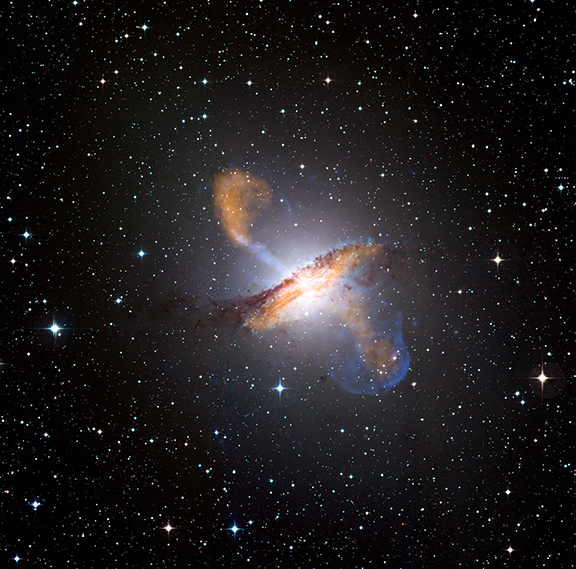
Data collected by the XMM-Newton was used to compile a three-dimensional large-scale map of the dark matter for the first time. The dark matter is an invisible form of matter that accounts for most of the mass of the Universe.


ESA has an entire website dedicated to the XMM-Newton mission. For more details about XMM-Newton you can visit the XMM-Newton Science Operations Center (XMM-Newton SOC) page.


  • Facebook
  • Google
  • Slashdot
  • Reddit
  • Live
  • TwitThis
October 18, 2008

NASA’s IBEX Ready For Launch

Posted by


Credits: NASA GSFC


The solar wind generated by our Sun carves out a protective bubble around the solar system, called the heliosphere. The interstellar medium, consisting of the gas and the dust found between the galaxies, interacts with the solar wind and defines the actual boundary, which is called the termination shock.


NASA has designed a mission to map the boundary of the solar system. The mission is called IBEX (Interstellar Boundary Explorer) and it is ready to launch. The data collected by IBEX will allow scientists to understand the interaction between our Sun and the galaxy for the first time. Understanding this interaction will help us protect future astronauts from the danger of galactic cosmic rays.


In January 2005, the Orbital Science Corporation was selected to develop, build, and launch a small spacecraft for NASA’s IBEX mission. The IBEX spacecraft is based on an already existing bus: the MicroStar satellite. IBEX will be launched by a Pegasus XL rocket, which will be dropped from an aircraft flying over the Pacific Ocean.


Credits: NASA GSFC


Pegasus began its commercial career in April 1990, and since then it has launched more than 80 satellites into space.


Pegasus is a three-stage launching system used to deploy small satellites weighing up to 1,000 pounds into Low Earth Orbit (LEO). An aircraft carries Pegasus to an altitude of 40,000 feet.


The rocket is released and free-falls before igniting its engines. It takes roughly ten minutes for Pegasus to deliver a satellite into orbit.


Pegasus will place IBEX into a 130 mile altitude orbit. An extra solid-fueled rocket will boost the spacecraft from the LEO. IBEX’s final orbit will be a highly elliptical orbit with the perigee at an altitude of 7,000 km and the apogee at 236,000 km. IBEX has to operate in this orbit because any interference from the Earth’s magnetosphere would make it impossible to take accurate measurements with the scientific instruments onboard.


Credits: NASA GSFC


IBEX has a mass of only 83.33 lbs (roughly 38 kg) and is described by NASA as being the size of a bus tire. The instruments onboard IBEX will collect particles called energetic neutral atoms (ENAs). The ENAs are radiated from the termination shock region. The ENA hits recorded by the instruments onboard IBEX will be used to create a map of this region.


The mission is scheduled to launch tomorrow, October 19th, 2008. The spacecraft will be operational for 24 months. You can find out more about the IBEX spacecraft on NASA’s IBEX mission web page.
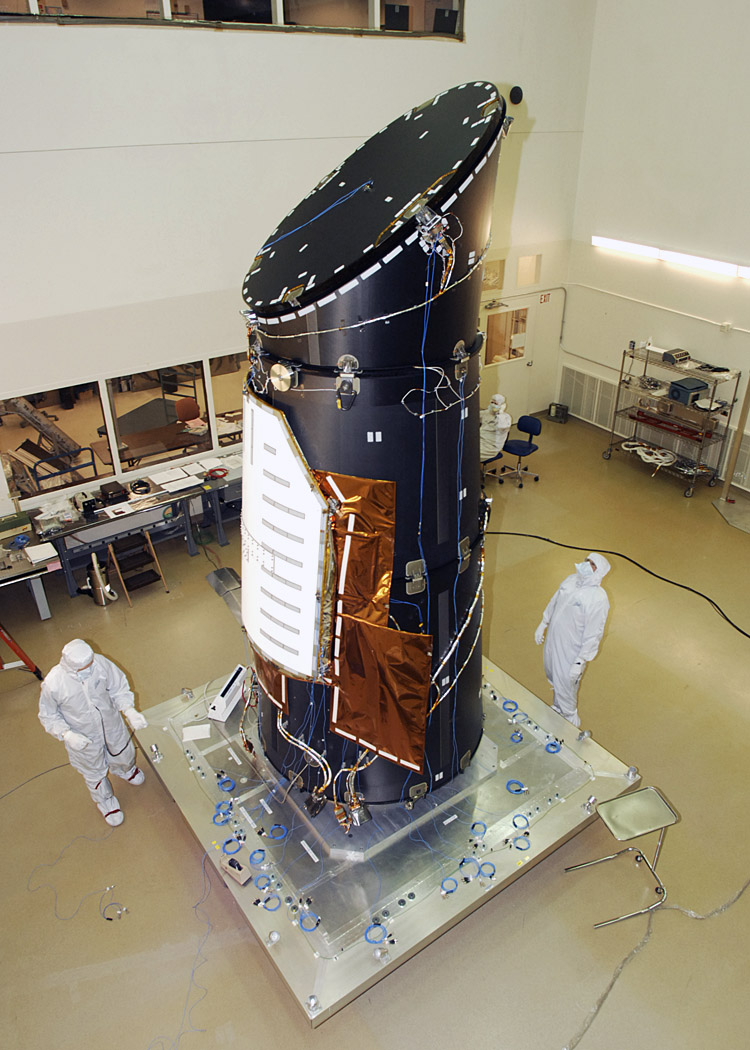
 

  • Facebook
  • Google
  • Slashdot
  • Reddit
  • Live
  • TwitThis
October 1, 2008

ESA to Study the Birth of the Universe

Posted by


Some of the most important questions asked in modern science are: how did the Universe begin, how did it evolve to its present state, and how will it continue to evolve in the future? To ask these questions, the remnant radiation that filled the Universe immediately after the Big Bang must be analyzed. This remnant radiation is known as the Cosmic Microwave Background (CMB).


Credits: ESA


ESA plans to answer these questions with Planck: the first European mission to study the birth of the Universe. The Planck Mission will collect CMB radiation measurements using highly sensitive sensors that are operating at very low temperatures. The measurements will be used to map the smallest variations of the CMB detected to date.


The Planck spacecraft will weigh around 1,900 kg at launch. It is 4.2 m high and has a maximum diameter of 4.2 m. There are two modules that comprise the spacecraft: a service module and the payload module.


The service module contains the systems for power generation, attitude control, data handling and communication, and the warm components of the scientific payload. The payload module contains the telescope, the optical bench, the detectors, and the cooling system (which is of critical importance, as we shall see).


The telescope is an important onboard component. The Planck telescope is a Gregorian telescope with an off-axis parabolic primary mirror 1.75 x 1.5 meters in size. A secondary mirror focuses the incoming microwave radiation on two sets of highly sensitive detectors: the Low Frequency Instrument (LFI) and the High Frequency Instrument (HFI). The Gregorian design offers two key advantages: it is compact and it does not block the optical path.


Credits: ESA/Thales


The LFI will be operating at –253 degrees Celsius. The array of twenty-two tuned radio receivers that comprise LFI will produce high-sensitivity, multi-frequency measurements of the microwave sky in the frequency range of 27 GHz to 77 GHz.


The HFI has to be cooled to –272.9 degrees Celsius in order to operate (one tenth of one degree above the absolute zero!). HFI’s fifty-two bolometric detectors will produce high-sensitivity, multi-frequency measurements of the diffuse sky radiation in the frequency range of 84 GHz to 1 THz.


A baffle surrounds the telescope and instruments. The baffle prevents light from the Sun and the Moon from altering the measurements. A complex system of refrigerators is used onboard the spacecraft in order to achieve the temperatures needed for nominal operation. The detectors have to work at temperatures close to the absolute zero, otherwise their own emissions can alter the measurements.


The two instruments will be used to measure the small variations of the CMB across the sky. By combining the measurements, a full sky map of unprecedented precision will be produced. The map will help astronomers decide which theories on the birth and the evolution of the Universe are correct. Questions like ‘what is the age of the Universe?’ or ‘what is the nature of the dark-matter?’ will be answered.


The mission was initially designed as COBRAS/SAMBA (Cosmic Background Radiation Anisotropy Satellite and Satellite for Measurement of Background Anisotropies) because it grew out of two mission proposals that had similar objectives. When the mission was approved in 1996, it was also renamed as Planck in honor of the German scientist Max Planck (1858 – 1947). Max Planck was awarded the Nobel Prize for Physics in 1918.


Credits: ESA


The mission is a collaborative effort. The Planck spacecraft was designed and built by a consortium led by Alcatel Alenia Space (Cannes, France). The telescope mirrors are manufactured by EADS Astrium (Friedrichshafen, Germany). The Low Frequency Instrument (LFI) was designed and built by a consortium led by the Instituto di Astrofisica Spaziale e Fisica Cosmica (IASF) in Bologna, Italy. The High Frequency Instrument (HFI) was designed and built by a consortium led by the Institut d’Astrophysique Spatiale (CNRS) in Orsay, France.


The Planck Mission has two predecessors: the Cosmic Background Explorer (COBE) and the Wilkinson Microwave Anisotropy Probe (WMAP).


Credits: ESA


The Planck spacecraft will be launched in early 2009 from Kourou, French Guiana. An Ariane 5 booster will place the spacecraft in a trajectory towards the L2 point. The L2 point stands for Second Lagrangian Point and it is located around 1.5 million kilometers away from Earth in a direction diametrically opposite the Sun. It will be a dual launch configuration, as the Herschel spacecraft will be launched together with Planck.


Between four to six months after the launch, Planck will reach its final position. It will take six more months before Planck will be declared operational.


Planck will perform scientific measurements for fifteen months, allowing two complete sky surveys. The spacecraft will be operational as along as there are resources for the cooling systems onboard.


For more details on the ESA’s Planck Mission you can visit the mission’s home page on the ESA website.


  • Facebook
  • Google
  • Slashdot
  • Reddit
  • Live
  • TwitThis