“An active region on the sun — an area of intense and complex magnetic fields — has rotated into view on the sun and seems to be growing rather quickly in this video captured by NASA’s Solar Dynamics Observatory between July 5-11, 2017. Such sunspots are a common occurrence on the sun, but are less frequent as we head toward solar minimum, which is the period of low solar activity during its regular approximately 11-year cycle. This sunspot is the first to appear after the sun was spotless for two days, and it is the only sunspot group at this moment. Like freckles on the face of the sun, they appear to be small features, but size is relative: The dark core of this sunspot is actually larger than Earth.”
“The SpaceX Falcon 9 rocket launched from the Kennedy Space Center, Florida, on August 14, sent an unpiloted Dragon cargo vehicle on a delivery run to the International Space Station. Loaded with more than three tons of supplies and scientific investigations, the Dragon is scheduled to arrive at the station on August 16 where it will be captured by Expedition 52 crewmembers Jack Fischer of NASA and Paolo Nespoli of the European Space Agency operating the station’s Canadarm2 robotic arm. Dragon will spend about a month attached to the Earth-facing port of the Harmony module.”
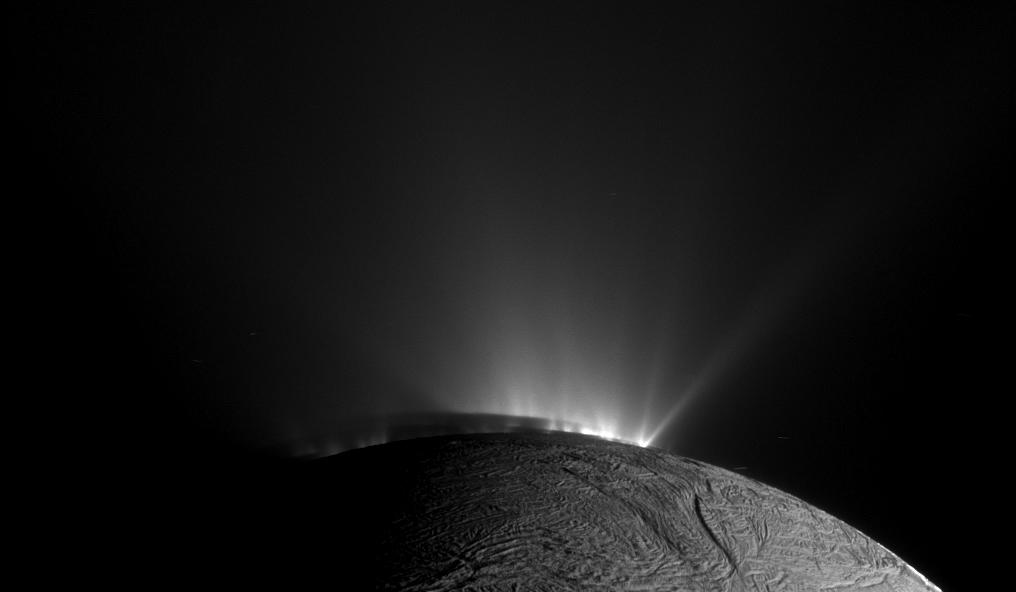
“November 30, 2010. This Cassini narrow-angle camera image — one of those acquired in the survey conducted by the Cassini imaging science team of the geyser basin at the south pole of Enceladus — was taken as Cassini was looking across the moon’s south pole. At the time, the spacecraft was essentially in the moon’s equatorial plane. The image scale is 1280 feet (390 meters) per pixel and the sun-Enceladus-spacecraft, or phase, angle is 162.5 degrees. The image was taken through the clear filter of the narrow angle camera, 1.4 years after southern autumnal equinox. The shadow of the body of Enceladus on the lower portions of the jets is clearly seen.
Post-equinox images like this, clearly showing the different projected locations of the intersection between the shadow and the curtain of jets from each fracture, were useful for scientists in checking the triangulated positions of the geysers.”
“After almost 20 years in space, NASA’s Cassini spacecraft begins the final chapter of its remarkable story of exploration: its Grand Finale. Between April and September 2017, Cassini will undertake a daring set of orbits that is, in many ways, like a whole new mission. Following a final close flyby of Saturn’s moon Titan, Cassini will leap over the planet’s icy rings and begin a series of 22 weekly dives between the planet and the rings.
No other mission has ever explored this unique region. What we learn from these final orbits will help to improve our understanding of how giant planets – and planetary systems everywhere – form and evolve.
On the final orbit, Cassini will plunge into Saturn’s atmosphere, sending back new and unique science to the very end. After losing contact with Earth, the spacecraft will burn up like a meteor, becoming part of the planet itself.
Cassini’s Grand Finale is about so much more than the spacecraft’s final dive into Saturn. That dramatic event is the capstone of six months of daring exploration and scientific discovery. And those six months are the thrilling final chapter in a historic 20-year journey.”
“A SpaceX Falcon 9 rocket launched from NASA’s Kennedy Space Center in Florida Aug. 14, sending an unpiloted Dragon cargo spacecraft on a delivery run to the International Space Station. Loaded with more than three tons of supplies and scientific investigations, the Dragon is scheduled to arrive at the station Aug. 16 where it will be captured by Expedition 52 crewmembers Jack Fischer of NASA and Paolo Nespoli of ESA (European Space Agency) operating the station’s Canadarm2 robotic arm. Dragon will spend about a month attached to the Earth-facing port of the Harmony module.”
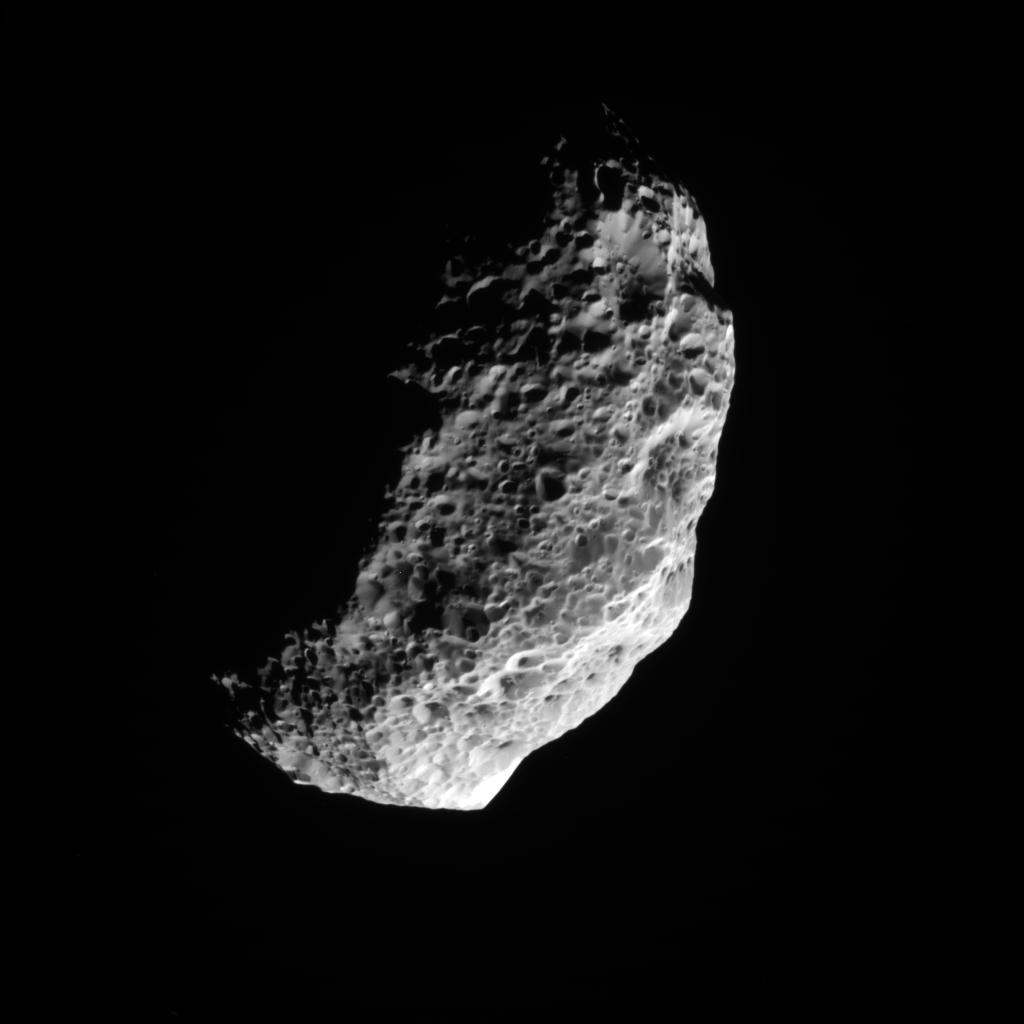
“November 28, 2010. NASA’s Cassini spacecraft obtained this raw image of the Saturnian moon Hyperion when the spacecraft was about 73,000 kilometers (45,000 miles) away from the moon’s surface.”
“After almost 20 years in space, NASA’s Cassini spacecraft begins the final chapter of its remarkable story of exploration: its Grand Finale. Between April and September 2017, Cassini will undertake a daring set of orbits that is, in many ways, like a whole new mission. Following a final close flyby of Saturn’s moon Titan, Cassini will leap over the planet’s icy rings and begin a series of 22 weekly dives between the planet and the rings.
No other mission has ever explored this unique region. What we learn from these final orbits will help to improve our understanding of how giant planets – and planetary systems everywhere – form and evolve.
On the final orbit, Cassini will plunge into Saturn’s atmosphere, sending back new and unique science to the very end. After losing contact with Earth, the spacecraft will burn up like a meteor, becoming part of the planet itself.
Cassini’s Grand Finale is about so much more than the spacecraft’s final dive into Saturn. That dramatic event is the capstone of six months of daring exploration and scientific discovery. And those six months are the thrilling final chapter in a historic 20-year journey.”
“A solar flare is a sudden flash of brightness observed near the Sun’s surface. It involves a very broad spectrum of emissions, an energy release of typically 1 × 10²⁰ joules of energy for a well-observed event. A major event can emit up to 1 × 1025 joules (the latter is roughly the equivalent of 1 billion megatons of TNT, or over 400 times more energy than released from the impact of Comet Shoemaker–Levy 9 with Jupiter). Flares are often, but not always, accompanied by a coronal mass ejection. The flare ejects clouds of electrons, ions, and atoms through the corona of the sun into space. These clouds typically reach Earth a day or two after the event. The term is also used to refer to similar phenomena in other stars, where the term stellar flare applies.
Solar flares affect all layers of the solar atmosphere (photosphere, chromosphere, and corona), when the plasma medium is heated to tens of millions kelvins, while the cosmic-ray-like electrons, protons, and heavier ions are accelerated to near the speed of light. They produce radiation across the electromagnetic spectrum at all wavelengths, from radio waves to gamma rays, although most of the energy is spread over frequencies outside the visual range and for this reason the majority of the flares are not visible to the naked eye and must be observed with special instruments. Flares occur in active regions around sunspots, where intense magnetic fields penetrate the photosphere to link the corona to the solar interior. Flares are powered by the sudden (timescales of minutes to tens of minutes) release of magnetic energy stored in the corona. The same energy releases may produce coronal mass ejections (CME), although the relation between CMEs and flares is still not well established.
X-rays and UV radiation emitted by solar flares can affect Earth’s ionosphere and disrupt long-range radio communications. Direct radio emission at decimetric wavelengths may disturb the operation of radars and other devices that use those frequencies.
Solar flares were first observed on the Sun by Richard Christopher Carrington and independently by Richard Hodgson in 1859 as localized visible brightenings of small areas within a sunspot group. Stellar flares can be inferred by looking at the lightcurves produced from the telescope or satellite data of variety of other stars.
The frequency of occurrence of solar flares varies, from several per day when the Sun is particularly “active” to less than one every week when the Sun is “quiet”, following the 11-year cycle (the solar cycle). Large flares are less frequent than smaller ones. On July 23, 2012, a massive, and potentially damaging, solar superstorm (solar flare, coronal mass ejection, solar EMP) barely missed Earth, according to NASA. According to NASA, there may be as much as a 12% chance of a similar event occurring between 2012 and 2022, although because this particular figure was based on an extreme extrapolation of the calculated frequency of future storms, the actual probability of this is quite uncertain.”
Video credit: NASA’s Goddard Space Flight Center/Genna Duberstein



 Subscribe to blog posts using RSS












