OrbitalHub

The place where space exploration, science, and engineering meet

Domain is for sale. $50,000,000.00 USD. Direct any inquiries to contact@orbitalhub.com.

Archive for the Space Exploration category

May 2, 2019

Cygnus Spacecraft

Posted by


Northrop Grumman dicit:

Northrop Grumman’s vision for the next step toward human space missions to Mars employs our flight-proven Cygnus advanced maneuvering spacecraft as a human habitat in cislunar space, the region between the Moon and Earth. In the early 2020s we would launch the initial habitat on NASA’s SLS rocket. Featuring a modular design, the habitat would serve both as a destination for crewed missions and as an unmanned testbed to prove-out the technologies needed for long-duration human space missions. The habitat is also envisioned as a base for lunar missions by international partners or commercial ventures. With additional habitation and propulsion modules, the habitat could be outfitted for a Mars pathfinder mission.

Video Credit: Northrop Grumman


  • Facebook
  • Google
  • Slashdot
  • Reddit
  • Live
  • TwitThis
April 17, 2019

MEV

Posted by


Northrop Grumman has made significant progress in developing its new satellite life extension service. The innovative technology, a first in the industry, gives satellite operators the capability to extend the life of a healthy satellite. Northrop Grumman remains on track to introduce its in-orbit satellite servicing system with the Mission Extension Vehicle-1 (MEV-1).

Video Credit: NASA Goddard


  • Facebook
  • Google
  • Slashdot
  • Reddit
  • Live
  • TwitThis
April 8, 2019

Hot Fire Engine Test for RS-25

Posted by


NASA dicit:

NASA is a step closer to returning astronauts to the Moon in the next five years following this successful “hot fire” test of flight engine No. 2062 on the A-1 Test Stand at Stennis Space Center in Mississippi. This April 4, 2019 test caps more than four years of testing for the RS-25 engines that will help power the first four missions of the Space Launch System rockets. It also concludes a 51-month test series that demonstrated RS-25 engines can perform at the higher power level needed to launch the super heavy-lift SLS rocket.

Video Credit: NASA


  • Facebook
  • Google
  • Slashdot
  • Reddit
  • Live
  • TwitThis
April 2, 2019

Electron Launch with R3D2

Posted by


Rocket Lab dicit:

DARPA’s Radio Frequency Risk Reduction Deployment Demonstration (R3D2) mission […] intends to space-qualify a prototype reflect array antenna to improve radio communications in small spacecraft. The antenna, made of a tissue-thin Kapton membrane, packs tightly inside the small satellite for stowage during launch, before deploying to its full size of 2.25 meters in diameter once it reaches low Earth orbit. This high compaction ratio enables larger antennas in smaller satellites, enabling satellite owners to take advantage of volume-limited launch opportunities while still providing significant capability. The mission could help validate emerging concepts for a resilient sensor and data transport layer in low Earth orbit – a capability that does not exist today, but one which could revolutionize global communications by laying the groundwork for a space-based internet.

Video Credit: Rocket Lab


  • Facebook
  • Google
  • Slashdot
  • Reddit
  • Live
  • TwitThis
April 1, 2019

US EVA-53 Simulation Updated

Posted by


Updated tasks on U.S. EVA 53.

Video Credit: NASA


  • Facebook
  • Google
  • Slashdot
  • Reddit
  • Live
  • TwitThis


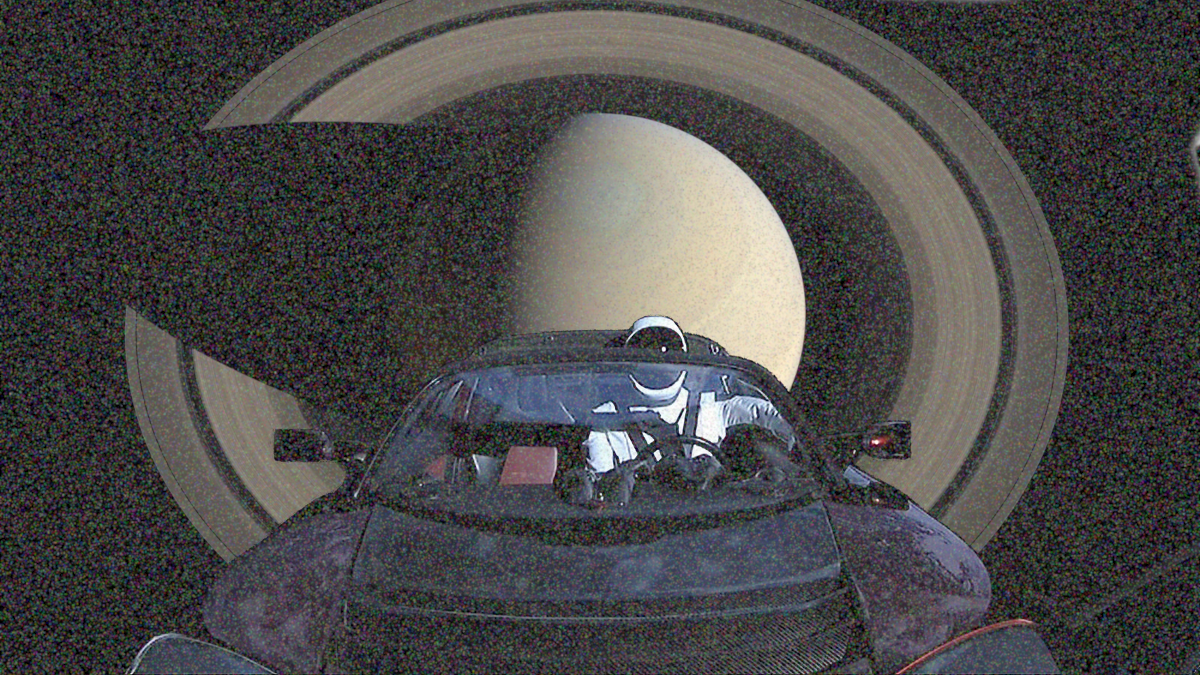
An amateur radio-astronomer from Northern Ontario received this image from Starman and the Falcon Heavy test payload.

There are rumors that SpaceX is developing a revolutionary propulsion system. Clearly, the Falcon Heavy test launch was an opportunity to test this new drive. The payload with Elon Musk’s roadster was the perfect decoy for a mission like this.

In terms of drive performance, the roadster was able to reach the Saturn system in a little more than a year. It took Cassini seven years to reach Saturn. When Earth and Saturn are closest, the distance between them is approximately 1.2 billion kilometers. We can conclude that the roadster drive must be a remarkable piece of engineering. It could be the scientific breakthrough that will allow humans to colonize the Solar System.

Image credit: Zgabeartza Iftode


  • Facebook
  • Google
  • Slashdot
  • Reddit
  • Live
  • TwitThis