OrbitalHub

The place where space exploration, science, and engineering meet

Domain is for sale. $50,000,000.00 USD. Direct any inquiries to contact@orbitalhub.com.


ULA dixit:

“CisLunar – the space between Earth and the moon – holds vast opportunities for humans. Reliable, accessible, affordable access to space will help open economic opportunities. ULA’s ability to provide reliable, affordable access to space, which will provide critical infrastructure to supporting a space economy.”

Wikipedia dixit:

“Originally proposed as the Advanced Cryogenic Evolved Stage by Boeing in 2006 as a concept for use as a new Delta IV second stage — and subsequently, the Advanced Common Evolved Stage by its corporate successor, United Launch Alliance by 2010 — ACES was intended to boost satellite payloads to geosynchronous orbit or, in the case of an interplanetary space probe, to or near to escape velocity. Other alternative uses included a proposal to provide in-space propellant depots in LEO or at L2 that could be used as way-stations for other rockets to stop and refuel on the way to beyond-LEO or interplanetary missions, and to provide the high-energy technical capacity for the cleanup of space debris.

The late-2000s ACES proposal by ULA also had a predecessor at Lockheed Martin, prior to the merger of Boeing and Lockheed Martin launch vehicle manufacturing and operations to form ULA in 2006. Known then as the Lockheed Martin common-stage concept, the upper stage was intended to “provide efficient, robust in-space transportation”, and take advantage of the high-mass fraction that is enabled by Centaur’s design and its common bulkhead to minimize combined LO2/LH2 boil off. A study funded by NASA led to the development of the Lockheed Martin concept known as ACES, under the original name of Advanced Cryogenic Evolved Stage as of 2006.

In April 2015, after ULA had announced the end of production of the Delta IV Medium in 2019 and the Delta IV Heavy in the mid-2020s, ULA renamed the stage the Advanced Cryogenic Evolved Stage, as ACES would in this case serve as the second stage on only a single launch vehicle, the Vulcan, beginning no earlier than 2023.

After the formation of ULA in 2006, the ACES concept became one that would provide a common stage that would be evolved from both Atlas and Delta rocket technology and could be used on both launch vehicles — thus “common”. The concept by 2010 was to utilize the new high-performance upper stage, if built, on both Atlas V and Delta IV/Delta IV Heavy launch vehicles. As further refined in a 2010 conference paper, ACES was intended to be a lower-cost, more-capable and more-flexible upper stage that would supplement, and perhaps replace, the existing ULA Centaur and Delta Cryogenic Second Stage (DCSS) upper stage vehicles.

In April 2015, ULA renamed the stage the Advanced Cryogenic Evolved Stage, and announced conceptual plans to complete development of the ACES technology for the Vulcan launch vehicle, flying no earlier than 2023, but currently planned for 2024-25. No plans to develop the stage for the Atlas V or Delta IV launch vehicle lines remain. However, just like earlier ACES concept proposals, ACES would continue to blend technical aspects of both Delta and Atlas technologies and manufacturing processes, as well as use ULA’s proprietary Integrated Vehicle Fluids (IVF) technology to significantly extend the ability of the upper stage to operate in space long term. The IVF technology utilizes a lightweight internal combustion engine to use propellant boiloff (normally wasted when boiloff gasses are vented to space) to operate the stage including production of power, maintaining stage attitude, and keeping the propellant tanks autogenously pressurized, eliminating the need for hydrazine fuel and liquid helium.

The ACES vehicle is “based on a simple modular design” where the “use of multiple barrel panels, similar to Centaur, provides a straightforward means to building multiple-length (propellant load) stages that are otherwise common. The common equipment shelf accommodates one, two, or four RL10 engines. While ACES can start with existing Centaur and Delta pneumatic, avionics and propulsion systems it is intended to transition to lower-cost and higher capability systems founded on the Integrated Vehicle Fluids (IVF) system concept. IVF eliminates all hydrazine, helium, and nearly all batteries from the vehicle. It consumes waste hydrogen and oxygen to produce power, generate settling and attitude control thrust, and autogenously pressurize the vehicle tanks. IVF is optimal for depot operations since only LH2 and LO2 need be transferred, and it extends mission lifetimes from the present dozen hours to multiple days.” With the addition of a solar power system, the vehicle can remain in space and operate indefinitely.”

Video credit: ULA


  • Facebook
  • Google
  • Slashdot
  • Reddit
  • Live
  • TwitThis
03-14-17

Delta IV WGS-9 Mission

Posted by


Wikipedia dixit:

“The Wideband Global SATCOM system (WGS) is a high capacity satellite communications system planned for use in partnership by the United States Department of Defense (DoD) and the Australian Department of Defence. The system is composed of the Space Segment satellites, the Terminal Segment users and the Control Segment operators.

DoD wideband satellite communication services are currently provided by a combination of the existing Defense Satellite Communications System (DSCS) and Global Broadcast Service (GBS) satellites. According to United Launch Alliance, quoted on Spaceflight Now, “A single WGS spacecraft has as much bandwidth as the entire existing DSCS constellation.”

The constellation of WGS satellites increases the communications capabilities of the militaries of the United States, Canada, and Australia by providing additional bandwidth and communications capabilities for tactical command and control, communications, and computers; intelligence, surveillance, and reconnaissance (C4ISR); battle management; and combat support information. Canada has also signed on to become a partner.

WGS also augments the current Ka-band Global Broadcast Service (on UHF F/O satellites) by providing additional information broadcast capabilities as well as providing new two-way capability on that band. The combination of the Wideband Global Satellites, DSCS satellites, GBS payloads, wideband payload and platform control assets, and earth terminals operating with them has been referred to as the Interim Wideband System (IWS). It provides services to the US DoD and Australian Department of Defence. The IWS System supports continuous 24-hour-per-day wideband satellite services to tactical users and some fixed infrastructure users. Limited protected services will be provided under conditions of stress to selected users employing terrestrial modems capable of providing protection against jamming.

The WGS satellites will complement the DSCS III Service Life Enhancement Program (SLEP) and GBS payloads and will offset the eventual decline in DSCS III capability. WGS will offer 4.875 GHz of instantaneous switchable bandwidth, thus each WGS can supply more than 10 times the capacity of a DSCS III Service Life Enhancement Program (SLEP) satellite. Once the full constellation of 6 WGS satellites is operational, they will replace the DSCS system. WGS-1 with its 2.4 Gbit/s wideband capacity, provided greater capability and bandwidth than all the DSCS satellites combined.

Operation and usage of the system is broken into 3 segments.

The end users of the communication services provided by the WGS are described by the DoD as the terminal segment. Users include the Australian Defence Force and U.S. Army ground mobile terminals, U.S. Navy ships and submarines, national command authorities for the nuclear forces, and various national security/allied national forces. Additionally, the Air Force Satellite Control Network will also use the WGS in a similar manner as the DSCS III constellation is used to route ATM packets through the DISA “cloud” to establish command and control streams with various satellite constellations. One of the emerging applications is SATCOM-ON-The-Move which is now being extensively used on the military tactical vehicles for Blue Force Tracking and C3 missions.

The satellite operators in charge of commanding and monitoring the satellite’s bus and payload systems as well as managing the network operating over the satellite are the control segment. Like the DSCS constellation that WGS will replace, spacecraft bus will be commanded by the 3rd Space Operations Squadron of Schriever AFB, Colorado. Payload commanding and network control will be handled by the Army 53rd Signal Battalion headquartered at nearby Peterson AFB, Colorado with subordinate elements A Co. at Fort Detrick, Maryland, B Co. at Fort Meade, Maryland, E Co. at Fort Buckner, Okinawa Japan, C Co. Landstuhl Germany, and, D Co. Wahiawa, Hawaii.

The primary contractor for the satellites themselves is Boeing Satellite Development Center, which is building them around the Boeing 702 satellite platform. Originally five satellites were planned. On October 3, 2007, Australia’s Department of Defence announced that the country would fund a sixth satellite in the constellation. Once in their orbits at an altitude of 22,300 mi (35,900 km), each will weigh approximately 7,600 lb (3,400 kg). The program intends to use both the Delta IV and the Atlas V as launch vehicles. The Air Force Space Command estimates each satellite will cost approximately US$300 million.”

Video credit: United Launch Alliance


  • Facebook
  • Google
  • Slashdot
  • Reddit
  • Live
  • TwitThis


Credits: Ronald C. Wittmann


There are numerous examples of successful implementation of mitigation measures, but also some not so successful, and even failures. There are two cases that I will mention, one from each camp.


Cosmos 954 was a Soviet Radar Ocean Reconnaissance Satellite (RORSAT) powered by an onboard nuclear reactor. At the time, the Russian designers were not able to find an alternative for the power system due to the power requirements of the payload carried by the spacecraft, which was a powerful radar. A post-mission mitigation method that involved parking the nuclear reactor on a higher orbit (with an estimated lifetime of hundreds of years) was adopted.


It seems that not enough effort was put into designing a reliable solution for the post-mission disposal method of the nuclear reactor. Besides the inherent low reliability associated with hardware in developmental phases, the quality assurance practices at that time were most likely affected by the conditions of the Cold War. In both camps, the concerns regarding the environment were ignored in favor of the military and political goals.


In 1978, COSMOS 954 failed to separate its nuclear reactor core and boost it into the post-mission parking orbit as planned. The reactor remained onboard the satellite and eventually re-entered into the Earth atmosphere and crashed near the Great Slave Lake in Canada’s Northwest Territories. The radioactive fuel was spread over a 124,000 km2 area. The recovery teams retrieved 12 large pieces of the reactor, which comprised only 1% of the reactor fuel. All of these pieces displayed lethal levels of radioactivity.


To highlight how dangerous and how serious the use of nuclear power sources for space mission is, consider these figures: at present, there are 32 defunct nuclear reactors in orbit around the Earth. There are also 13 reactor fuel cores and at least 8 radio-thermal generators (RTGs). The total mass of RTG nuclear fuel in orbit is in the order of 150 kg. The total mass of Uranium-235 reactor fuel in orbit is in the order of 1,000 kg.


RADARSAT-1 is an Earth observation satellite developed in Canada. Equipped with a powerful synthetic aperture radar (SAR) instrument, RADARSAT-1 monitors environmental changes and the planet’s natural resources. Well beyond the planned five-year lifetime, the satellite continues to provide images of the Earth for both scientific and commercial applications.


Following the guidelines of the United Nations Committee on the Peaceful Uses of Outer Space (COPUOS) document entitled Guidelines for Space Debris Mitigation, and implementing mitigation measures required for the space hardware manufacturers in Canada, the Canadian Space Agency has prepared post-mission disposal plans for its remote sensing satellite RADARSAT-1. As a prerequisite to the end of mission procedures, the energy stored in the propellant tanks, the wheels, and the batteries of the satellite will be removed, as suggested in the COPUOS guidelines. Also, the remaining fuel will be used to lower the orbit in addition to orienting the satellite so that drag is maximized. These measures will aim to reduce the orbit life span of the satellite to the lowest possible.


Simulations performed using NASA’s long-term debris environment evolutionary model (LEO-to-GEO Environment Debris model or LEGEND) or ESA’s debris environment long-term analysis tool (DELTA) have shown that even if new launches are not conducted, the existing population of orbital debris will continue to increase. This increase in number is caused by collisions between the objects already orbiting the Earth at the present time. Following the Iridium/Cosmos collision in 2009, the U.S. Air Force has issued hundreds of notifications to Russia and China regarding potential crashes between their satellites and other objects in orbit.


Even if we are contemplating grim future developments like the one mentioned above, international initiatives do not seem to gain enough momentum. NASA (National Aeronautics and Space Administration) and DARPA (Defense Advanced Research Projects Agency) were the sponsors of the first International Conference on Orbital Debris Removal, which was held in Chantilly, Virginia, December 8-10, 2009. The conclusions of the conference included the observation that:


“No evident consensus or conclusions were reached at the conference. Removing existing, non-cooperative objects from Earth orbit is an extremely difficult and likely expensive task. Although some of the techniques for removal discussed at the Conference have the potential of being developed into technically feasible systems, each concept seems to currently suffer from either a lack of development and testing or economic viability.”


  • Facebook
  • Google
  • Slashdot
  • Reddit
  • Live
  • TwitThis


Credits: NASA


Let us see how the areas mentioned in the previous Sustainability in LEO post are covered at national level in the United States.


The United States has implemented a space traffic management program in the form of the Joint Space Operations Center (JSpOC) of the U.S. Strategic Command at Vandenberg Air Force Base in California.


JSpOC conducts periodic conjunction assessments for all NASA programs and projects that operate maneuverable spacecraft in low Earth orbits (LEO) or in geosynchronous orbits (GEO). Depending on the mission, the conjunction assessments can be performed up to three times daily. If JSpOC identifies an object that is expected to come in the proximity of a NASA spacecraft, and the collision risk is high enough (for manned missions the minimal value accepted is 1 in 10,000, while for robotic missions the threshold is 1 in 1,000), a conjunction assessment alert message is sent to the mission control in order to have collision avoidance maneuver commands sent to the spacecraft. The alert messages contain the predicted time and distance at closest approach, as well as the uncertainty associated with the prediction.


The control of the creation of space debris is addressed by orbital debris mitigation standard practices in four major areas: normal operations, accidental explosions, safe flight profile and operational configuration, and post-mission disposal of space structures. There are also NASA standards and processes that aim at limiting the generation of orbital debris.


The commonly-adopted mitigation methods, which focus on minimization of space debris creation, will not preserve the near-Earth environment for the future generations. As a matter of fact, the debris population increase will be worse than predicted by LEGEND-generated models due to ongoing launch activities and unexpected (but possible) major breakups. Here is where active space debris environment remediation comes into play.


The active space debris environment remediation is mainly concerned with the removal of large objects from orbit. Such large objects are defunct spacecraft (i.e. communication satellites that exceeded their operational life), upper stages of launch vehicles, and other mission-related objects. The removal of large objects from orbit is known as Active Debris Removal (ADR). Several innovative concepts are under study. Among them, tethers used for momentum exchange or electro-dynamic drag force, aerodynamic drag, solar sails, and auxiliary propulsion units. LEGEND studies have revealed that ADR is a viable control method as long as an effective removal selection criterion based on mass and collision probability is used, and there are at least five objects removed from orbit every year. The electrodynamic tethers seem to lead the competition so far, as they have a low mass requirement and can remove spent or dysfunctional spacecraft from low Earth orbit rapidly and safely.


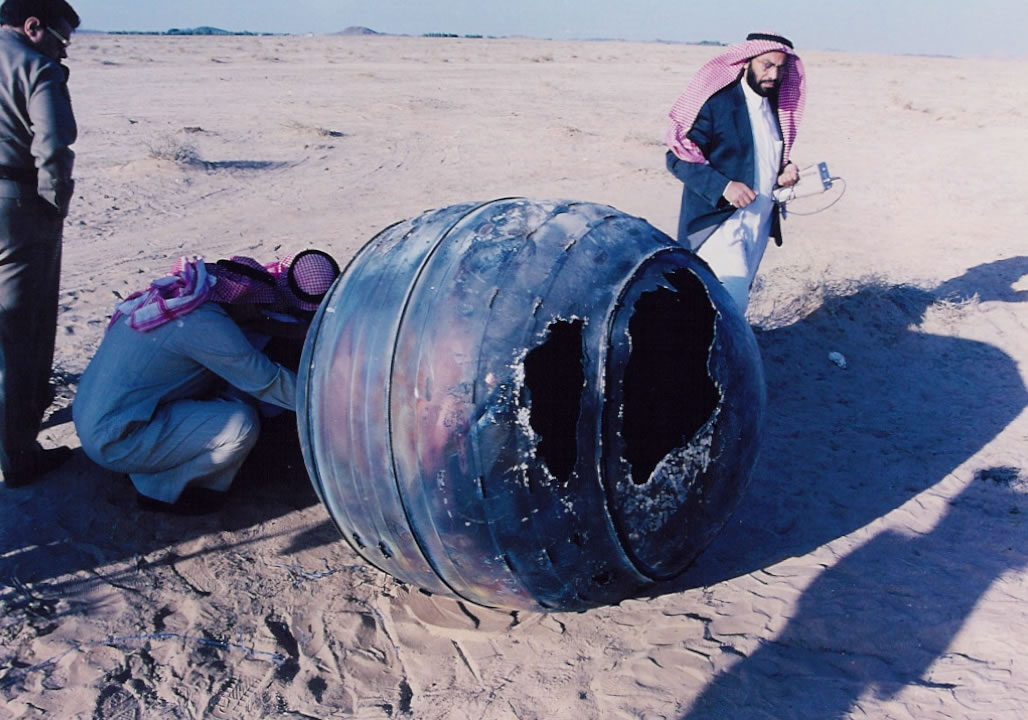
Re-entry in the Earth’s atmosphere of space mission related objects is an important aspect to be considered in this context. Even though no casualties or injuries have been reported so far being caused by components of re-entering spacecraft, fragments from space hardware pose a risk to human life and property on the ground. One big concern is caused by the fact that the point of impact from uncontrolled re-entries cannot be calculated exactly. The uncertainties are due to a large number of parameters that affect the trajectory and the heat of ablation of objects re-entering the atmosphere.


  • Facebook
  • Google
  • Slashdot
  • Reddit
  • Live
  • TwitThis


Credits: NASA


Space debris mitigation measures address issues in two major areas: protection from space debris and reduction of the space debris population growth.


Protection methods vary depending on the size of the space debris. Space debris fragments smaller than 0.1 mm in diameter do not have enough energy to penetrate protection panels. Even spacecraft thermal blankets and structural panels can offer protection from such small kinetic impactors.


However, larger debris fragments pose a more serious threat and there are few active measures that can be adopted to minimize the possibility or the consequences of impacts.


First, avoiding space debris is the method that always proves successful, so flying at altitudes and inclinations where space debris density is low should always be considered. Second, orienting sensitive surfaces away from or mounting a bumper on the leading edge can offer more protection for the spacecraft. Multilayered bumpers cause the fragmentation of the space debris and also prevent ejected material from dispersing from the point of impact. Bumpers add mass and volume to the spacecraft and this is why few space missions can exercise this option.


A promising new method for protection from orbital debris impact is shielding with metallic foams. Extensive research and experimental impact campaigns have proven that metallic open-cell foams provide improved protection against hypervelocity impacts with almost no ejecta generated at impact, while offering comparable mechanical and thermal performance to honeycomb structures, which are currently used for shielding. The fact that no ejecta are generated is of great importance, as fragments generated at impact can add to the already existing debris population in Earth orbit.


At this point, it appears that the best protection method is avoiding the creation of space debris.


The long-term projections of the space debris environment generated by models like LEGEND or DELTA have proven that only active methods can maintain a stable environment of artificial objects in Earth orbit. It is quite obvious that unchanged operational practices or even an immediate stop to launch and release activities will not prevent the collisions between already existing space hardware. Scenarios like the one proposed by NASA scientist Donald J. Kessler in 1978 are very likely to occur. In the scenario proposed by Kessler, which is also known as the Kessler Syndrome, space exploration and the use of satellites in proximity of Earth will become unfeasible due to an exponential growth of the debris population caused by collisional cascading. The exponential growth is due to the fact that the material ejected during a hypervelocity impact becomes space debris itself. Laboratory experiments have shown that as a result of such an impact, 1 kg of aluminum can form several hundred thousand 1 mm sized particles.


Failure to address the potential uncontrollable growth of the space debris population will lead to major restrictions on the ability to exploit space. There is a debate in the scientific community over whether or not critical density has already been reached in certain orbital regions and if we are beyond the point where we can address the growth of the debris population.


There are various classifications of the space debris mitigation methods. For example, two broad categories might include, on one hand, measures that restrict the generation of space debris in the near future, such as limiting the production of mission-related objects and the avoidance of breakups, and, on the other hand, measures that restrict their generation for the long term, which include post-mission disposal methods and active measures to remove space debris from protected regions.


There are three major areas that could allow space faring nations to maintain a stable debris environment: space traffic management, control the creation of space debris, and active space debris environment remediation.


  • Facebook
  • Google
  • Slashdot
  • Reddit
  • Live
  • TwitThis


Credits: NASA


As mentioned in a previous post, only a small fraction of the existing space debris population is detectable and tracked by ground systems. A smaller fraction is catalogued by special programs and/or departments of national space agencies. This is where statistics comes into play. Numerous models have been created in order to assess present collision risks associated with certain orbits and to predict future evolution of the debris environment around Earth.


The National Aeronautics and Space Administration (NASA) has developed two categories of applications for modeling of space debris environment and risk analysis. The first category, based on evolutionary models such as NASA’s long term debris environment evolutionary model (LEO-to-GEO Environment Debris model or LEGEND), are designed to predict the evolution of the debris environment.


These models cover the near-Earth space between 200 km and 50,000 km, provide space debris characteristics for a debris population consisting of particles as small as 1 mm, and have a typical projection period of 100 years. The second category, which consists of engineering models like ORDEM2000, is used for debris impact risk assessment for spacecraft and satellites, and also as benchmarks for ground-based debris measurements and observations.


The European Space Agency (ESA) has a different set of tools used for modeling the space debris environment and assessing risk associated with collisions in Earth orbit. The DISCOS database (the Database and Information System Characterizing Objects in Space) consolidates the knowledge on all known objects tracked since Sputnik-1, and it is recognized as a reliable and dependable source of information on space objects in Earth orbit. MASTER (Meteoroid and Space Debris Terrestrial Environment Reference) is the agency’s most prominent debris risk assessment tool, which uses statistical methods to determine the impact flux information from all recorded historic debris generation events. ESA also uses DELTA (Debris Environment Long-Term Analysis) to conduct analysis of the effectiveness of debris mitigation measures on the stability of the debris population. Such analysis can cover 100 to 200 year time spans.


  • Facebook
  • Google
  • Slashdot
  • Reddit
  • Live
  • TwitThis